
Church of Ireland denies claim by conservative group GAFCON that it has taken over the global Anglican communion
The Church of Ireland has said it does not support a conservative group's claim to have taken over the leadership of the Anglican communion.
The church leadership confirmed its fealty to the Archbishop of Canterbury amid a schism in worldwide Anglicanism involving GAFCON.

GAFCON is a traditionalist organisation which stands for Global Anglican Future Conference, and a raft of global bishops and archbishops sit on its Primates Council while others serve as advisors to the group.
Some clerics in the Church of Ireland are among those active in the movement.
One Belfast minister who is a director of GAFCON Ireland has backed the group’s actions – saying the faith’s identity “is defined by theology, not structure”.
Trevor Johnston, minister of All Saints' in south Belfast, says the group “are in spiritual communion with all Christians who share our faith, theology, and prayer”.
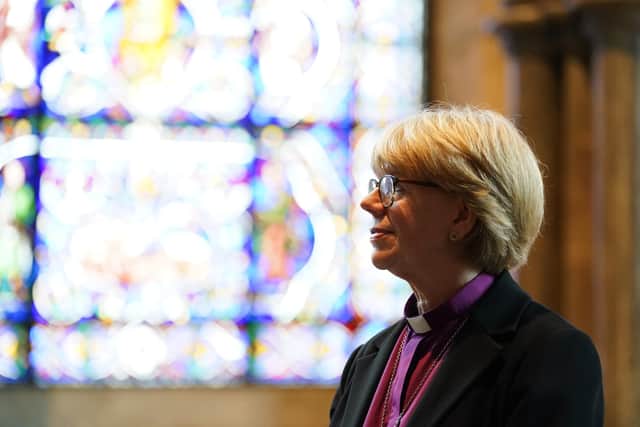
The appointment last month of Bishop Sarah Mullally as Archbishop of Canterbury deepened the existing divide in Anglicanism between liberals and traditionalists, with many in the latter camp believing that she is too liberal (and that it is not theologically acceptable for a woman to hold the post anyway).
Matters then escalated when GAFCON issued a declaration this month titled 'The Future Has Arrived', signed by Rev Laurent Mbanda, chairman of GAFCON Primates’ Council and Archbishop of Rwanda.
It said: “The first Global Anglican Future Conference (GAFCON) gathered in 2008 in Jerusalem to prayerfully respond to the abandonment of the scriptures by some of the most senior leaders of the Anglican Communion, and to seek their repentance.
“In the absence of such repentance, we have been prayerfully advancing towards a future for faithful Anglicans, where the Bible is restored to the heart of the Communion.
“Today, that future has arrived.”It went on to say that “we declare that the Anglican Communion will be reorderedwith only one foundation of communion, namely the Holy Bible”.
It continued: “We reject the so-called Instruments of Communion, namely the Archbishop of Canterbury, the Lambeth Conference, the Anglican Consultative Council (ACC), and the Primates Meeting, which have failed to uphold the doctrine and discipline of the Anglican Communion.”
In short, it went on to say that “we [GAFCON] are now the Global Anglican Communion”.
It called on churches to cut ties with the Church of England and Archbishop of Canterbury, and sign up to GAFCON's Jerusalem Declaration of 2008, which it describes as “the contemporary standard for Anglican identity”.
In response, the Church of Ireland has released a declaration of its own stating that it only recognises the Canterbury-led organisation as being the true church body.
In the name of Archbishop of Armagh John McDowell, and Archbishop of Dublin Michael Jackson, the statement said: “The Anglican Communion is a body of autonomous Anglican Provinces (including the Church of Ireland) who voluntarily join together in clearly defined ways.
“It has existed in a formal sense since 1867, when the Archbishop of Canterbury issued invitations to what became the first Lambeth Conference.
“From the beginning, the Office of the Archbishop of Canterbury and the convening of the Lambeth Conference were expressions of Anglican unity and identity which, as the Communion grew over time, were supplemented by two further instruments of unity – the Primates’ Meeting and the Anglican Consultative Council (ACC).
“This is the Anglican Communion to which the Church of Ireland belongs.”
It went on to add that “the Church of Ireland recognises no body other than the one described in the preceding paragraphs as the Anglican Communion”.
The Church of Ireland statement added that “we do not suggest that the Anglican Communion as it has existed in history and continues to exist today is a perfect organisation” and that its provinces “will not agree on everything”.
But it said “we are committed to studying the Scriptures and learning from the insights of the past together with our fellow Anglicans, in communion, around the world”.
GAFCON Ireland director Trevor Johnston has hit back at the Anglican hierarchy, saying that “decades-worth of patience” had been shown on the part of conservatives, amid “decline, division, loss of gospel clarity and vitality”.
He said: “It was the Anglican Church of Canada and the Episcopal Church (USA) who first took steps to break the terms of Communion.
"Despite many appeals across the Communion to turn back from this path, in 2002, the Canadian Diocese of New Westminster permitted same-sex blessings, and in 2003, the American Diocese of New Hampshire consecrated a bishop in a same-sex relationship.
"Tragically, many within these provinces who opposed this breaking of Communion were made unwelcome in their provinces, with clergy losing their positions, pensions, and church buildings.
"This breaking of Lambeth I.10 was met with silence from the instruments of Communion: the Archbishop of Canterbury, the Anglican Consultative Council, the Primates Council, and the Lambeth Conference itself.
“The formation of GAFCON in 2008 was the formal response to this ongoing crisis. Its most recent statement is the result of almost 20 years of pleading for faithfulness to Christ – pleas that, sadly, have fallen on deaf ears.
“Through their silence and failure to act on further breaches of Lambeth I.10 by other provinces, the instruments of Communion have effectively placed themselves out of communion with the majority of Anglicans worldwide (approximately 85%).
"It is therefore difficult to see how they can continue to be regarded as ‘instruments of unity’ in any meaningful sense.
"Decades-worth of patience and pleading have been met by resistance, rejection and the resolute determination to change doctrine and practice.
"As has been seen across the world, the outcome of this path is clear: decline, division, loss of gospel clarity and vitality.
Rev Johnston said members of his own south Belfast church are “passionate for the gospel of Christ and the drift within our denomination is of major concern,” adding: “They are not unaware of the threat it poses to the Church’s very identity – the future excites them.”
Rev Johnston said “the plain teaching of Christ’s Apostles has been denied in various provinces”, amid divisions which began to emerge in the 1970s.