
DUP minister looking at changing council rules - warning politicians can't be 'effectively gagged' by 'unelected commissioner'
Gordon Lyons is examining changes to rules governing councillor conduct, warning that the complaints process is being used in a “vexatious way” impinging on the free speech rights of politicians.
The DUP communities minister says public representatives cannot be “effectively gagged” to speak in a way that an unelected commissioner approves of – and that the electorate should be the ultimate judge at elections.
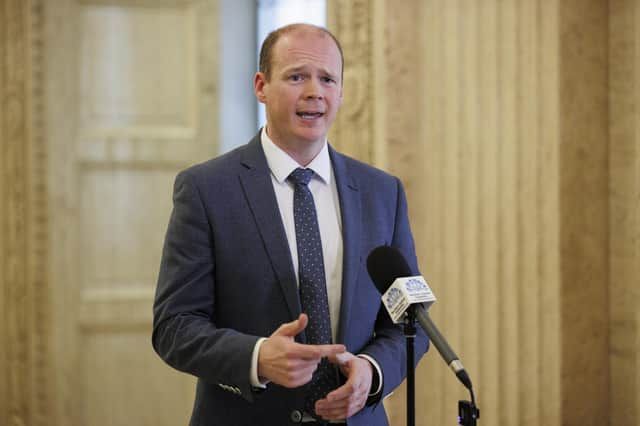

It comes in response to a call from Lisburn North independent councillor Gary Hynds for a review of the Local Government Commissioner for Standards (LGCS) process after facing two probes into political comments, over which he was cleared.
He had told the News Letter he has serious concerns about whether standards procedures are always being used proportionately when complaints stem from “robust political opinions expressed publicly”. He also called for Minister Lyons to to review the current system to determine whether investigations are proportionate.
A DUP councillor was recently handed a three month suspension by the local government watchdog over comments about supporters of “LGBTQIA alphabet soup agenda” being the same people who “defend” Hamas. Commissioner Margaret Kelly decided that the comments – while already determined by police not to be hate speech – had “affected individuals who had protected characteristics” in law, and was “personally hurtful to a number of individuals”.
Minister Lyons told the News Letter: “As Minister responsible for local government in Northern Ireland, I am deeply concerned about some of the conclusions reached by, and the disproportionate impacts from, reports of Standards Commissioners.
“There is now a real risk that the complaints process is being used in a vexatious way that goes beyond upholding standards and instead is being used to restrict free speech and police political contributions made both in public proceedings as well as public communications to constituents.
“Elected members should not be effectively gagged to only use terminology and styles that an unelected commissioner approves of and who cannot be held to account for such actions.
“The electorate are the ultimate judge of any elected representative. I am currently examining what changes can be made to the Code of Conduct so that the highest standards can be maintained without infringing on the rights of elected representatives to express their views.
“Freedom of speech was hard won and must be protected.”
A spokesperson for LGCS says Commissioner Margaret Kelly “fully supports the right to freedom of expression and the enhanced right to freedom of expression available to politicians including councillors”. They say the “majority of allegations relating to political speech are closed without investigation or adjudication”.
Cllr Gary Hynds told the News Letter that since being elected, he has faced three separate complaints through the standards process. “I was fully cleared in two cases after lengthy investigations, while a third case formed part of my wider experience of the process”, he said.
The two complaints which weren’t upheld relate to political views he had expressed. One was over comments saying Alliance were “cheerleaders for prehistoric head choppers and vile rapists” over their support for recognition of a Palestinian state while Gaza was run by Hamas. He was also investigated over a Facebook post in July 2025 to support the campaign 'Defund the BBC' and not pay the TV licence.
“I expressed strong political views about the reality of recognising a state while Hamas remains in control. People are entitled to disagree with that view, but political disagreement alone should not automatically become a formal standards issue”, he said.
In relation to the BBC, Cllr Hynds said he raised concerns that many people already share — particularly younger generations who are increasingly switching off traditional media and turning elsewhere for news and information.”
The Lisburn councillor said his wider concern is the impact repeated complaints can have on elected representatives speaking openly on contentious issues.
“Nobody should be above scrutiny, and genuine misconduct should always be dealt with properly. But there is a legitimate debate about whether complaints processes are always being used proportionately when issues relate to political speech.”
He said even complaints that do not result in findings can create significant stress and discourage politicians from speaking openly. “Even when you’re cleared, these investigations take time, create stress and can create a chilling effect where elected representatives begin second-guessing whether they can speak openly on difficult issues”, he added.
Cllr Hynds said he has now joined Free Speech Union as a result of his concerns.
“My experiences have become so concerning that I’ve now felt the need to join the Free Speech Union because I believe robust political speech needs protecting. That should concern everyone. In a free and democratic country, elected representatives should not feel they need outside protection simply for expressing lawful political opinions.”
In October 2025, Cllr Hynds was suspended for one month over an altercation took place between himself and a senior member of council staff in June 2024. LGCS said he had “agreed that his behaviour was intimidatory and that he had breached the respect provision of the Code. However, he denied that his actions amounted to bullying or harassment”.
The body ruled Cllr Hynds “may have failed to comply” with the Code’s rules which deal with respect and consideration for others and the Deputy Commissioner stated presented evidence “which suggested that the councillor may have conducted himself in a manner” which could have brought his position into disrepute.
LGCS said the Commissioner can only investigate when a written allegation is received.
“On average just over 50% of allegations received each year are closed without an investigation and an average of 3 cases per year progress to adjudication.
“In 2025/26 100% of the allegations received were assessed within the target timescale of 4 weeks and 96% of investigations were completed within the 40-week target. Where written allegations are received the Commissioner recognises the impact that an investigation can have on a councillor and ensures that proportionality is applied throughout the process, with cases closed as soon as it is established that no breach has occurred or that further action would not be proportionate” the watchdog said.