
Equality Commission's take on Supreme Court ruling a 'political document dressed in legal language' - Allister
The Equality Commission is “actively promoting a controversial ideological agenda” and using the Windsor Framework as its legal cover – and its guidance on the impact of the Supreme Court sex ruling in Northern Ireland is a “political document dressed in legal language”, Jim Allister has said.
His comments come as the human rights watchdog dodged giving its view on whether Northern Ireland will automatically follow a ruling by the Supreme Court that sex is determined by biology – citing uncertainty caused by the Windsor Framework.
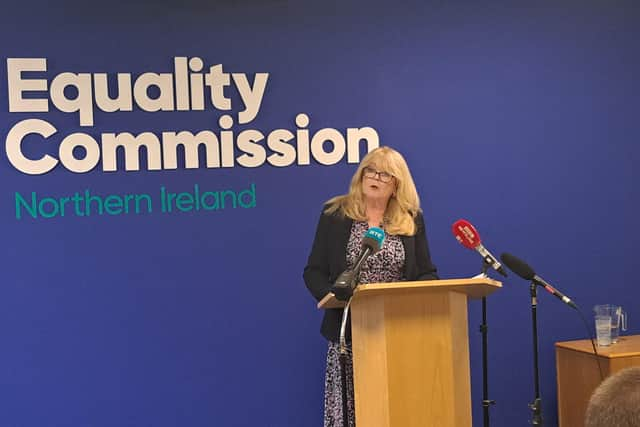

The Commission (ECNI) has also created further uncertainty by raising questions about what terms like ‘man’ and ‘woman’ mean – and questioned whether ‘sex’ means the same in Northern Ireland as it does in the rest of the UK.
Chief Commissioner Geraldine McGahey says that if it were not for the Framework - the Supreme Court ruling would apply here.
However, TUV leader Mr Allister says he is “deeply concerned” by the direction ECNI has taken.
“The document published today marks a clear departure from the Commission’s statutory role as an impartial guardian of equality law. Instead, it reveals an organisation now actively promoting a controversial ideological agenda — using Article 2 of the Windsor Framework as its legal cover.
“Let me be clear: this paper is not neutral guidance. It is a political document dressed in legal language. It seeks to redefine key concepts like ‘sex’ and ‘gender reassignment’ in ways that go far beyond what our domestic law currently recognises — and flies in the face of the clarity brought by the Supreme Court.
“The Commission claims that Article 2 of the Windsor Framework requires public authorities, employers, and service providers to align with retained EU equality directives, highlighting once again the pernicious influence of the EU in Northern Ireland. However, even this is highly debatable, given that across the EU many different positions are accommodated when it comes to so-called ‘trans rights’.
“Frankly, they are simply wrong. In pushing this into the courts again, they are seeking to kick the can down the road — and they have been influenced by trans lobby groups.
“In doing so, they have exposed themselves as being deeply influenced by a profoundly dangerous ideology.
“No one in Northern Ireland voted for this. No one gave the Equality Commission the authority to act as a proxy legislator. And yet that is exactly what is happening.
“The guidance now being issued to employers and public bodies reads less like a legal resource and more like a manifesto for gender ideology — with demands to rewrite policies, reinterpret longstanding legal terms, and submit to oversight from a Commission that is no longer even pretending to be neutral.
“This is a fundamental breach of public trust. The Equality Commission was established to protect people from genuine discrimination.
“We are witnessing the transformation of a public body into an activist organisation.
“Recent polling has shown that people in Northern Ireland — across the political spectrum — back the common-sense ruling of the Supreme Court. This decision by the Commission is frankly outrageous. If their claims in relation to Article 2 of the Windsor Framework are correct, then it merely underscores the fact that the Protocol needs to go, and that, contrary to the claims of some, its pernicious influence goes well beyond trade.
“However, this throws up a very particular challenge to HMG: they need to come out fighting against the creep of Article 2 of the Protocol. This will show where the government really stands on our ever expanding subjugation to EU diktat.”
The Commission has now set out a "road map of actions" it will take to "achieve legal certainty".
Geraldine McGahey said: “After much consideration and analysis, the Commission has concluded that the situation in Northern Ireland, in respect of this matter, is much more nuanced and complicated, and there is significant uncertainty due to our unique legal landscape.
“We have no interest in merely speculating as to how a court might determine these issues in the future. We will not answer these legal uncertainties by weighing the arguments “for” and “against”. It is important that the Commission shows leadership as people and their lives are at the heart of this issue.
“To achieve greater long-term certainty and clarity for all involved, the Commission will be seeking a Declaration from the courts to address several questions regarding the significant legal uncertainties.