
Former NIO minister at heart of Irish Sea border deals says 'fundamental changes' needed to Windsor Framework
A former Northern Ireland Office minister involved in recent deals on the Irish Sea border has said while they “ameliorated some of the worst impacts of the protocol” – significant problems remain and there is “clear evidence of trade diversion”.
Lord Caine’s comments appear to signal a significant shift in Conservative party policy – accepting that “more fundamental changes are going to be needed” to the Windsor Framework.

The Tory peer has been a strong advocate of the deal – as well as the Safeguarding the Union side-deal with the DUP which restored Stormont but did not alter the UK-EU trade pact.
Speaking to the News Letter on a visit to Belfast last March, Tory leader Kemi Badenoch said her party wasn’t seeking to “unpick” the trade and human rights deal – adding “what we need to do is make sure that we don't start going backwards on any of the things that we have done”.
However, there has been growing evidence that Northern Ireland’s trade with Great Britain is being diverted to the Republic and EU. The government has the power to take unilateral action in the event of trade diversion – but Labour has instead committed to implementing the EU deal in full.
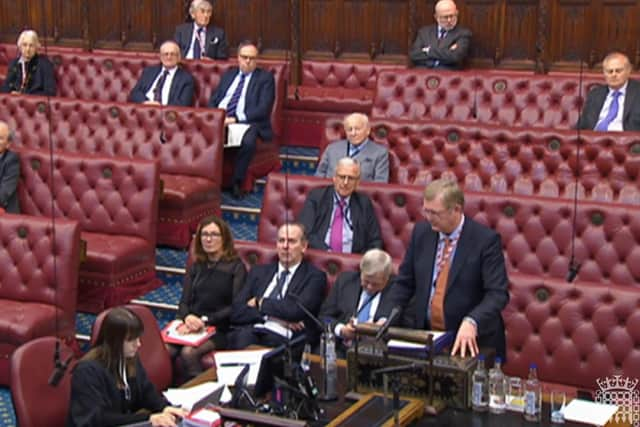
In a speech in the House of Lords on Wednesday, Lord Jonathan Caine said that – taken alongside Safeguarding the Union – the Windsor Framework was a significant improvement on the original Northern Ireland Protocol.
“However, I fully accept that we clearly did not get everything right or solve every problem – although, given the unfortunate history of the protocol and the joint report of December 2017, it might be argued that it was the best we could have achieved in the circumstances” he said.
The comments came as peers discussed a report by the Northern Ireland Scrutiny Committee on ‘Strengthening Northern Ireland’s voice in the context of the Windsor Framework’.
The former NIO minister said that “there is clear evidence of trade diversion” – and raised concerns about how effective democratic safeguards put in place under the previous government’s arrangements had been.
“On democratic scrutiny, whatever the measures to improve this in the Windsor Framework and Safeguarding the Union, such as the Stormont brake and the applicability Motion, it is at least arguable – I put it mildly – that these have not necessarily worked as effectively or strongly as we might have hoped at the time. As a result… Northern Ireland, uniquely in the United Kingdom, has to accept and implement laws put forward by a supranational body of which we are not a member and over the shaping of which it still has little or no influence”, he told peers.
Lord Caine pointed to comments from the DUP peer Lord Dodds, who had said there is a “denial of democracy” in Northern Ireland under the deal.
The Tory veteran also questioned how his party - whose instinct always should be to make life for business and consumers easier– “could have settled for such a mind-boggling set of arrangements”. However, he defended the deals as having made progress in difficult circumstances.
The former NIO minister said theWindsor Framework was a “valiant” attempt to address the issues created by the original Irish Sea border deal – and was motivated “by a desire significantly to reduce checks on goods that the protocol had introduced, protect Northern Ireland’s position within the UK internal market, and of course copper-fasten Northern Ireland’s place as an integral part of our United Kingdom”.
He added: “Taken with the subsequent Command Paper, Safeguarding the Union, in January 2024, it ameliorated some of the worst impacts of the protocol. It has led to the freer flow of goods coming from Great Britain to Northern Ireland and vice versa, while at the same time ensuring that Northern Ireland has unfettered access to the EU single market”.
The Conservative peer also urged the government to commit to “the long-term funding and longevity of the principal bodies established” under the STU Command Paper: the independent monitoring panel, InterTrade UK and the east-west council.
The government’s NIO spokesperson Baroness Anderson said the Labour administration will only support trading arrangements that protect NI’s place in the UK and its internal market and avoid a hard border on the island of Ireland. She said the Windsor Framework “really does provide the best basis for that”.