
Further uncertainty over Supreme Court ruling as Equality watchdog stalls guidance over Windsor Framework
Northern Ireland will not automatically follow a ruling by the Supreme Court that sex is determined by biology – because of uncertainty caused by the Windsor Framework, the Equality Commission has said.
The commission (ECNI) has dodged giving clear guidance on the implications of the ruling – and created further uncertainty by raising questions about what terms like ‘man’ and ‘woman’ mean.
Chief Commissioner Geraldine McGahey has also said that sex – and related terms – might not mean the same thing in Northern Ireland as in the rest of the UK.
The campaign group For Women Scotland – whose legal victory over the Scottish government clarified the law in Great Britain – has questioned what the commission thinks sex means in the province. They asked: “If you get the ferry, does it change shortly after leaving Cairnryan? And is that painful?”
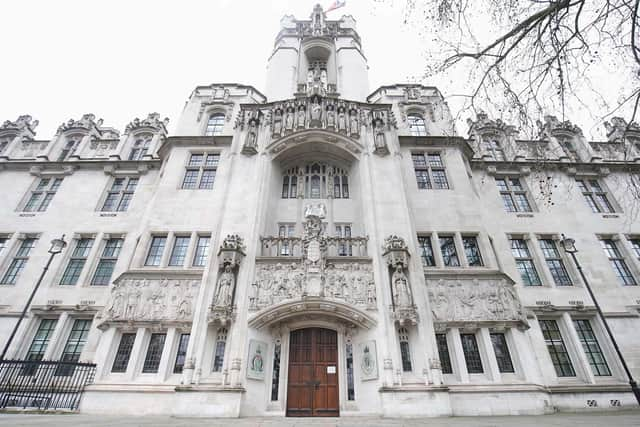

ECNI now wants the High Court in Belfast to rule on how Article 2 of the Windsor Framework affects the legal situation in Northern Ireland. Ms McGahey says that if it were not for the post-Brexit deal - the Supreme Court ruling would apply here.
For months, ministers and public bodies have decided to take no action on implementing the judgement by the UK’s highest court, arguing that they were waiting for the local equality watchdog’s guidance.
The news means that uncertainty will continue, with a final resolution possibly a year or more away. Any ruling by the High Court in Belfast could itself end up back in the UK Supreme Court, if challenged.
The Commission has now set out a “road map of actions” it will take to “achieve legal certainty”.
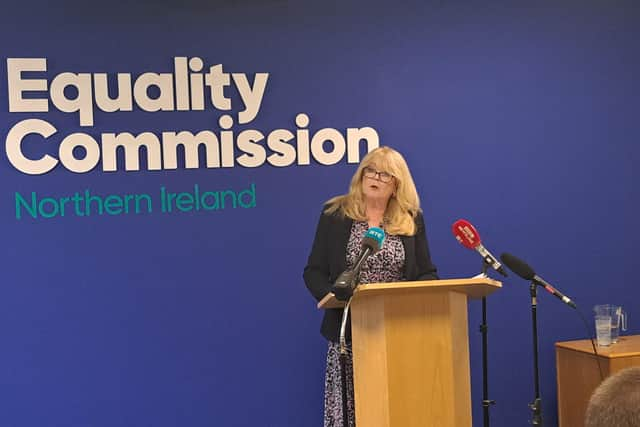
However, the commission has also introduced further uncertainty itself, in relation to the legal definition of male and female in Northern Ireland.
Pointing to local equality laws from the 1970s, as well as the 1998 Northern Ireland Act, the Chief Commissioner said: “Each of these pieces of legislation use terms like 'sex', 'men' and 'women' without providing comprehensive definitions”.
However, the Supreme Court referenced 1970s employment legislation in its judgement. It said “there can be no doubt” that in 1975, when GB sex discrimination laws were passed, Parliament intended that these words “would refer to biological sex”.
Northern Ireland’s equivalent law was passed a year later, also by Westminster.
The ECNI chief also said the situation “is much more nuanced and complicated” in the province – and that ECNI “considers that there is significant legal uncertainty in Northern Ireland due to the unique legal landscape here”.
Ms McGahey added: “In short, it may be that the meaning of ‘sex’, and related terms, should be interpreted differently in Northern Ireland and whether this is so requires clarification”.
Asked by the News Letter which specific part of Article 2 of the Framework was causing an issue around the implementation of the Supreme Court judgement, the ECNI chief said it is the “entirety” of the law. “Article 2 is about ensuring there is no diminution of rights that are protected or safeguarded within the Good Friday Agreement. There is debate as to which right that actually might be, and it’s for the courts who should adjudicate on that – whether it’s a civil right, or whether it’s on gender discrimination”.
ECNI’s long awaited verdict was published on Friday morning – but did not give the clarity that was expected.
Geraldine McGahey said: “After much consideration and analysis, the Commission has concluded that the situation in Northern Ireland, in respect of this matter, is much more nuanced and complicated, and there is significant uncertainty due to our unique legal landscape.
“We have no interest in merely speculating as to how a court might determine these issues in the future. We will not answer these legal uncertainties by weighing the arguments ‘for’ and ‘against’. It is important that the Commission shows leadership as people and their lives are at the heart of this issue”.
She added: “We fully recognise the challenges faced by employers and service providers as they try to navigate these uncertainties. As this is an evolving area of law, we will keep our interim information for employers and service providers under review and offer advice on a case-by-case basis where the law is clear”.