
Fury from ex-soldiers over Troubles Bill now 'unprecedented in modern history' says Northern Ireland Veterans Commissioner David Johnstone
Renewed criticism of the government's Troubles Bill from senior ex-military figures shows that the scale of opposition from veterans is “unprecedented in modern history”.
That is the view of the Northern Ireland veterans' commissioner, who said the bill has created a “feeling of betrayal that cannot and must not be ignored”.
He was responding to the latest collective salvo of criticism aimed at the bill from former officers, published this time in The Daily Telegraph.
The seven former SAS commandos accused the Labour government of being “complicit” in a “war on our armed forces” (details below).
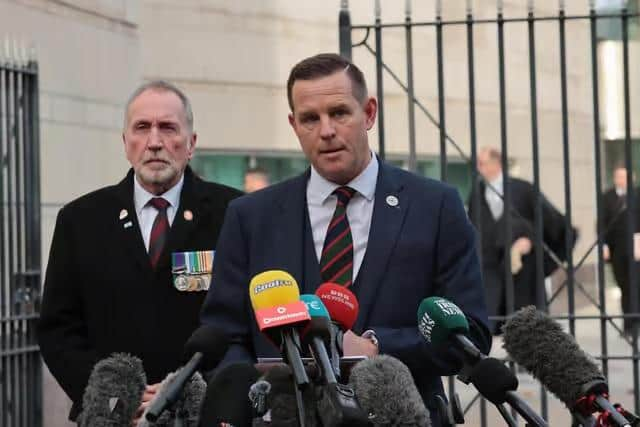

The Troubles Bill passed through its second reading in the Commons in November by 320 votes to 105.
It involves setting up a new Legacy Commission to investigate historic cases, reopening Troubles inquests, and re-permitting civil claims against the state.
Opponents say it restarts processes of legal action that unfairly focus on state actions, as opposed to the far greater number of paramilitary crimes.
The letter in The Daily Telegraph comes after The Times had published a letter in November from nine retired generals warning of the effects of the Troubles Bill on soldiers.
Now Veterans Commissioner David Johnstone has told the News Letter: “The reaction of the veterans and armed forces community to this Troubles Bill has been unprecedented in modern history.
“Every veterans’ organisation, regimental association, the Royal British Legion, special forces community, and all three veterans commissioners have raised concerns about this bill as it currently stands.
“The public comments of Lord Dannatt [the ex-head of the Army who has also criticised the bill], so many senior serving and retired officers, and the threat of legal action by the SAS Regimental Association demonstrate a feeling of betrayal that cannot and must not be ignored by this government.
“I encourage the government to ask the most basic of questions: why are veterans of Op Banner and current armed forces community so opposed to this legislation?”
Objections include “the morality of Op Banner soldiers being treated worse than the terrorists who were given Royal Pardons, exempting them from prosecutions,” the “demonising [of] state forces through re-started coroners’ inquests and lawfare,” and that the bill “makes no distinction” between armed forces, police, and paramilitaries – but “arguably these are not the main objections”.
Rather, he said, it is that the bill “strikes at the heart of the vital relationship between the government and its armed forces, and specifically its special forces”.
He added: “The Troubles Bill restarts the conveyor belt that will potentially lead to more soldiers facing years of legal process, and this breach of trust is fundamentally what is wrong with the Troubles Bill.”
TUV leader Jim Allister meanwhile told the News Letter: “I am not surprised that military leaders, particularly in regard to special forces, continue to show deep concern.
“The Clonoe inquest [which ruled the SAS killing of four IRA men to be unjustified] demonstrated the perversity of an inquest system that this bill perpetuates...
“On the inquest civil standard of proof, the SAS can be vilified with no regard to the split-second decisions required when facing fully-armed terrorists.
“Warped findings such as at Clonoe not only upend the reality of facing armed terrorists but inevitably create a recruitment chill factor.
“Stripping out the inquest circus from the bill should be a major focus of those who care about integrity and the defeat of terrorism.”
The MoD told the News Letter: “This government’s commitment to our Northern Ireland veterans is unshakeable.
"The previous government’s Legacy Act was ruled unlawful by the courts and delivered no real protections to veterans in legacy processes.
“The new NI Troubles Bill, and its associated elements, delivers six lawful and deliverable protections, designed in consultation with veterans so the legislation works for them.
“We are aware of the strength of feeling within the defence community on this topic.
"We have had constructive meetings with former senior officers, representatives of regimental associations, and the third sector to ensure their views and experiences are taken into consideration as this bill progresses through parliament.”
WHAT DID THE LETTER IN THE DAILY TELEGRAPH SAY?
The most senior of the signatories of the letter in The Daily Telegraph are retired Brigadier Aldwin Wight and retired Lt Col Richard Williams.
Brigadier Wight was commanding officer of the 22nd SAS Regiment – the main, full-time component of the SAS – from 1992 to 1994, and had been stationed in Northern Ireland.
Lt Col Williams also commanded 22 SAS, from 2005 to 2007.
Their five co-signatories from the same regiment are George Simm (regimental sergeant major), Jamie Lowther-Pinkerson (squadron commander), Bob Parr (warrant officer first class), David Maddan (squadron commander), and Nick Kitson (squadron commander), whose time in the regiment spans between 1991 and 2004.
Their letter begins: "Grey-zone warfare is not new.
"It lets enemies gain ground without firing a shot.
"Through lawfare, leaks, and disinformation, it erodes trust in Britain’s military and paralyses its leaders – achieving what hostile states cannot on the battlefield."
It goes on to add that "inquiries that spill operational secrets before concluding give adversaries a narrative of lawless troops and treacherous leaders", adding that "grey-zone actors weaponise courts, NGOs and media for bloodless coercion".
It adds: "Commanders now hesitate, fearing years of litigation.
"Troops feel abandoned.
"The public smells cover-ups.
"Allies question our secrecy and reliability.
"This self-sabotage needs no foreign hand.
"Our politics, media incentives, and judicial overreach do the job, gifting opportunities to Moscow’s narrative warriors.
"In this Troubles Bill, the government is complicit in this war on our armed forces."
The letter also says special forces troops "are not asking for immunity; they simply want fair procedures and decisive political leadership", and concludes: "A democracy that won’t back its warriors won’t long endure."
A similar letter from nine ex-generals in The Times in November had said: “Today every deployed member of the British armed forces must consider not only the enemy in front but the lawyer behind.
"The fear that lawful actions may later be judged unlawful will paralyse decision-making, distort rules of engagement and deter initiative.
"We will lose our fighting edge at exactly the moment it is most needed.
"And make no mistake, our closest allies are watching uneasily, and our enemies will be rubbing their hands."
They particularly voiced concern over the Northern Ireland Troubles Bill and the "legal activism" behind it.
"This lawfare is a direct threat to national security," they said.
Their letter added: "By extending the same protections to those who enforced the law and those who defied it, the bill becomes morally incoherent.
"It treats those who upheld the peace and those who bombed and murdered in pursuit of political ends as equivalent actors in a shared tragedy."