
International barrister: 'The Northern Ireland Protocol can't be made to work democratically'
A barrister who specialises in EU law has said whilst the Protocol could be made to “work” for businesses, he doesn’t believe it could be made to work democratically.
Tom Sharpe KC was being quizzed by MPs on the European Scrutiny Committee on Wednesday.
The committee is examining government proposals to amend the post-Brexit trading arrangement.
The international barrister, who has worked for clients in the Hong Kong and North America, and who declared at the outset of the hearing that he is a member of the Conservative Party, said that the Protocol as it stands represents “a very powerful restriction on UK sovereignty".
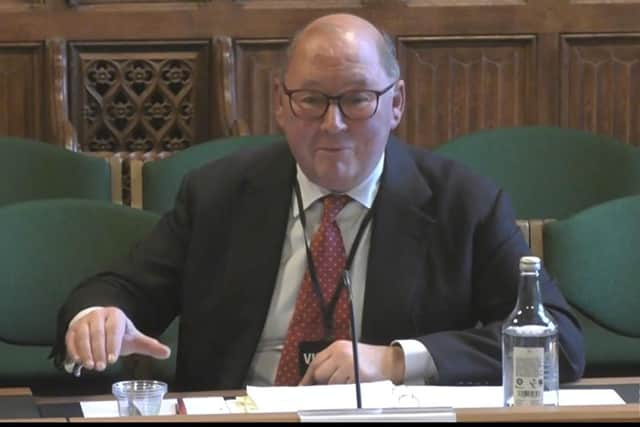

Mr Sharpe said of the current situation: “I don't favour this. But that's all history. We're lumbered with it.
"We've got a protocol, which is a document in international law.
"We can walk away from it with some risks. or we can attempt to amend it…
"As it stands it's a very powerful restriction on UK sovereignty for a significant part of the UK.
"I don't just mean in terms of population and economy, but historically and emotionally.”
He was at one stage asked if it was “ever possible to make the Protocol itself work – can you turn that legislative sow’s ear into a silk purse?”
He replied: “By work, I mean, will it function to the satisfaction of the business community in Northern Ireland? I'm not so pessimistic about that.”
But when it comes to the the “democratic deficiency” created by the Protocol, and whether he can see that being made to work, he said: “No I can't.
"In answer to that specific issue, no I don't. It's the fundamental issue: who governs people in Northern Ireland? It should be Stormont, it should be the UK Parliament.”
Also giving evidence to the MPs was Stuart Anderson, head of public affairs at the Northern Ireland Chamber of Commerce and Industry.
His body represents about 1,000 or so businesses, and in its most recent quarterly survey, they found 21% were saying it the Protocol “was difficult but we adapted”, while “15% are saying the Protocol just doesn't work for us”.
Some 25% said “it doesn't impact upon us at all”.