
Irish council elections an 'unmitigated disaster' for Sinn Fein, says Taoiseach Simon Harris
The Irish premier has branded Sinn Fein’s performance in the council elections as an “unmitigated disaster”, but has refused to call an early general election despite government parties performing better than expected.
It comes as the leader of Sinn Fein said she is “sorry” that her candidates did not perform better in Ireland’s local elections, amid criticism of the party’s strategy in the council races.
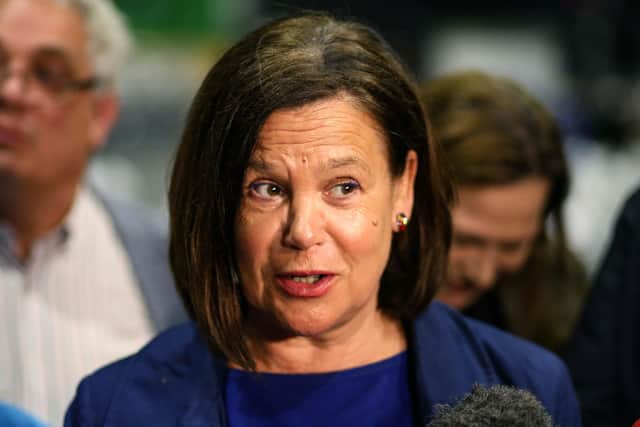

Mary Lou McDonald made the comments as vote counting continues for Ireland’s local and European elections.
At 9pm on Sunday, with almost 600 of 949 council seats filled, the state of the parties was: Fine Gael 170; Fianna Fail 147; Sinn Fein 49; Independents 119.
By 7.45am on Monday, with 826 of the 949 seats filled, Fine Gael were on 215 seats, Fianna Fail 205 seats, Sinn Fein 91, and Independents 164.
Simon Harris said that the Irish public did not want to “buy what Sinn Fein were selling”.
Mr Harris also accused Ms McDonald of making comments that were “quite insulting” to the Irish people when she tried to “second guess” them.
Speaking at the RDS count centre in south Dublin, Mr Harris said: “I was very disappointed to hear her comments in relation to, ‘maybe the people on this occasion didn’t really understand this’.
“The people of this country are sovereign.
“As I travelled around the country, I think the people knew exactly what Sinn Fein were selling, and they just didn’t want to buy it.”
He added: “I think what Sinn Fein needs to realise here is that the Irish people will see through the noise.
“The Irish people don’t believe they live in a failed state.
“The Irish people don’t believe in all of the negativity and the ‘rah rah rah’ but the Irish people want is pragmatic delivery.
“The Irish people do want change.
“They want credible change.
“That’s the sort of change I’m offering with Fine Gael and our coalition colleagues.
“They can carry out all the reviews they want, I don’t get distracted by their business.
“Leadership issues in Sinn Fein are a matter for Sinn Fein.”
Asked why he would not call a general election off the back of the results, Mr Harris said: “Because we’ve lots to do”.
Earlier, Ms McDonald said she was “disappointed” that more of her candidates were not elected.
Early indications show there will be no Sinn Fein surge, while government parties do not appear to have suffered a major electoral blow.
The fuller picture of the state of play will probably not become clear until Monday.
Commentators have noted that Sinn Fein’s strategy in some constituencies had led to its vote being split too much.
Ms McDonald said: “Clearly, we didn’t get that right.”
She added: “It’s not just the number of the candidates, but the fact that in so many cases they were first-time candidates.”
Irish voters have voted to elect almost 1,000 new councillors, 14 members to the European Parliament and, for the first time, one city’s citizens were asked to pick their mayor.
Despite winning 24.5% of first preference votes in a historic result in the 2020 general election, and hovering above 30% in opinion polls for a long time, the fate of many of Sinn Fein’s candidates is expected to depend on transfers.
However, Sinn Fein has made some gains on the 2019 election, where it won around 9% of first preference votes and 81 council seats out of 949.
Ireland’s deputy premier Micheal Martin said that “the moral of the story” of the Irish elections was that polling should not be taken “as gospel”.
The tanaiste and Fianna Fail leader said that there had been 15 national opinion polls, which had Fianna Fail averaging at 16% and Sinn Fein averaging at 26.6%.
He said internet polling “has flaws” and does not capture “the dynamic” of an electoral campaign, or various other factors including personality, geography and policies.
Despite the strong showing for government parties so far, ministers stuck to the line that the coalition government would “go the full distance” to February or March before a general election is called.
Mr Martin said he would not be making the “error” of drawing conclusions from the local election results about a future general election, saying that it would have a different dynamic and cover different issues.
The full results of the European and local elections will take days to be finalised thanks to Ireland’s system of proportional representation which allows voters to rank every candidate in each race by order of preference.
The process means ballot papers are sorted and counted multiple times by hand.
Counting in the European elections began yesterday morning.
Meanwhile, a TUV spokesperson said the results “give the lie to the claims of some that the rise of Sinn Fein is irreversible”.
They added: “Those who give Sinn Fein a character reference for them to wave in the faces of the Southern electorate by sharing power with them at Stormont only to then claim that you must vote for them to stop Sinn Fein in Northern Ireland should also reflect on the weekend’s results.”