
Jon Burrows challenges Michelle O'Neill to debate saying unionism 'has sat back too long' - but TUV brand it 'foolish and misguided'
The Ulster Unionist leader has challenged the Sinn Fein first minister to a debate on Northern Ireland’s place in the UK – saying he is ready “any time or any place”.
Michelle O’Neill has said she welcomes Jon Burrows to the debate – saying it is “the space we are in” and that she is “up for all the debates”.
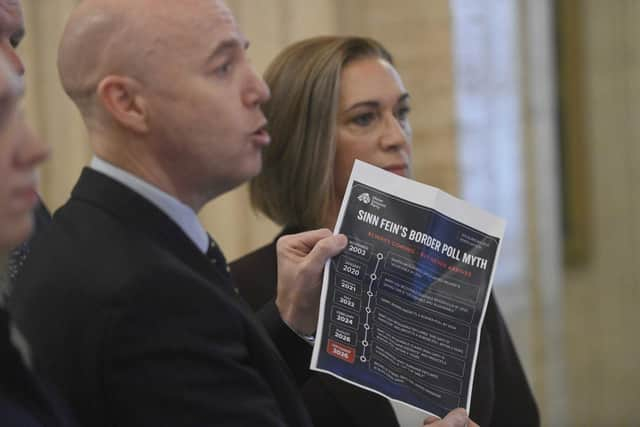

However, there has been criticism from other unionists over the UUP boss’s approach – with the TUV calling it a “foolish move”.
It comes amid continual demands from Sinn Fein for a referendum on breaking up the United Kingdom. This week, the party signed a memorandum with other UK nationalist parties.
That included restating the long-standing aims of the separatist movements self-determination for their respective countries.
It was billed as a “historic” event, given that nationalists now occupy the position of first minister in the three UK devolved nations. However, Michelle O’Neill was locked out of a formal governmental deal between the trio, as her office is jointly held with the DUP.
Reacting to comments from the Sinn Fein leader welcoming him to “the debate” – Mr Burrows said: “So apparently, Michelle O'Neill, the first minister for all, has accepted my challenge for a debate – her case for United Ireland, and my compelling case for staying in the United Kingdom.
“My message to Michelle now: put your money where your mouth is. You said you would do it. Any time or any place, I'll even come to you.
“Let's get the debate going. Unionism has sat back too long. Let's make the case for our United Kingdom of Great Britain and Northern Ireland. I await your reply, Michelle”.
However, the UUP leader’s comments have been criticised by other unionists. A TUV spokesperson told the News Letter: “The drive to break up the UK has been ongoing since the Union was formed in 1801.
“Unionists should not engage in a debate which has no end point. To date, Unionism has recognised the wisdom of refusing to engage in a discussion which can only end when Unionism as a philosophy ceases to exist.
“Mr Burrows’s offer to begin debating the subject is foolish and misguided.”
Speaking to reporters at Stormont on Tuesday, Ms O’Neill said: “I think that this is the space that we're in, and people can choose to bury their heads in the sand, or they can engage in the conversation around constitutional change.
“There's a better future for all of us. There's a way to rectify the wrongs of partition, and there's a way for us to reach to the future.
“And we all have a stake in the future. This is our home. This is our place. We share it together. Let's build it better.
“And I think that the way to do that is to end partition and have the referendum put to the people. Let's have the question”.
The First Minister said the event in Cardiff “was the first of many engagements that you'll see with our leaderships across the three parties working together with that common cause”.
Mr Burrows had described a Cardiff press conference between Sinn Fein, the SNP and Plaid Cymru as a nationalist “circus” – and said it would change nothing.
The UUP boss said it was “not three devolved nations gathering for a conference on the break-up of the United Kingdom; it is three nationalist politicians signing each other's manifestos” – adding that “it counts for absolutely nothing”.
Downing Street said that Prime Minister Andy Burnham believes strongly in the United Kingdom – and is focused on easing the cost-of-living crisis for households across the country rather than on “constitutional debates”.
His official spokesman said the PM “is committed to delivering change across all four nations of the UK and believes strongly in the Union. The UK is at its best when people come together around our shared values and problem-solving, rather than division, and the Prime Minister will continue to ease pressures on household finances, and delivering greater economic security, rather than engaging in constitutional debates or further referendums.”
In a joint political manifesto which was very light on detail, the three nationalist parties rejected the UK government’s approach to the economy and said they would manage it differently, without explaining how.