
Kemi Badenoch Tory leadership win welcomed by Northern Ireland politicians as a chance to strengthen the Union
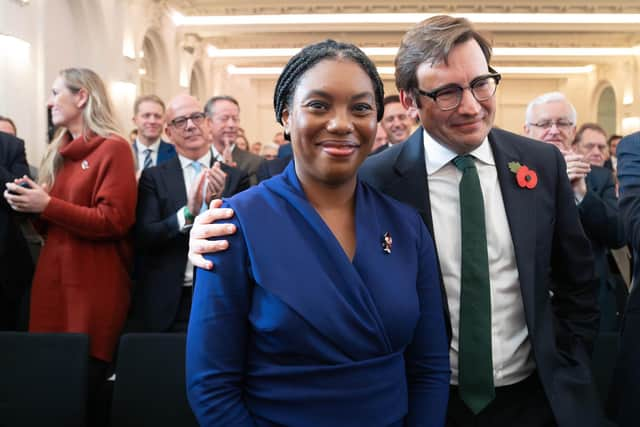
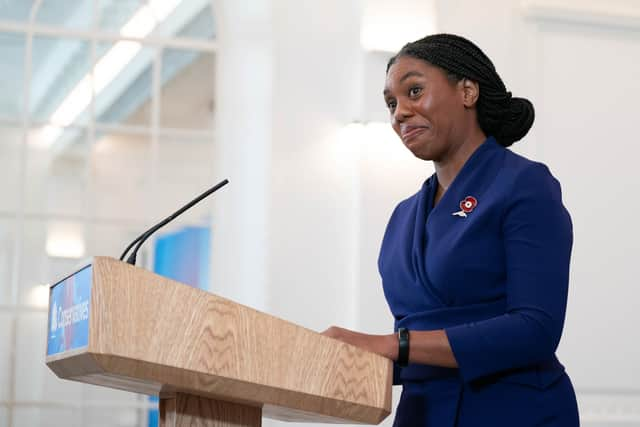
Kemi Badenoch's victory has been given a broad welcome by Unionists.
Members of the DUP, TUV and UUP indicated their hope that they can work with the new Conservative leader to make their visions of a stronger Union a reality.
And Mrs Badenoch has a surprising connection to the province, as her husband once stood for election here.
Banker Hamish Badenoch ran as an MP candidate for the Tories in Foyle in 2015.
Despite boasting of his Scottish and Irish roots – his mother was born in the Republic – he didn't make much of an impression, coming in last place with just 132 votes.
Welcoming the new Tory leader, Deputy First Minister Emma Little-Pengelly stated: “I look forward to working with her and her team, in particular on protecting and strengthening the Union, driving forward prosperity, growth and support for every part of the United Kingdom and on Northern Ireland issues.”
Meanwhile TUV leader Jim Allister MP drafted a letter in which he congratulated Mrs Badenoch while asking for her support in an upcoming debate over scrapping the post-Brexit sea border.
“I trust in your important work as Leader of the Opposition you will keep a focus on the constitutional detriment wrought by the Protocol/Windsor Framework, whereby this part of the United Kingdom has been left behind under the EU Single Market and Customs Zone rules,” he wrote.


“In consequence, in over 300 areas our laws are made by a foreign parliament and our citizens disenfranchised as a result.
“This is an unbearable situation which diminishes the territorial and constitutional integrity of our country.”
Mr Allister added that he hopes to talk through those issues and his upcoming private member's bill attempting to get rid of the sea border with the new Tory leader and her team.
Although UUP MLA Tom Elliott didn't offer any direct words in favour of Mrs Badenoch, he did retweet several supportive messages from the likes of Israel's ambassador to the UK Tzipi Hotovely and the country's foreign affairs minister Israel Katz.
And former Ulster Unionist Lord John Kilclooney called on the party to invite the new leader to Northern Ireland – though he questioned: “Does [the] UUP leadership have the initiative?”
An enthusiastic Brexiteer, Mrs Badenoch wasn't particularly vocal on the subject of Northern Ireland during her time as Business Secretary in Rishi Sunak's cabinet.
She did, however, oppose a move that was seen as a sweetener to get the DUP back into Stormont, which involved a promise to screen any new laws to make sure they didn't create extra trade barriers between the province and Great Britain.
While Mrs Badenoch confirmed that she wasn't involved in any negotiations involving Northern Ireland at the time, she was adamant that the UK needed to be free to diverge from the EU at will in order to 'seize the benefits of Brexit'.
When the issue came up, many Tories were worried that screening new laws to protect trade with Northern Ireland would create vast amounts of red tape, or potentially have a chilling effect that meant new legislation wouldn't be put forward.
Some even went as far as suggesting that the move would tie the UK to European standards, with Mrs Badenoch stating that the country had to be able to freely change regulations 'otherwise there would be no point'.
A mother of three, the new Tory leader has described herself as an agnostic with 'cultural Christian' values.
Although she has claimed to be on the liberal wing of the Conservatives, her winning the leadership challenge is largely seen as a victory for the hardline right of the party, especially those focused on anti-woke culture war matters.
Mrs Badenoch has been vocal in her opposition to transgender rights, recently getting into a very public spat with Doctor Who actor David Tennant over the issue, and in 2019 abstained on a vote to introduce gay marriage in Northern Ireland.
She has also attacked identity politics as 'the very opposite of our crucial and enduring British values', and argued that any histories of colonialism and the British Empire should teach about 'good things that happened' in conquered countries as well as any negative impacts.