
Margaret Thatcher died with Northern Ireland on her heart in regret at the Anglo Irish Agreement, says one of her most trusted aides
Margaret Thatcher died with Northern Ireland on her heart, in regret at the Anglo Irish Agreement, her key advisor has said.
(Click here to read how ‘Brighton bomb did not spook Thatcher into deal’ and click here to read claim that ‘unionist leaders behaved disgracefully’)
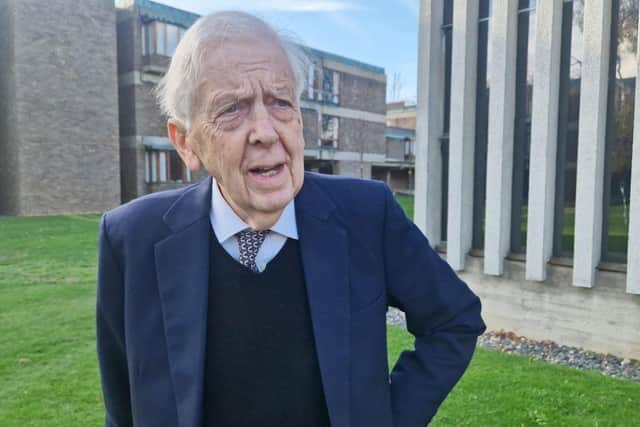
Charles Powell, who was the then prime minister’s private secretary for foreign affairs, spoke to the News Letter last week about the agreement between the UK and the Republic of Ireland in 1985, which gave the latter a formal say in the running of Northern Ireland.
On Saturday, this newspaper reported a record of a February 1986 meeting held between Mrs Thatcher and her then Irish counterpart Garret Fitzgerald, in which the UK premier was already unhappy at the lack of Irish co-operation on security – a mere three months after the Anglo-Irish Agreement (AIA) was signed at Hillsborough Castle on November 15 1985.

A note of the meeting was written by Mr Powell (now Lord Powell). In it, Mrs Thatcher said that she understood the deep frustrations of unionists, who had been entirely cut out of the negotiations. Mrs Thatcher was also scathing about the attitude of John Hume and the SDLP that he led – for example the party’s failure to attend the funerals of Catholic RUC officers murdered by the IRA. Mr Hume was seen as being the chief intended political beneficiary of the AIA.
Lack of Irish security co-operation against the IRA terror campaign would become a long-running sore between London and Dublin, with several notable Irish extradition refusals of IRA suspects as late as Mrs Thatcher’s final year in office, 1990 – she left Downing Street five years to the month after the AIA.
Last week Lord Powell was at a conference at Churchill College Cambridge, to mark the 40th anniversary of the agreement, where the News Letter asked him about past comments he had made about Mrs Thatcher’s lifelong regret at the AIA. He had previously, for example in a TV documentary, compared her regret to the reputed comments of Queen Mary of England, who lost control of Calais in France, which had been an English possession for 200 years, and was said to have remarked: “When I am dead and opened, you shall find Calais engraved on my heart.”
Lord Powell said from Cambridge: “Well, Margaret Thatcher was never really at ease with the Anglo Irish Agreement. It emerged from a tussle between her natural instincts and an intellectual belief that something had to be done about Northern Ireland, imitating rather the Prince of Wales in 1936 saying something had to be done about the miners in Wales.
“And so that put Northern Ireland on the agenda after her 1983 election victory and led her to decide that she must make some effort to improve the rather bleak situation in Northern Ireland. But she never had very high expectations of it. Her main hope was that it would resolve or improve the security situation and would lead to much greater security co-operation across the border with the Republic.
“So she embarked on it rather gingerly and took it a step at a time, and it was dragged out quite a bit, the negotiation, when eventually they came to an agreement which she felt she could accept. But once the agreement was in force and in the years following, she became steadily more disillusioned with it because it was not producing the results for which she had hoped, particularly in the security co-operation side.”
Lord Powell continued: “And so she saw there were more IRA incidents, there were troubles over getting people extradited. I mean, nothing seemed to have improved. And it led to her saying to Garret Fitzgerald that ‘you got the glory, I got the problems’. And that really rather sums up what she felt about it. That that sort of evolution of her thinking really did continue after she stopped being prime minister and went into retirement and reflected on it more.
“I think this feeling that she had let down Northern Ireland grew and she … really I think I compared it to Queen Mary the first who lost Calais as a British possession after 200 years, and said that when I am dead and they open me up, they will find Calais lying on my heart. And I think maybe Margaret Thatcher had Northern Ireland lying on her heart.”
He added: “Well, that was what I would call her final state of mind about the agreement. You know, I suppose she was thinking about it very often in her last two or three years.”