
Matthew O'Toole on the future for Stormont: Even reasonable people ask me - what difference would it make if it did go?
The News Letter has been in continuous publication since 1737, and sometimes it feels like dysfunction at Stormont has been going on almost as long.
The last few weeks in particular has felt to many people, of all backgrounds, like a depressing exercise in negative nostalgia.

Reopening a dark and divisive chapter in our past with no clear useful endpoint other than, inevitably, further division. The urge to make us see the worst in each other.
And so it has proven, perhaps to the satisfaction of the handful of people driving this agenda, but to many other people’s exhausted frustration. Including, no doubt, many members of loyal orders in places outside Portadown who have worked to achieve acceptance and local accommodations in the last two decades.
The most important questions facing us now are not how long we can dwell on the difficult and divisive few weeks of Drumcree ‘26, but where we collectively go from here.
First, how we return at least some of our political focus to questions of basic governance, such as setting a Budget, fixing services and agreeing pay deals for public sector workers.
And second, how we recommit ourselves to the clearly unfinished work of healing rather than exploiting the tragic divisions of our past. I think many ordinary unionists, know that the small group determined to crowbar open the Drumcree issue weren’t doing it simply to achieve a small parade down one road and then move on; they wanted a row, and a big one. One of them has even self-published a book detailing strategies for a “culture war”, complete with flames on the cover, just to underline their commitment to peaceful reconciliation.
This is not to dismiss sincere questions relating to the rule of law and the events on the Garvaghy Road. My party, for its part, has said that it stands over its response to that extraordinary night a fortnight ago - and accept the consequences which might follow.
We have our roots in peaceful, non-violent demonstration, but is also committed to taking responsibility for our actions.
It would be tempting to point out decades of examples of senior DUP representatives skirting and breaking the law - often with glee - but it wouldn’t serve much constructive purpose.
Our responsibility is the hard but vital work of constructive opposition. Not nationalist or unionist opposition, but accountability on behalf of everyone who lives here.
While the distraction at Drumcree has been ongoing, the Executive’s Budget crisis has passed into the second half of the financial year. That isn’t just dry accountancy, it is plunging public services into crisis as cuts are being made in the absence of certainty. Just last week at a public meeting, someone who works at a local tech stood up to tell me she had been laid off by her college as they make cuts in the absence of an Executive Budget.
The same is happening across Northern Ireland in a range of areas, with services being cut by default, with no accountability.
And that brings us to the question that never really goes away: when will Stormont collapse? It is understandable that people ask this question, both because it has collapsed so often before, and because, well… the state of the place. Not just the poor state of Executive delivery, but the toxic mudslinging and glorying in division which seems to define the devolved Assembly.
While the people trying to tear down Stormont tend to be the most unreasonable, even reasonable people ask me: what difference would it make if it did go?
My answer in the News Letter today is similar to the answer I gave in a piece in the Irish News earlier this year, when parts of Republicanism were jockeying for Sinn Féin to walk out of Government.
Now, hardline loyalism is demanding the DUP collapse Government. In both cases, reflexive anger and absolutism is substituted for strategy, and short-term political calculation substituted for any concept of the common good.
The shared view of both main parties is that the UK Government has made unacceptable decisions in relation to Northern Ireland and, effectively, cannot be trusted. Why then does it make sense to hand over all power to that Government to make any decision it wants, abdicating all local accountability.
If parties think the public is angry now at the irresponsibility they see at Stormont, just wait till they have to accept a punishment Budget passed at Westminster with no local responsibility taken.
Wait until public sector workers are forced to strike for their wages over the winter months while Executive MLAs (who received theirs automatically) can only shrug and say: “not our fault, blame London.”
There is no future for Northern Ireland, either in the UK or in a new Ireland, that can credibly be built on simply shifting blame elsewhere. Whatever we want to build, we have to start here, together.
Today at Stormont, grinding as it is, we will use our Opposition time to press for a new political consensus on the major challenges we all know we face but refuse to tackle - an unreformed health service, underinvested water infrastructure, environmental catastrophe at Lough Neagh - because distracting ourselves with division is easier.
That hard work of building for the common good is much more difficult than collapsing into division.
And for those who say the events of the past few weeks prove a new Ireland based on respect for difference - including for the Orange tradition - isn’t possible, I’d respectfully suggest they cast their minds back just a few weeks further back to the Fleadh in Belfast. The largest ever celebration of Irish traditional music included, and celebrated, loyalist and Ulster British bands, an integral and distinctive part of our culture.
That’s the kind of Northern Ireland most of us want to live in, and I hope the new Ireland of the future.
Occasionally seeing the good not just the worst of each other. Its for those who want to build that future together, wherever we see it, to resist those who so desperately want to force us back into trenches.
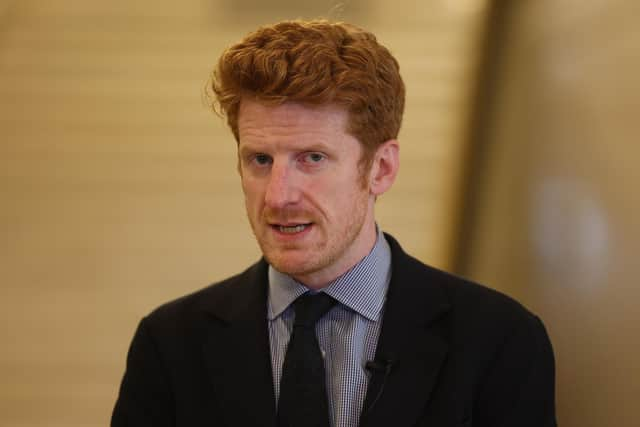
Matthew O’Toole is leader of the Opposition at Stormont