
Michelle O'Neill locked out of key meeting of UK's nationalist first minsters - as Sinn Fein leader not there to represent Northern Ireland
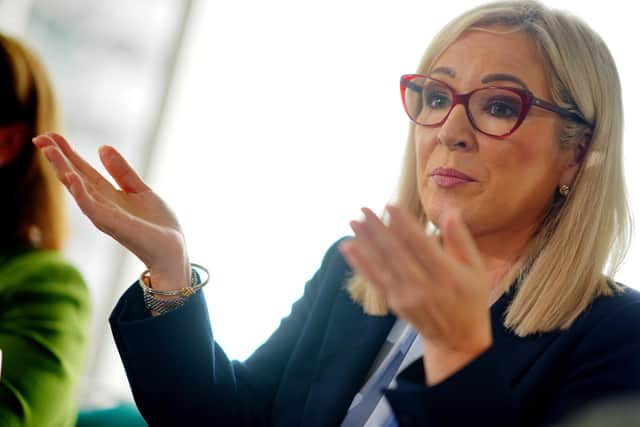
Michelle O’Neill was locked out of a key meeting of the UK’s nationalist first ministers on Monday, as the Sinn Fein politician was not attending a “historic” gathering in Cardiff in an official capacity.
Nationalist leaders from the three devolved administrations gathered in Cardiff for talks about “working more closely” – including on constitutional issues.

However, Welsh First Minister Rhun ap Iorwerth and Scottish First Minister John Swinney met separately in the afternoon in their roles as leaders of their respective devolved governments.
The formal agreement on “future collaboration in areas of shared interest” could not be signed by Northern Ireland’s First Minister Michelle O’Neill – as she is in a joint office.
The DUP deputy First Minister Emma Little-Pengelly – who would have to agree to any such move – says her ministerial counterpart had “no authority to sign a Wreckers’ Charter”.
Ms Little-Pengelly told the News Letter that despite the briefing from Sinn Fein, Michelle O’Neill was “never attending this ‘Summit of Separatists’ as First Minister.
“Being robustly challenged over attempts to portray this party political gathering as a summit of First Ministers has now forced a clarification of honesty. We warned that a nationalist First Minister would seek to weaponise the office to advance Sinn Fein’s constitutional agenda. We are also now seeing other First Ministers blur the line between governing for everyone and campaigning to break up the United Kingdom.
“The constitutional position is simple. Michelle O’Neill may attend Sinn Fein events as Sinn Fein vice president, but she cannot use the office of First Minister as a platform for separatism or pretend to speak for Northern Ireland on matters for which she has neither authority nor consent”, the Lagan Valley MLA said.
Representatives of nationalism in three of the UK nations held a press conference in Cardiff on Monday morning. SNP leader John Swinney MSP, Plaid Cymru leader Rhun ap Iorwerth MS and Sinn Fein’s Michelle O’Neill MLA and Mary Lou McDonald TD gathered as their three parties announced a joint political platform.
Afterwards, the first ministers of Scotland and Wales announced a “new era” of co-operation between their respective governments. John Swinney and Rhun ap Iorwerth signed an agreement in Cardiff on Monday afternoon pledging to make the case for “greater fairness” and power over the “constitutional futures” of their countries together.
Mr Swinney and Mr ap Iorwerth signed the Cardiff Agreement at the Welsh Government offices in Cathays Park following the press conference – in what the Scottish First Minister described as “an important moment in the history of devolution”.
The agreement sets out areas of planned co-operation, including tackling child poverty, addressing cost of living pressures and international engagement.
Mr ap Iorwerth said: “While Wales and Scotland are on different constitutional journeys, we both share a commitment to strong, accountable devolved government, and to a relationship between the governments of these islands built on trust and mutual respect.
“We share a belief that our people should decide their own future, and that the union isn’t working fairly for either nation.
“We will use every opportunity available to us to press the case for greater fairness for Wales and Scotland and for powers over our constitutional futures.”
Mr Swinney said: “The signing of the agreement is an important moment in the history of devolution. It will improve the way the Scottish and Welsh governments work together on our shared priorities so we can deliver better outcomes for the people we serve.
“The agreement reflects a relationship built on trust and mutual respect. Distinct approaches will still be necessary, but we share common goals and a commitment to learning from each other.
“The new era of co-operation represented by the signing of this agreement is underpinned by a shared belief that the people of Scotland and Wales are best placed to decide their own constitutional future and should not be held back by a UK system that does not work for our nations.”