
Mystery over why local councils abandoned single sex spaces is explained by training authority’s trans 'capture’ - TUV
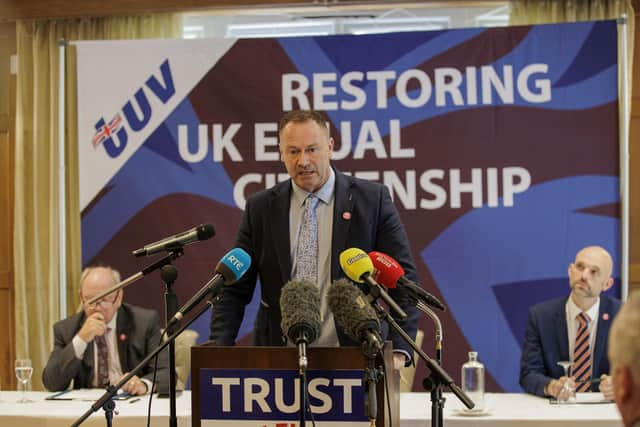
A public body which trains local council officials has been “captured” by the trans lobby, and has given “misleading” legal advice to councils, according to a TUV councillor.
The Local Government Staff Commission (LGSC) had advised local authorities in Northern Ireland that transgender people can use facilities – such as toilets and changing facilities – which align with their chosen gender.

The LGSC now says it is waiting for guidance from the Equality Commission (ECNI) in light of the Supreme Court sex ruling, which said sex is defined by biology not identity.
However, when asked by the News Letter whether it had checked its current ‘Guidance for Local Government Trans Equality Document’ with ECNI, it declined to say.
A spokesperson said it was based on “best practice at the time”.
The policy was uncovered by the TUV party chairman Keith Ratcliffe who says it explains why local authorities have abandoned single sex facilities on council premises across Northern Ireland.
The Armagh, Banbridge and Craigavon (ABC) councillor began asking questions of the council in relation to a pride event in Lurgan.
Mr Ratcliffe told the News Letter: “Lurgan Pride have made no secret of their opposition to the Supreme Court’s ruling. In light of this, I have asked ABC Council to seek assurances that those using Lurgan Park for the event in August will respect single-sex facilities, particularly council-owned toilets.
“It was later suggested to me that the council already permits individuals to use toilets and changing areas that align with their self-declared ‘gender identity’ rather than their biological sex. I therefore contacted the Chief Executive to seek clarity on the matter.
“I have since been informed that, while the council does not have a formal policy on access to single-sex spaces, it does operate under internal staff guidelines. These guidelines advise staff that transgender individuals are entitled to access facilities, including toilets, in line with their gender identity. This position is supported by the Local Government Staff Commission’s Trans Equality Guide to Councils (2024), which offers similar advice.
“The council has also confirmed that it has contacted the Equality Commission for guidance in light of the Supreme Court ruling.
“It is quite clear that the Supreme Court’s judgment applies in Northern Ireland. I therefore fail to understand the delay. I have written to the council making it clear that their current approach must be brought into compliance with the law as a matter of urgency.
“In addition, I have written to the Local Government Staff Commission, challenging how they became so captured by the trans lobby that they issued such misleading legal advice to councils. I have also asked whether this guidance has now been withdrawn in light of the Supreme Court ruling.
“Frankly, this entire episode exposes how the trans lobby has successfully infiltrated public bodies such as the Local Government Staff Commission, reshaping policy and practice according to an ideology that is increasingly out of step with both legal precedent and biological reality.
“Serious questions must now be asked about how professional organisations were so easily taken in by activists pushing an agenda with no basis in law or fact.”
The LGSC told the News Letter: “the Guidance for Local Government Trans Equality Document was issued to Councils on 29 May 2024, based on best practice at the time. The Document will be reviewed once the Equality Commission issues its guidance following the Supreme Court ruling”.
A letter to the TUV councillor from ABC council said LGSC issued a Trans Equality Guide to Councils in 2024 – which was in line with other legal advice they had received which said that trans people “are entitled to access facilities and toilets that correspond with their gender identity”.
The letter also said: “In relation to the recent judgment the Equality Commission issued a statement on 17 April 2025 and said that ‘while the judgment is not directly concerned with the relationship between the Gender Recognition Act 2004 and our corresponding equality law, the Sex Discrimination (NI) Order 1976, our initial view is that the judgment is likely to be deemed by our industrial tribunals and courts to be highly persuasive and, consequently, it is likely to be followed in cases where similar issues arise.’
“The Equality Commission have also said they will now review their guidance and make amendments where necessary. We have contacted the Equality Commission regarding this judgment and have sought advice on the implications for our Council Services. Amendments will then be made to our guidance as required”.