
New draft Religious Education syllabus for Northern Ireland keeps Christianity central in line with Supreme Court says Minister Paul Givan
The new draft Religious Education syllabus for Northern Ireland "recognises the central place of Christianity" in line with a recent Supreme Court judgment, Education Minister Paul Givan has said.
His department has launched the draft syllabus for public consultation following a Supreme Court ruling last November that found Religious Education (RE) in Northern Ireland does not approach the subject in an “objective, critical and pluralist manner”.

The case was brought by a Belfast primary school pupil whose parents objected after she came home praying grace before meals, as she had been taught in school. The court found her school had unlawfully crossed the line from education about Christianity into "indoctrination".
However, while calling for reforms, the court acknowledged that "Christianity is the most important religion in Northern Ireland" and said the Department of Education was free to arrange "for the greater part of religious education to focus on knowledge of Christianity".
It also said there was "no challenge" to collective worship in schools "being focused on the Christian religion".
The draft syllabus was developed by a Religious Education Drafting Group led by Professor Noel Purdy OBE of Stranmillis University College and former Long Tower Primary School principal Joyce Logue.
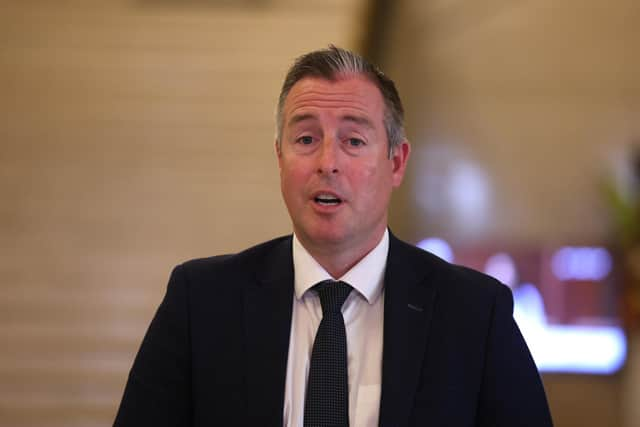
Minister Givan said: “This draft syllabus responds directly to the Supreme Court judgment. It seeks to meet the requirement for greater objectivity and recognises the central place of Christianity in Northern Ireland’s history, culture and society."
He added: “It is now important that teachers, parents and wider stakeholders take the opportunity and respond to the consultation to help ensure that Religious Education is both legally robust and fit for purpose.”
The document was created after 25 stakeholder meetings, research involving children and young people, and a call for evidence which attracted over 1,000 responses.
Professor Purdy said the syllabus "treats RE as a rigorous academic subject while helping pupils explore beliefs, practices and ethical questions in ways that are objective, critical and pluralistic".
It has been developed through engagement with churches, representatives of other religious traditions and those with no religious beliefs.
Bishop Andrew Forster, speaking on behalf of the Presbyterian, Methodist and Church of Ireland denominations, welcomed Christianity remaining central.
“As Christianity is the faith identity of almost 80% of the population in Northern Ireland, we welcome the fact that it remains a core focus of RE at every key stage," he said.
Northern Ireland Humanists Coordinator Boyd Sleator said the draft was "a real" improvement because it recognises RE must be objective, critical, and pluralistic - and “finally” includes humanism.
"But the Department must go further. Christianity is still given a special structural role throughout the syllabus, while humanism is not clearly guaranteed. The Supreme Court was clear that children must not be indoctrinated through RE or collective worship."
But James Kennedy, NI Policy Officer with The Christian Institute, took the opposite view. “It is absolutely right that the syllabus is focused on Christianity, given that most people in Northern Ireland still identify in some way with Christian belief," he said.
He also expressed concern that from age seven pupils would study seven religions and worldviews, suggesting there was “an ideological position” where “the deep differences between beliefs are ‘ironed out’ for the sake of easy comparison”.
The consultation runs until 30 September 2026.