
NICVA defends community sector schemes as 'good value for money' after questions over effectiveness
The umbrella group representing community and voluntary sector organisations in Northern Ireland has defended employment schemes run by its members as “very effective” and “good value for money”.
The Northern Ireland Council for Voluntary Action (Nicva) was responding to questions about how effectively public money has been spent on projects designed to get people back to work.

Figures obtained by the News Letter showed that the taxpayer spent £26m in one year, with just 2218 people in work which lasted for at least six months. In one year, a £27.3m spend resulted in just 643 people – 5% of participants – employed for six months.
Those schemes dealt with 13,644 people in 2025/26, the majority of which did not find work as a result. Nicva says the support they received works out £1,850 per participant, and that the projects “outperformed anticipated targets”.
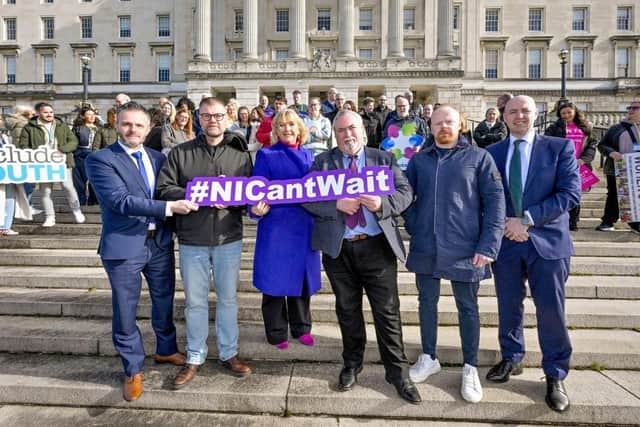
There was cross-party uproar at Stormont earlier this year when the UK government decided that it would shift Local Growth Fund cash towards capital projects and away from the kind of “employment, skills and inclusion services” operated by community and voluntary sector (CVS) organisations.
The scheme’s predecessor, the UK Shared Prosperity Fund, had funnelled most of its spending in Northern Ireland through CVS groups.
Last week, Ulster University Senior Economist Dr. Esmond Birnie questioned whether the schemes were the “most effective ones possible” – and questioned the “relatively high” costs.
Pointing to the number of people who subsequently stayed in work for at least six months, Dr Birnie said it is a “cost per (reasonably long lasting) job of £11.6k which seems relatively high”.
Nicva says the schemes supported more people than they were funded to. The organisation’s Director of Insight and Policy Jenny Potter told the News Letter: “The voluntary and community sector has a strong record of helping people who are the furthest from the labour market with intensive support.
“Overall, there is lots of evidence that these projects, which haven't finished reporting for 2025/26, are very effective. Data shared by the UK Government shows they outperformed anticipated targets and are good value for money, in comparison to similar schemes across the UK.
“Thousands of people have been left without this vital support after the ongoing cuts to the Local Growth Fund (LGF). We will continue to monitor the detrimental impact of this lack of certainty on our sector and the services we provide in Northern Ireland”.
Nicva say that as well as helping people into employment, the projects also helped thousands of people progress into education or training.
The funding of the CVS sector in Northern Ireland through this revenue stream has the backing of all the main Stormont parties.
£129 million is currently available for Northern Ireland from the three-year LGF scheme – but the Executive is not happy that it will have to spend the bulk of that money on capital projects.
Ministers have previously written to the former UK Communities Secretary Steve Reed calling for “a more favourable resource allocation”, which would benefit the sector.
The letter said that the “much-reduced quantum of the Local Growth Fund will have a significant and detrimental impact on achieving local growth, and the capital/revenue split of this fund makes matters much worse”.
That split is 70/30 in favour of capital projects, meaning less cash for the CVS sector.
The News Letter asked the government about the money spent on UKSPF’s economic inactivity schemes; and their effectiveness in tackling economic inactivity.
The data showed that under UKSPF:
- in 2023/24, £27,322,370 was spent on economic inactivity projects, 79.61% of the funding available to NI. That resulted in 2,371 people in some form of employment, with 643 staying for six months or more – 5% of the 12,889 participants.
- in 2024/25, £30,711,589 was spent, 45.11% of the total. That resulted in 4,847 in some form of employment, with 2,924 staying in work for six months or more – 21% of the 13,872 participants.
- in 2025/26, £25,753,485 was spent on the schemes, 57.29% of the NI total. This got 4,143 back into some form of work, with 2,218 getting work for six months or more – 16% of the 13,664 signed up.
UUP MP Robin Swann has previously said voluntary organisations “would rather have a revenue stream than a capital stream” and “that’s where the 70/30 split is really damaging”.
DUP leader Gavin Robinson has previously said there would be “truly awful consequences for community services as a direct result of choices made” by the government over LGF.
Minister announces how capital funds will be spent.
John O’Dowd has announced how the Executive will divvy out cash that all of the Stormont parties wanted to spend on employment and inclusion schemes run by community and voluntary sector (CVS) groups.
The Sinn Fein finance minister says that £27.4 million Local Growth Funding will be used to boost regional growth, support businesses, regenerate communities and improve connectivity.
Minister O’Dowd said the investment will “deliver tangible benefits for communities, businesses and our agricultural sector” across Northern Ireland.
The UK government has prioritised capital projects, allocating cash to back up a strategic shift away from employability schemes run by charities and community groups.
“It will support entrepreneurs, start-ups and social enterprises to grow and thrive, while funding for community regeneration will help transform vacant and underused assets, improve access to employment and skills opportunities, and strengthen the social economy.
“Investment in agricultural innovation will boost productivity and help our rural sector while improvements to transport and connectivity will make it easier for people and businesses to access opportunities and participate in economic growth”, Mr O’Dowd said.
The allocations are as follows:
- £13.292m to Department for the Economy to support investment in innovation, start-up and business development, and support social enterprise development.
- £7.068m to Department for Communities to improve community infrastructure, regenerate vacant and underused assets, enhance access to employment and skills opportunities, and support social enterprises.
- £3.82m to Department of Agriculture, Environment and Rural Affairs to support innovation and productivity within the agricultural sector.
- £3.249m to Department for Infrastructure for investment in transport and connectivity improvements.
The Minister added: “While my Executive colleagues and I urged the British Government to reconsider its decision to impose a capital-heavy profile, Westminster confirmed that the funding profile would remain unchanged.
“The entire handling by the British Government on this Fund put us in a position which was far from ideal. However, to make the best use of the available funding, the Executive has now agreed capital allocations from the Local Growth Fund for 2026-27. A co-design process, involving the community and voluntary sector alongside other key stakeholders, has begun to shape the delivery of the Local Growth Fund in 2027/28 and 2028/29.
“I will continue to argue that funding priorities should be determined by locally elected Ministers, not Westminster. I will also continue to make the case that the overall funding package falls short of previous EU Funding and breaches former British Government commitments that we would not be left financially worse off following Brexit.”