
Possible toughening-up of street preacher curbs for Belfast city centre 'deeply concerning' says Christian campaigner
The possible toughening-up of a law that would curb street preaching has been described as "deeply concerning" by a Christian campaigner.
James Kennedy of the Christian Institute said that there is a risk of politicians in Belfast imposing "blunt and ill-thought-through restrictions" that would "discriminate" against religious expression.
He was speaking after news emerged that a planned council bye-law to restrict the use of amplification in the city centre is to be scrapped and redrafted, amid Alliance concerns that it is too lax.
Alliance councillor Jenna Maghie said that the level of fines involved was too low, and complained that the bye-law would not bar the use of "graphic imagery" by protestors – a reference to the placards which are sometimes displayed by anti-abortion demonstrators.
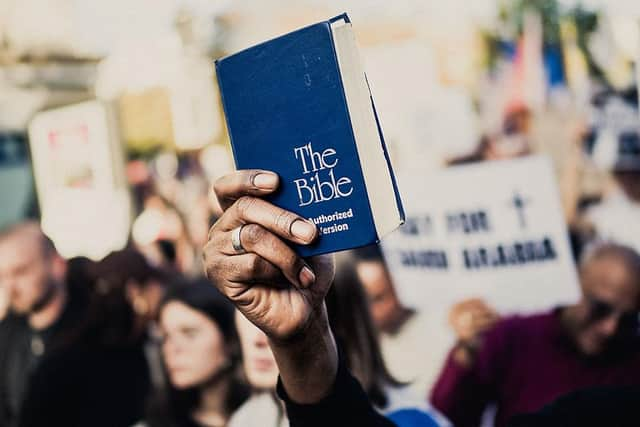

Councillors have now agreed to send the matter back to the committee which first came up with the proposals so it can try again.
The new bye-law would apply to preachers and buskers alike.
Mr Kennedy, the Christian Institute's policy officer for Northern Ireland, told the News Letter: "It is absolutely right that the plans to silence street preachers in Belfast have been sent back to the drawing board.
"However, it is deeply concerning that some now seem intent on expanding their efforts to target wider Christian witness in the public square."
He said the limit that had been proposed by the council for amplified sounds – 70 decibels – was "only about the level of traffic noise" and was "both impractical and unfairly selective".
It would restrict street preachers whilst "appearing to exempt much louder activities" like council-led events or protests.
“We strongly urge the council to engage constructively with those involved in responsible street preaching and other Christian witness, rather than imposing blunt and ill-thought-through restrictions that risk unfairly discriminating against religious expression," he said.
“The Bible commands Christians to 'Go into all the world and preach the Gospel', and we hope those in Belfast will continue to be free to do so.
"The right to express deeply held beliefs in the public square is a fundamental freedom, and we trust the council will respect this as they reconsider their approach.”
The Christian Institute recently drew up a 'Street Preachers Charter' for England and Wales (and is drafting one for Northern Ireland too).
It states: "Sometimes the proportionate use of amplification can help enhance a preacher’s natural voice, particularly in a noisy setting.
"But if too loud, amplification can deter passers-by from stopping and prevent drawing in a crowd. It can distort the sound and appear aggressive.
"Always consider volume levels and respect the surrounding area."
The new draft bye-law had been unanimously agreed last month at the Strategic Policy and Resources Committee.
It would have meant individuals in the city centre could be fined £500 if they go over 70 decibels.
With no elected representatives at the meeting airing any direct dissent, the matter did not go to a vote, and it appeared the plan would be ratified by the full council this week (before going to Stormont for the green light).
However, at Monday's full council meeting, a number of parties rejected the draft bye-law.
Alliance councillor Jenna Maghie said at the Monday meeting: “Anyone who was at the [committee meeting] will know how much I struggled with what was put in front of us, because I didn’t feel they went far enough, and I was unsure they would be effective on amplification.
"And they don’t deal with graphic imagery at all [by anti-abortion protestors].
“I’ve done more reflection, I’ve done more engagement, and I can’t support these [restrictions] being what we bring forward.
"Asking for the bare minimum to be approved because that’s what we think we might get isn’t good enough. It isn’t delivery for the people of this city and the visitors to it.”
She added: “The [committee] paper notes that ‘the display of graphic imagery and amplification can have a negative effect on social and economic activity’.
"I’ve said it before, and I will continue to say it again and again: both are more than a negative impact, some are traumatising for people in our city, and that is not good enough.”
She also complained that the fines were not high enough.
She proposed that the committee should “do better”.
An earlier version of the draft bye-law had proposed that preachers would have to ask the council for a permit, but this proposal had been dropped.
The fact that the matter is now back before the committee raises the prospect that this could be discussed again.
At the Strategic Policy and Resources Committee last month, DUP councillor Bradley Ferguson had thanked officials for their drafting of the planned bye-law, saying: “Quite a bit of work went into this and I know [we were] robust going through this. But it seems pretty balanced, and the way to go.”
But at Monday's full council meeting, DUP deputy group leader Dean McCullough said: “From the outset, these bye-laws were driven by a desire to target certain groups, primarily street preachers and the pro-life witnesses.
"We heard references to so-called hate preachers, whatever that means, and we all sat through the debates on graphic imagery. We were told that showing the reality of abortion was too graphic.
“Yet (at the same time) a stained glass window in this very building contains images and indeed wording that many would view as provocative, confrontational or explicit.”
This is a reference to a new LGBTQQIA+ commemorative window, which bears the slogan “save sodomy from Ulster”.
He added: “What utter folly on the part of some far-left councillors to believe that street preachers, members of the most persecuted religion on Earth, would ever seek or need their permission to preach.
"Jesus Christ is Lord. It is Christmas, and I don’t need a permit from this council to proclaim that.”
He said his party could not support a 70 decibel limit “that renders amplification effectively useless”.
Green Party councillor Aine Groogan said the council had to “go back to basic principles” and have further consultation.
Councillors unanimously agreed for the draft bye-law to return to the Strategic Policy and Resources Committee.
The balance of power on the council favours nationalists, with those in the ‘other’ bracket often having a decisive say on how votes go.
The biggest bloc is Sinn Fein with 22 members (the SDLP have five – making 27 nationalists in total).
The DUP, the next biggest bloc, has 14 (the UUP have two and TUV one – making 17 unionists in total).
Alliance has 11 councillors, and the Greens have three, People Before Profit have one, and there is one independent – an ex-SDLP man (making 16 ‘other’ councillors in all).