
RTÉ staff return to offices as garda probe bomb threat
Staff at Ireland’s national broadcaster have returned to its offices after a bomb threat led to the evacuation of its television and radio headquarters in Dublin.
Other media organisations in Ireland were also sent “very serious” threats on Friday morning, the Irish Government said, adding authorities are working to find those responsible.

The incidents came after bomb threats were sent to airlines across Europe, including one targeting flights from Dublin, over recent days.
Gardaí were called to the scene at the Donnybrook campus, and garda sniffer dogs carried out searches of the area, which has now been declared safe.
The emailed threats to media outlets were received ahead of a week when Ireland will host two major European political summits as part of its six-month presidency of the EU Council.
RTÉ Radio One went off air around 9am on Friday and replaced its programme Today With David McCullagh with a pre-recorded programme of music.
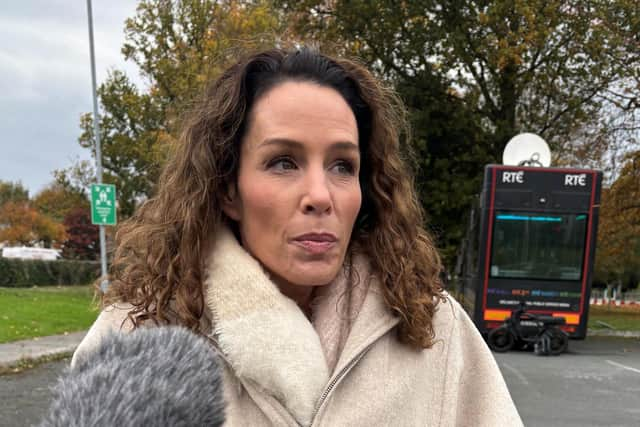
The show returned later in the morning, with McCullagh presenting from a mobile broadcasting truck as gardaí continued to search the RTÉ buildings.
Staff including radio and television presenters at the Montrose campus were told to leave the studio buildings after the email was received.
Children being looked after in a creche on site were also evacuated.
RTÉ director-general Kevin Bakhurst joined staff members outside the station’s mobile broadcast vehicle as they awaited updates of the search.
“On the basis of the information we had, we decided that we wanted to put the safety of the staff first and evacuate the buildings,” he said.
“It’s a disgraceful attack on the media, on free media, and unfortunately, probably where it comes from, they don’t really appreciate the importance of free media.”
McCullagh told listeners the threat warned of a bomb which would explode within 45 minutes.
Threats were also sent to Virgin Media, Newstalk and the Irish Independent.
RTÉ presenter Sarah McInerney said the sender of the email claimed to have been part of a group responsible for other recent threats against airlines, and had claimed an operative had planted an explosive device in the building.
Irish police, including the armed response unit and sniffer dogs, attended the site.
Minister for Justice Jim O’Callaghan said the threats were being taken “very seriously” and are being investigated by gardaí.
“Europe has increasingly become the target of different forms of hybrid attacks, which are evolving in complexity and sophistication,” he said in a statement.
“To counter these threats, it is important to strengthen our co-operation and co-ordination.
“Threats of this nature are completely unacceptable and every effort will be made to identify those responsible.”
Taoiseach Micheál Martin told RTÉ Radio One: “It is worrying and we take the threat seriously. Obviously, because the safety of the Irish public is our first priority, and indeed across Europe.
“Yesterday, there appeared to be co-ordinated efforts to disrupt air travel and so forth.
“The gardaí, the Defence Forces, cyber and aviation authorities are working to establish who’s behind this, as are their European counterparts.
“It’s not determined yet whether it’s individuals or a co-ordinated attack.
“However, we will go after this to identify who’s responsible and to hold them accountable.”
Mr Martin said there would be a “very significant security operation” in place for the European Political Community meeting on Thursday next week and the informal meeting of EU heads of state on Friday.
“We’ve been alive to this risk since before our presidency and our agencies have worked extremely hard on this, and we have had meetings even in the last week in preparation for next week,” he said.
“It does highlight, and I would say this to all of our main representative bodies in society, the security stakes are much higher in this period of time than they have been for a long time in Europe.”
He added: “We have the largest number of prime ministers ever at the one time in our country (for the EU Council events) and that does call for a very significant security operation.
“The gardaí are to be commended on the extraordinary preparation that they’ve put into this, as have our Defence Forces, and both are working very closely together and working with like-minded agencies across Europe, so we’re confident in terms of our capacities and in terms of the preparation we’ve put into this.”
A Garda work-to-rule action for the duration of the events has been directed by a representative organisation for rank-and-file members, while public sector workers are planning a nationwide strike on Thursday.
Commenting on Friday’s emailed threats, Mr Martin added: “It just illustrates how relatively simple it can be to cause disruption and to undermine the normal operation of society through unconventional activities of this kind, which are designed to cause disruption, designed to cause fear and anxiety. So we have to remain calm and very focused on this.”
Tánaiste Simon Harris said the Government is “alive” to the risks associated with the types of threats received by Irish media outlets on Friday.
“There’s a very serious and evolving situation this morning, and obviously this comes on the back of a number of bomb scares yesterday and in recent days in relation to airlines as well,” he told Cork 96FM.
“So this is evolving in real time. I think it’s fair to say we don’t yet know who is responsible for what’s happening this morning. We don’t yet know whether it’s an individual behind this effort or some form of a co-ordinated effort.
“But what I do want to assure the people of this country is that this is an issue being taken very seriously by the gardaí, by our security forces and our cyber experts.
“They’re working now on this issue and of course they’ll be liaising as appropriate with European counterparts as well.
“The priority is that people are safe, but we need to work to identify the culprits as well.
“I want people to know that we’re alive to these risks.”
Presenter Sarah McInerney said that there is a sense of “inevitability” around the threat.
She told reporters at the site: “We’ve seen what’s been happening this week, and when you stop and think about it, surely it was only a matter of time.
“It’s more concern about how do we prevent stuff like this happening again because it’s been so disruptive. We’re doing our best to stay on air. I think the teams everywhere are doing a really good job, but we are so dependent on technology.
“It looks that it was a hoax, and it’ll all be fine. But it’s how do we make ourselves proofed for this in the future?
“That is going to be the next really big question, that we need to address really, really quickly because we can’t be at the behest of people who want to send out an email and cause disruption like this to everybody’s lives. That’s not OK.
“When you’re not prepared for something like this, it’s very hard to keep the show on the road, quite literally.”
Seamus Dooley, the secretary of the National Union of Journalists in Ireland, said the threat was a “deeply disturbing” attack on press freedom.
A Garda spokesperson said: “An Garda Síochána is aware of a threat made against media organisations here and in Europe.
“An Garda Síochána has been liaising with the Irish media organisations and the threats will be investigated.”