
Stop ‘outrageous’ UK pay-out to Gerry Adams - Unionists tell Labour to act over Legacy Act changes that make possible compensation to ex Sinn Fein leader
Unionist leaders have demanded government action to stop Gerry Adams receiving damages from the UK over internment, after the former Sinn Fein president won his defamation case against the BBC.
Mr Adams successfully sued the broadcaster – winning 100,000 euros in damages – over an episode of the Spotlight programme and an accompanying online story, which he said defamed him by alleging he sanctioned the killing of former SF official Denis Donaldson, for which he denies any involvement.
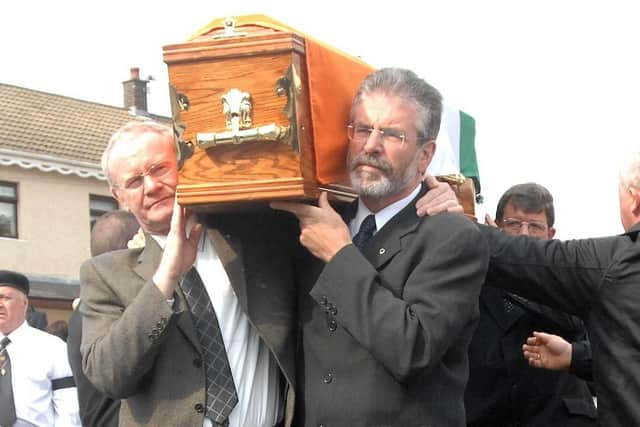

A jury at the High Court in Dublin found in his favour yesterday, with Mr Adams’ legal team said the verdict of the jury was a “full vindication” for their client.
The former republican leader could also stand to benefit from compensation from the UK state after the government repealed parts of the Conservative Party’s Legacy Act which would have blocked compensation. Speaking after his victory, Mr Adams said the “British prime minister is refusing to pay” internees – but the DUP leader says the two issues are not linked.
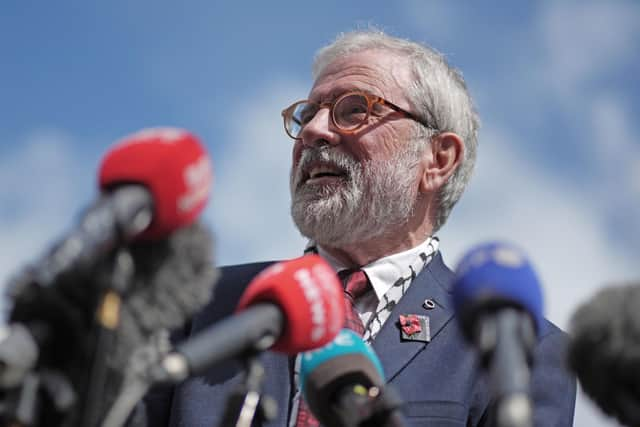
Gavin Robinson said: “A claim for compensation by Gerry Adams or other internees has been a separate issue stemming from repeal of the Legacy Act.
“To compensate Gerry Adams in this respect would be outrageous, but for it to be secured because of an administration error is unconscionable.
“The government, having said they are looking at ‘every conceivable way’ to prevent damages being paid, must step forward and demonstrate that is the case.”
TUV leader Jim Allister says the government “rolled over” on the issue.
“Though it has promised remedial action, nothing has yet materialised,” he said. The government initially promised action in January, but has not updated its position since then. A spokesperson for the prime minister said that “operationally the UK government’s position remains the same” as that set out by the prime minister in January – and they “are working on a remedial order”.
During Prime Minister’s Questions on January 15, Sir Keir Starmer said that the 2023 Legacy Act “was unfit, not least because it gave immunity to hundreds of terrorists and was not supported by victims in Northern Ireland—nor, I believe, by any of the political parties in Northern Ireland. The court found it unlawful”.
The prime minister told MPs the government “will put in place a better framework”. He said: “We are working on a draft remedial order and replacement legislation, and we will look at every conceivable way to prevent these types of cases from claiming damages”.
He had been responding to criticism from the opposition leader Kemi Badenoch, who said that Sir Keir’s government “may write a cheque to compensate Gerry Adams”, calling the situation “shameful”.
However, when pushed on the issue in January, Downing Street could not guarantee that compensation payouts would be prevented.
“Clearly the government’s intention is to prevent compensation from being paid. We are going to look at every option but I can’t get ahead of that process,” the prime minister’s official spokesman said when asked about a guarantee.
Asked if there are real options to block payments, he said the PM wouldn’t make the commitment in Parliament if he didn’t think he could address this issue.
A spokesperson for the prime minister said that “operationally the UK government’s position remains the same” and that they are “working on a remedial order”. The previous Tory government had legislated to block compensation payments to Adams and others interned in the 1970s. Labour then repealed parts of the law after a court ruling, paving the way for compensation claims for those deemed by the Supreme Court to have been illegally held without trial, such as Mr Adams.
The News Letter has been reporting on the possibility of Gerry Adams getting compensation since the 2020 Supreme Court ruling that he had been unlawfully detained sparked outrage in government and political and legal circles.
We ran an essay by Lord Howell, a minister of state in the Northern Ireland Office when Gerry Adams was interned in 1973, who explained his amazement that the court had found that the interim custody order (ICO) made in relation to Mr Adams had not been lawfully made because it had not been done by the then secretary of state, Willie Whitelaw.
The Rt Hon The Lord Howell of Guildford, formerly David Howell, said that the judgment recorded that the ICO was signed by a minister of state – but does not say which minister of state. He said that he did not know if it had been his signature on the ICO but that he did know how the Detention of Terrorists (Northern Ireland) Order 1972, that came into force in November of that year should have been interpreted. But he added: “The fundamental failure of the Supreme Court’s judgment is its total misunderstanding of the nature of ministerial and departmental government and methods of operating.
“A junior minister on duty at Stormont is in effect the persona of Her Majesty’s government and is thereby empowered to act for and as the secretary of state in the latter’s absence. And the secretary of state was often unavoidably absent.
“In relation to Northern Ireland, it was inherent in the nature of direct rule that the secretary of state had to be frequently in London – in Parliament or the cabinet – and that his responsibilities would often have to be exercised by a junior minister on the ground.”
He added: “The Supreme Court’s assertion that it would not have been difficult for the secretary of state to consider each case personally and to make each ICO himself simply does not match the reality.
“As it happens, almost all signing of ICOs, where the actual signing of the document took place in Stormont Castle, was discussed directly with other ministers and usually with the secretary of state by telephone or message, if he had to be in London or his constituency home in Penrith.”
Lord Howell further said: “In any case, in relation to Gerry Adams one can be absolutely sure that it would have been discussed most fully and confirmed by the secretary of state before the ICO was made. The political salience and security implications of detaining Mr Adams would have made this unavoidable.”
He said: “It is quite startling to see the Supreme Court reasoning that the prosecution had failed in Gerry Adams’s case to prove that the secretary of state had personally authorised his detention.
“The shape of the 1972 Order makes very clear that an ICO signed by a minister of state or under secretary of state is the same as an ICO signed by the secretary of state himself and authorises detention.
“It would have been utterly unworkable for the Royal Ulster Constabulary to have refused to detain suspected terrorists unless and until proof had been provided that an ICO signed by the minister had also been personally considered by the secretary of state.”