
Terror offences not among those being increased by Naomi Long's new bill - leading to questions from the DUP
Sentences for terrorist offences are not among those being stiffened by a new bill from the justice minister, prompting questions from a DUP MLA.
The Department of Justice said that terror sentences are a matter for Westminster, but Paul Frew said he wants to know the “legal basis for their position”.
This week the department, headed by Alliance leader Naomi Long, revealed details of its forthcoming Criminal Justice (Sentencing etc) Bill.
It will raise the penalties for attacking members of the emergency services, and for causing death or serious injury by driving whilst under the influence of drink or drugs.

The News Letter has previously reported on the lenient sentences handed out to people convicted under terror legislation in Northern Ireland.
Asked if terror sentences will be addressed in the bill, the department responded: “The Criminal Justice (Sentencing etc) Bill includes provisions to make a number of changes to sentencing policy, including increasing the maximum sentences available for some offences.
"The Criminal Justice (Sentencing etc) Bill does not include any provisions relating to sentences for terror offences.
"Provisions for dealing with terrorism are and always have been an excepted matter, for which the UK Parliament retains exclusive authority.”
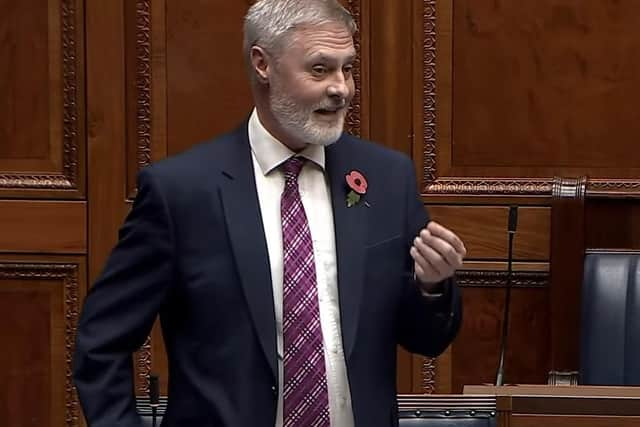
Paul Frew, a member of the justice committee at Stormont, said: “The department’s explanation raises a number of important questions which need to be properly clarified.
"While terrorism legislation itself is largely a matter for Westminster, with the offences and maximum tariffs specified, the broader sentencing framework in Northern Ireland is devolved in terms of guidance.
"Given that the purpose of this bill is to strengthen sentencing, it is entirely reasonable to ask why terrorism offences would not be captured within those provisions.
"Given Northern Ireland’s history and the ongoing threat from terrorism, the public will expect the strongest possible sentencing framework to apply.
"I will be exploring this issue with the department to understand the legal basis for their position and to ensure there are no gaps which could result in weaker sentencing arrangements here than elsewhere in the UK.”
The explanatory notes attached to a different recent bill, the Terrorist Offenders (Restriction of Early Release) Bill of 2020, had stated: “Counter-terrorism is a reserved matter, although prisons and sentencing (including release provisions) are devolved to Scotland and Northern Ireland.”
Last year, a man from Lurgan was given a five year and three month-long jail term for trying to obtain gun parts, while another man was given an 18-month jail term for planting bombs at a GAA club in east Belfast.
In 2020, the News Letter highlighted the case of seven CIRA men who had pleaded guilty to membership of a proscribed organisation, providing weapons and explosives training, conspiring to possess explosives, firearms, and ammunition with intent to endanger life, and preparing acts of terrorism.
They were all sentenced to between three-and-a-half and five years in jail.
UUP MLA Doug Beattie said at the time: “Where the rest of these islands take this seriously, Northern Ireland seems to give a bye-ball to these terrorists and our sentencing does not match the crime.
"We must get real with these people and sentencing must act as a deterrent.”
In 2017, two men from Co Meath who planted a bomb at a hotel in Londonderry city which was due to host a PSNI recruitment event were jailed for five years each.
In 2016, a west Belfast man was handed a term of four-and-a-half years in jail after admitting possessing a PPS43 sub-machine gun and bullets with intent to endanger life.
That same year a north Belfast man walked free from court with a suspended sentence after admitting his role in a plot which saw a bomb planted on a public street in the Ardoyne, which was thought to have been aimed at police but which failed to detonate.