
The debate over Dublin’s Irish language policy raged for years
The Language Freedom Movement (LFM) was an Irish movement set up by those who were unhappy with the Dublin government's Irish language policy.
The debate raged on amid the backdrop of the 50th anniversary of the 1916 Rising, quickly becoming one of the most emotive issues of the decade.
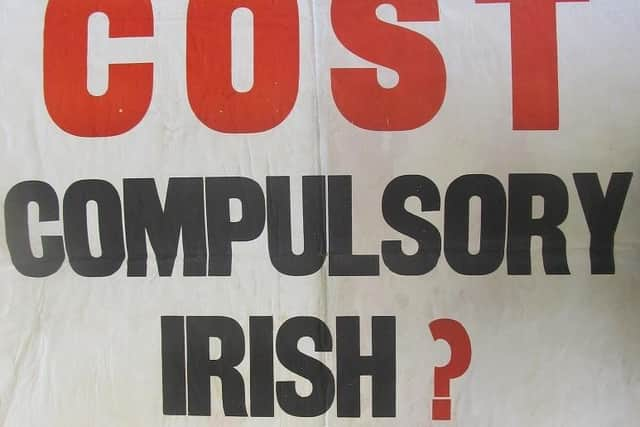

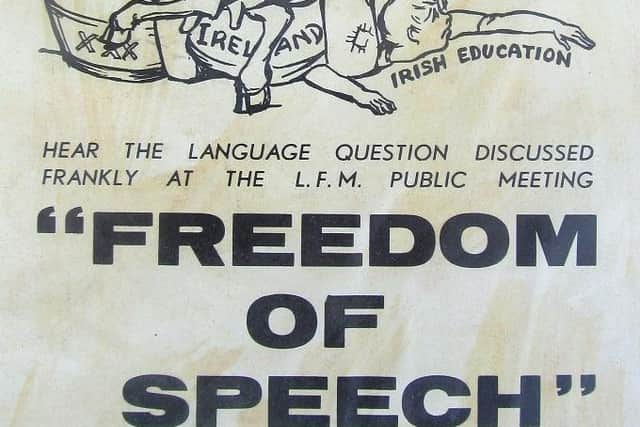
The organisation had the backing of several notable Irish-speaking writers including Séamus Ó Grianna (‘Máire’) and John B Keane. It was not ‘anti-Irish’ but rather called for the removal of it being mandatory to pass Irish to get your overall exam and halted as a requirement to join the civil service or police.
The Irish Free State (established in 1922) made the revival and promotion of the Irish language a central pillar of its national identity and state policy. The Irish language and Irish history were entrenched into the school curriculum.
In the 1920s during the construction of the then Irish Free State the Irish language was made compulsory in education, for jobs in the Civil Service and for joining the police. Irish was adopted as an official language of the state (albeit on par with English due to the Treaty).
In the 1930s if a pupil failed the Irish part of their Leaving Certificate they were deemed to have failed all of their Leaving Certificate.
Irish was forced on an English-speaking population, and Irish was used to differ itself from Britishness or ‘the English’.
As with the adoption of the Irish tricolor in 1922 (on the foundation of the new state) Irish was compulsory to the changes made to the state to ‘de-Britify’ it.
The first report of the Free State Department of Education stated that the central educational aim was ‘the strengthening of the national fibre by giving the language, music, history and tradition of Ireland their natural place in the life of Irish schools’.
Policy makers intended history to reflect a romantic but unhistorical ideal of Ireland’s Gaelic past held by many Irish revolutionaries including Patrick Pearse, the leader of the 1916 Easter Rebellion.
Echoing Canon Law and the emphasis of the role of the Roman Catholic Church in the new state, the Central Association of Catholic Clerical School Managers had asserted in 1921 that: ‘The only satisfactory system for Catholics is one wherein Catholic children are taught in Catholic schools by Catholic teachers under Catholic control.
‘In the period after independence when the revolution was consolidated, nationalists conducted the politics of national self-assertion and fostered nationalist ideology and culture.’
The Catholic Bulletin in 1924, declared that: ‘The Irish nation is a Gaelic nation; its language and literature is the Gaelic Language; its history is the history of the Gael. All other elements have no part …’.
Historian Roy Foster (in his book ‘Modern Ireland 1600-1972’) was highly critical of the cultural revival movement taking place in education, stating: ‘The emotions focused by cultural revivalism around the turn of the century were fundamentally sectarian and even racialist.’ For many unionists, nationalism and the cultural revival were inextricably linked with Catholicism.
Some other European states were also adopting extreme approaches to asserting their nationalism at the time in the aftermath of the First World War.
Article eight of the Irish Constitution of 1937 made Irish the first and official language of Eire. In the 1961 general election Fine Gael in their campaign called for an end to the policy of compulsory Irish in State Examinations.
However, in 1965 a Fianna Fail government introduced a government White Paper entitled 'The Restoration of the Irish Language', which reiterated that government policy was to ‘restore the Irish language as a general medium of communication’.
By the mid-60s, the question of compulsory Irish had become one of the most emotive issues of the decade, fuelled by arguments conducted in the press, at public meetings, and on television.
The LFM wanted to see Irish dropped as a compulsory language taught in schools and halted as a requirement to join the civil service. They were not opposed to the Irish language, believing that it had its place and that no one should be prevented from learning or speaking it despite it being a dying language. Between 1922 and 1939 Gaelic speakers halved in Irish speaking areas (Gaeltachts).
At a meeting hosted by the LFM in the Mansion House (the meeting place of the first Dáil) on September 21 1966 around 2,000 people (mostly protestors) turned out, and a row broke out between members of the LFM and protestors supporting the Irish language policy. A large tricolour was removed by a protestor from the stage.
An eyewitness commented: “About 2,000 people turned up and jammed into every available space in the room. It was clear that the overwhelming majority of them were unfriendly to the organisers of the meeting. There was enough shouting, jeering, heckling, booing and chanting to drown out the chairman's opening remarks.
“Union Jacks were waved derisively at the platform. On the platform itself was an Irish tricolour which a member of the audience made haste to seize at the outset, shouting that the national flag should not be displayed at a meeting of this kind. As he was hustled away, a shower of papers was flung at the stage, and a stink bomb was let off. Immediately after this, a fight broke out, involving about 10 men. It was evident there was going to be serious trouble unless something was done to lower the temperature.”
The impasse ended when the LFM allowed four protestors to form part of the panel.
Elsewhere in the Republic of Ireland, parents grew worried as to the standard of education their children were receiving, as the Irish language and history took priority over other subjects. Some approached the Language Freedom Movement for advice in how to re-examine the issue.
Referendums were run in schools in Ahascragh, Waterford, and other locations which asked parents if they wished for the medium of instruction to be changed from Irish to English. The Gaelic League ran their own referendums in these areas, and disputes over results became just one factor of the strong argument which played out between both sides.
The LFM remained active through various by-elections and public campaigns before concluding its activities around 1974, shortly after the National Coalition government ended the mandatory pass mark for Irish as a condition for earning the Leaving Certificate in 1973.