
The Troubles to become a required part of the curriculum for all Northern Irish schools
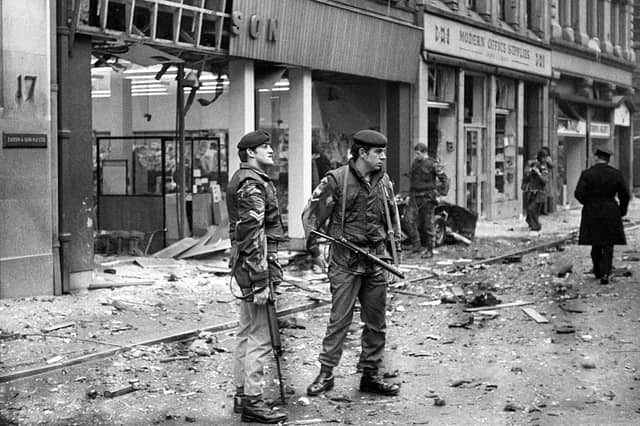

The history of the Troubles is to be put on the Northern Irish school curriculum officially for the first time, the Department of Education has said.
It has prompted Jon Burrows to urge vigilance against “revisionism”, while the TUV has said that paramilitary victims must be put at the centre of the content.
Some schools already cover the Troubles in their teaching, but this move will make it a requirement.
The department said that the new Northern Ireland Curriculum 2028 – which is out for consultation until September 30 – will have a “substantially stronger” focus on the history of the Province’s development than present.
Right now there is a requirement for “a general, high-level reference to the partition of Ireland and how it has influenced Northern Ireland today” at Key Stage 3 level.
But “beyond this there is no legally-mandated content on the history of Northern Ireland” (though it did also add that “the history of Northern Ireland 1968-1998 is also a significant element of the current CCEA GCSE history course and is regularly taught”).
The new curriculum will instead require Key Stage 3 pupils to study “the origins and course of the Troubles, peace processes, and legacies of conflict in Northern Ireland”.
Alongside this, teachers must also cover:
“The creation of Northern Ireland and the Irish Free State;
"Changes and contrasts in the economies, social lives, cultures and identities of Northern Ireland and the Irish Free State until 1945;
"Economic and social challenges, efforts at modernisation, and the expanding role of the state in Northern Ireland after 1945; and
"Ordinary lives in Northern Ireland after 1945.”
A “draft framework” document for the new history curriculum gives a little more detail.
It states that pupils should learn about “how political violence and security measures affected everyday routines, travel and community relations,” for example.
They should also learn about “the search for safety and security and the role of family and neighbourhoods in sustaining daily life,” and about “efforts to create non-sectarian spaces such as the Peace People and the emergence of non-sectarian recreations such as punk”.
The department told the News Letter this will apply to all publicly-funded schools – including Catholic, controlled, and integrated – except for special schools.
Mr Burrows said: “Reform is necessary, but it must be undertaken carefully and correctly.”
He continued: “Pupils should understand the political developments of that period, including the Belfast Agreement and the St Andrews Agreement, as well as the terrible human cost experienced across Northern Ireland.
"However, this history must be taught accurately, sensitively and without revisionism.
"Terrorist organisations from both republican and loyalist backgrounds inflicted death and destruction on our citizens.
"Those actions were unjustified and wrong.
"No curriculum should sanitise terrorism, diminish the suffering of victims or allow contested political narratives to be presented as established fact.”
TUV press officer Sammy Morrison said “it is vital that the voice of victims and the savagery of the terrorist campaign is spelt out”.
In his day, “there was little attention within the curriculum on what the terrorists actually did and the impact they had on communities and individuals”.
“It was possible, for example, to complete the course without realising for example that the IRA largely targeted UDR men when they were off duty,” he said.
"If we are to reform the curriculum, the fact that the terrorists went and shot the postman, the milkman, or the farmer as they went about their day to day jobs it would remove much of the glamour around terrorism which particularly impacts the nationalist community.”