
Unionist politicians slam Dublin's record on the Troubles as deal with UK on legacy draws near
Politicians from the three main unionist parties have all denounced the Dublin government's record on the Troubles as a plan on how to deal with the legacy of the conflict draws nearer.
They made the comments after a meeting between the Irish taoiseach and UK prime minister, in which it was re-emphasised that a deal between the two governments on dealing with the past is close to completion.
The DUP leader Gavin Robinson MP said that "for too long, our government have acquiesced to the outrageous demands of the Irish government whilst never reeling against their interstate case or their lamentable failure to open their archives for the Omagh families".
UUP MLA Doug Beattie meanwhile said that an unwillingness by Dublin to address the Republic's own role in the Troubles has "left many victims’ families struggling to find out how the truth about the murder of their loved one", with the taoiseach "vague and evasive" about what he plans to do about it.

TUV leader Jim Allister MP said the UK government is showing "craven complicity with Dublin" in designing Troubles legacy mechanisms, despite a lack of action on the part of the Irish state over republican crimes in its own territory, and that the more it "boasts" of its talks with the UK government on the issue, "the more it alienates" IRA victims.
Talks have been going on for months regarding some kind of London-Dublin agreement on Troubles issues.
A week ago, Irish deputy leader (tanaiste) Simon Harris had said "we’re effectively there in relation to a deal on legacy", adding that it will involve "commitments from my government in relation to our obligations in our jurisdiction".
Unionists had voiced concern that any deal will allow the Irish government to appoint someone to the panel overseeing the UK's Independent Commission for Reconciliation and Information Recovery (ICRIR), the body which is meant to unravel many of the unsolved cases of the Troubles.
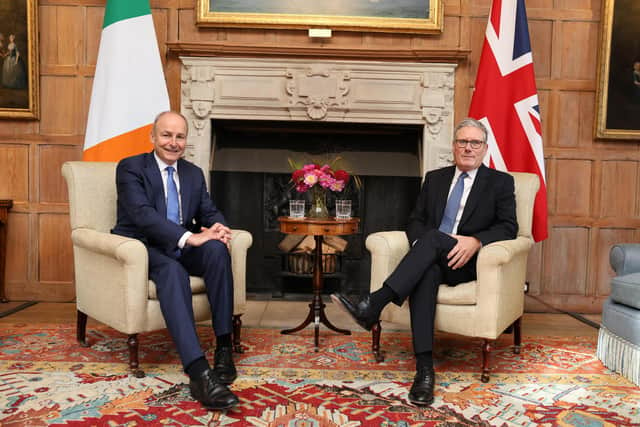
Now today the taoiseach Micheal Martin has met with Sir Kier Starmer at the UK government retreat of Chequers in Buckinghamshire.
Speaking to the press there, Mr Martin said the two governments “are at one” on the way forward – but would not give details or a timeframe for when a deal will be done, except to say it is "very close".
The meeting, he said, had been “very warm and constructive”.
DUP leader Gavin Robinson said: "For months now, our government and the Irish have trailed that an agreement on legacy is coming. Just round the corner, just one more turn, yet victims are left in abeyance.
"This process has been castigated by families who believe they may have been listened to, but are rarely heard.
"Many regret that for too long, our government have acquiesced to the outrageous demands of the Irish government, whilst never reeling against their interstate case [against the UK over the Legacy Act], or their lamentable failure to open their archives for the Omagh families.
"It would appear that such failure continues.
"It needs to end in a way that honours our victims and their families, asserts our sovereignty, and protects our veterans."
Mr Allister said: “Considering the 'constructive' relationship had with the IRA in facilitating its murder campaign in Northern Ireland through hosting training grounds, safe houses, sanctuary and refusal of extradition, the more Dublin boasts of its role in designing the legacy approach, the more it alienates from their proposals those who were made victims because of its assistance to the Provos.
"If the UK government had any guts and cared for innocent victims, it wouldn’t be in craven complicity with Dublin in shaping Legacy proposals to meet their demands, while the Republic itself does nothing to own up to the blood of soldiers and civilians on its hands.”
And Mr Beattie said: "Again, the Taoiseach has been vague and evasive on legacy, and the absence of any plan from the Irish government to address the legacy of our past and the part that Ireland played in it has left many victims’ families struggling to find out how the truth about the murder of their loved one.
"Few will take the taoiseach or the Irish government seriously until they start to show that they, along with the UK government, intend to put justice and victims at the heart of any legacy proposals.
"That means seeing more than a timid Memorandum of Understanding between the Irish and UK government - it means seeing robust legacy mechanisms both sides of the border."