
Unionists round on Irish state for failure to co-operate with ICRIR after bosses reveal their enquiries go unanswered

Unionists have savaged the Irish government’s Troubles approach after it was revealed that letters from the Independent Commission for Reconciliation and Information Recovery (ICRIR) are going unanswered.
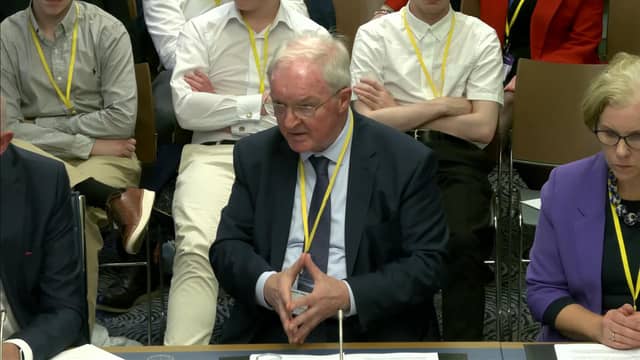
It comes after the leadership team of ICRIR, including chief commissioner Sir Declan Morgan, appeared at Stormont’s Executive Committee to answer questions about its work and revealed the lack of co-operation from the Republic’s authorities.
Sir Declan said there were cases that had not come to the ICRIR because they were aware that the Irish state “hasn’t yet committed to providing the information”, adding: “The present position is that Ireland is not providing us with information in relation to investigations.”
He also said that new legislation aimed at encouraging cross-border co-operation will not be laid in the Dail until the Troubles Bill is passed into law – something which was made less likely by last week’s resignation of armed forces minister Al Carns, who publicly criticised it and cited it as a reason for leaving.
Meanwhile commissioner for investigations Peter Sheridan, a former assistant chief constable of the PSNI, also told the meeting that “victims’ families will know I’ve made requests for information [to RoI authorities]; I’ve had no response to any of them yet”, adding that this these letters were in low “double figures”, perhaps around “11 or 12”.
He believes there is “no reluctance” from the gardai themselves though, but rather “it’s a political issue – the politics of it has to be resolved to enable the guards to release the information, but there’s no response to any of my letters to date”.
Independent MLA Doug Beattie has now said: “The Irish government is simply not serious about legacy, and the UK government appears too weak to hold it to account...
“Even when the Labour government brings forward new legacy proposals, the reality will remain unchanged: the Irish government will take no proactive steps to investigate Troubles-related incidents.
"The proposed Garda Legacy Unit, to be established as part of the agreed legacy framework between the UK and Irish governments, will not carry out investigations.
"Instead, it will merely pass information to the Legacy Commission – the new name for the ICRIR – under the UK government’s plans.
"However, this process is fundamentally flawed.
"The information provided will be subject to prior redaction, meaning the Legacy Commission will not have access to all relevant material; bodies such as the Irish Directorate of Military Intelligence will be able to withhold or redact information at their discretion, limiting the effectiveness of any investigation.”
He also said that even with the passage of Ireland’s International Co-operation (Omagh Bombing Inquiry) Act 2026, witnesses cannot be compelled to attend and give evidence.
"It is time for the UK government to prioritise its own citizens and show greater resolve in confronting the Irish Government’s intransigence,” he said.
"Strong relations and mutual trust with our nearest neighbour are important and welcome, but when that trust is abused, it is right to reconsider the approach.”
DUP committee member Deborah Erskine said the meeting had been a “stark” illustration of the “shameful failure of the Irish government to co-operate”.
"The Irish government has continually sought to lecture the United Kingdom on legacy issues whilst doing nothing to help victims and survivors find the truth about what happened to them,” she said.
"There is no impediment, legal or otherwise to the Irish government helping victims secure information about their loved ones murder.
"The only thing standing in the way is a cynical political judgement.
"The passage of the Troubles Bill is nothing other than a smokescreen and excuse for Irish inaction.
“Their position is indefensible and the lack of pressure placed upon them by our own government is shameful.”
UUP leader Jon Burrows MLA said the lack of response to ICRIR from Irish authorities is “disgraceful” but “not surprising”.
“Shamefully, the Irish state declined 97% of extradition requests for terrorist suspects made by the UK authorities during the Troubles,” he said.
"This policy of frustrating justice for victims is long established.
“The fact that Dublin will not legislate until after the UK does is equally unsurprising.
"It is simply pathetic that our government is led by the nose in this way.
"It is utter hypocrisy for the Irish to take an inter-state case against the UK on legacy - it should be the other way round.”
And TUV MLA Timothy Gaston, like Mrs Erskine a member of the committee, said: “What we now know, as a result of evidence given by the ICRIR to the Executive Office Committee yesterday, is that requests for assistance sent to An Garda Siochana in relation to Troubles-related investigations are simply being ignored.
“For Sir Peter Sheridan to reveal that correspondence relating to murders in Northern Ireland with a cross-border element is effectively receiving no response from the Garda authorities is an astonishing indictment of the Irish Government’s attitude towards victims.
“Dublin cannot continue to demand a seat at the table when dealing with the legacy of the Troubles while simultaneously refusing to assist investigations into terrorist crimes.
"Such an approach demonstrates a lack of commitment to truth, justice and accountability for the thousands of innocent people whose lives were devastated by terrorism.
“The Irish government has serious questions to answer about whether it is genuinely committed to helping victims obtain justice, or whether it remains more interested in protecting uncomfortable truths about its own role during the Troubles.”
The Irish government responded via its Department of Justice.
It said: “The agreement of the Joint Framework on Legacy by the Irish and UK governments in September 2025 marked a welcome return to a partnership approach to Northern Ireland matters.”
This framework involved putting in place measures “to facilitate the fullest possible cooperation with the reformed Legacy Commission ‘once established’ – Irish authorities cannot cooperate with an un-reformed ICRIR established under the current unamended Legacy Act”.
Legislative proposals were published in Dublin last week to facilitate this, it added, and minister Jim O’Callaghan “has stated his intention to act quickly and introduce the bill to the Houses of the Oireachtas as soon as the UK Bill is enacted”.
Meanwhile the Northern Ireland Office said: “There is no doubt that sharing of information by the Irish authorities will be hugely important for legacy investigations.
"The Joint Framework includes unprecedented information sharing commitments by the Irish government, and the government was pleased to see the recent publication of Irish Government legislation that will facilitate this.
"At present ICRIR does not have information sharing arrangements with the Irish authorities, and we are aware that this is causing delay in progressing a number of investigations by the Commission.
"In light of the Dillon judgment, which found the ICRIR capable of conducting effective and human rights compliant investigations, we would encourage consideration of interim arrangements to allow the Gardai to share information with the ICRIR, and to allow those cases to progress on behalf of victims and survivors.
"This, of course, is a matter for the Irish Government."
Among the cases in the ICRIR’s portfolio are:
The Narrow Water bus attack of 1979, when the IRA killed 18 paratroopers outside Warrenpoint;
The coach bombing on the M62 motorway in Yorkshire in 1974, when the IRA killed nine soldiers and three civilians;
The car bomb murder of ex-policeman James Sefton and his wife Ellen on the Ballygomartin Road in Belfast in 1990 by the IRA;
And the deaths of Eric Guiney and his son Desmond who were attacked by a republican mob while travelling in their milk lorry on the Antrim Road in north Belfast in 1981.