
UUP leader Jon Burrows asks why Dublin failed to stop explosives from factory providing bulk of IRA bombs over 20 years

The government has been asked to probe claims that the Irish state failed to stop explosives from a single southern factory from making up most of the IRA's explosives for 20 years - despite persistent concerns being raised.
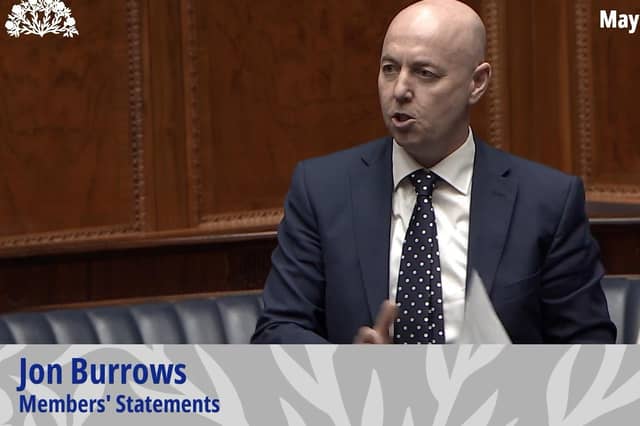
Speaking in the assembly chamber, UUP leader Jon Burrows asked why there are so many investigations into claims of UK collusion, yet none into claims that the Irish state took no action when concerns were repeatedly raised about explosives from a Co Meath factory fuelling the IRA bombing campaign.
Mr Burrows said that archives and Hansard records show “a very substantial proportion” of high explosives recovered from the IRA originated from “a single source” – a Co Meath factory.
And he asked why the Irish government has never instigated any inquiry, since links to a single factory were repeatedly raised in the Oireachtas.
“For more than two decades, over 10,000 explosive devices were deployed across Northern Ireland and Great Britain, mainly by the Provisional IRA,” he said, during Members Statements on Tuesday.
“This bombing campaign destroyed infrastructure, cost billions and destroyed lives.”
However he said, nobody has ever asked who armed the IRA bombing campaign before Libya supplied it with Semtex high explosives in the 1980s.
Mr Burrows added: “Evidence presented over many years before Westminster and the Oireachtas pointed to a loss, theft or diversion of commercial grade explosives from a factory in the Irish Republic. These concerns were not isolated. They were repeatedly made, but no action was taken about the loss of explosive material from that factory.”
A former colleague of his spent years researching archives from the 70s and 80s, he said.
“And it shows that a very substantial proportion of high explosives recovered by the security forces from either undetonated devices or from searches that was in the hands of the IRA originated from a single source. And that source was the Irish Industrial Explosives Facility in Enfield, Co Meath.
“Now, the security forces in Northern Ireland have been accused of collusion, simply for missing a piece of intelligence or not having the opportunity to interview one witness.
“Yet, tonnes of commercial explosions over many years ends up in the murderous hands of the IRA from a factory in the Republic of Ireland, an issue that was raised multiple times and little or no action was taken. Why is that?
“The scale of the leaks of explosives are vast. In 1973, 1974 and 1982 if you review Hansard, it is clear that all gelignite recovered by the security forces emanated from this factory in the Republic of Ireland. This is a matter of profound public importance. It goes to how the IRA bombing campaign was sustained.”
Dublin hasn't instigated any inquiry into these bombs that have originated from the Irish Republic, he said.
“I now ask that the government take steps to find out why explosives came from Irish Industrial Explosives without checks.”
The Irish government and a successor of Irish Industrial Explosives were invited to comment.