
Unmarried mother in supreme court challenge over widowed parent's allowance
A lawyer has questioned whether an unmarried mother at the centre of a legal battle to access widowed parent's allowance is being made an example of.
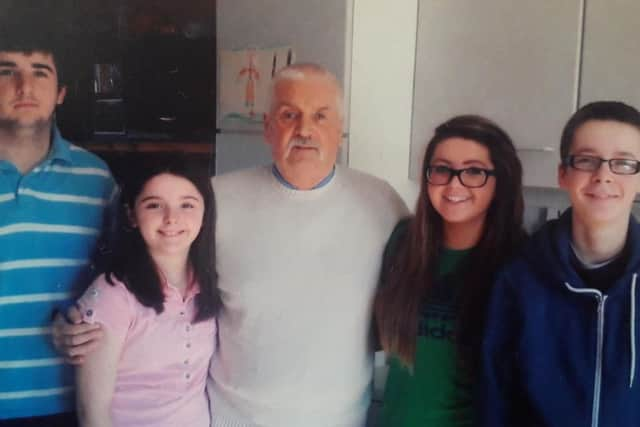
Special needs classroom assistant Siobhan McLaughlin, 46, from Armoy in Co Antrim, was with her partner John Adams, a groundsman, for 23 years.
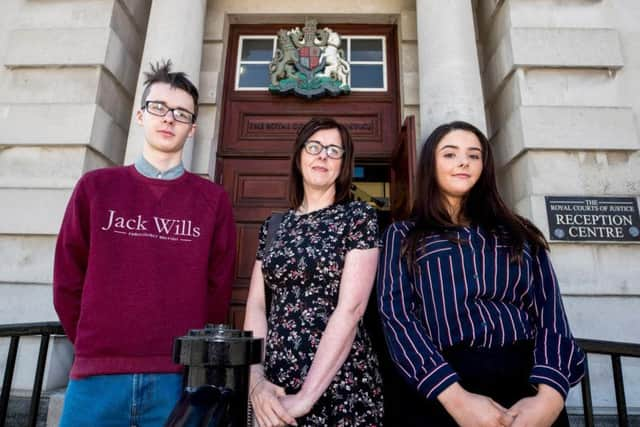

The couple had four children - Rebecca, 15, Billy, 16, Lisa, 21, and Stuart, 23.
Following Mr Adams's death from cancer in January 2014, Ms McLaughlin was refused widowed parent's allowance because they were not married or in a civil partnership.
She applied for a judicial review of the decision, claiming unlawful discrimination based on her marital status and won her original court case, later overturned by the Court of Appeal.
Ms McLaughlin has now applied to the Supreme Court, sitting in Northern Ireland for the first time, for judicial review and hopes her legal challenge will help other families.
Her lawyer, Frank O'Donoghue QC, asked the court: "Is there a defensive aspect to this legislation, holding up Ms McLaughlin as an example to what might happen to you if you don't get married?"
Mr O'Donoghue said Ms McLaughlin should be treated in the same way as a married couple with children after the death of the main earner.
"The court should require the state, as we prepare to enter the third decade of the 21st century, to justify this obvious difference in treatment, beyond the rather simplistic and rigid explanation that one widow was married and the other was not," he said.
"A more inclusive measure could have and should have been used. As a bare minimum, entitlement to widowed parent's allowance on the part of cohabiting unmarried parents and children is required."
Mr O'Donoghue said the benefit is not for the married couple but for the survivor and children and claimed there is no evidence proving current restrictions promote marriage.
He argued changing the regulations would not create a significant additional administrative social security burden.
The court also heard from Helen Mountfield QC on behalf of the Child Poverty Action Group, who argued the ruling is incompatible with international law and "penalises" children whose parents are not married, treating them as "less worthy".
Earlier, Ms McLaughlin said: "It is wrong that a child born out of wedlock is not seen as deserving as one born to a married couple."
She had to supplement her income by taking on additional evening cleaning work after her partner's death and said thinking about the difference the benefit would have made is "heartbreaking".
Ms McLaughlin said: "It might have meant that I could have been at home every night to prepare the supper, as I had been when John was here.
"But because I had to go back to work, I am no longer there - so not only did they (the children) lose their dad, they also lost me and that stability."
She added: "It was a family unit. The children have John's surname, his name is on their birth certificates."
The case, at the Royal Courts of Justice, continues.