
Driest July in at least 190 years for Northern Irish weather observatory with just 5% of expected rainfall
Armagh Observatory saw just 5% of the typical July rainfall, making it the driest July in its 190-year-old record books.
Its newly-released monthly figures show too that it was much warmer than average – in fact, it was the sixth-warmest on record.
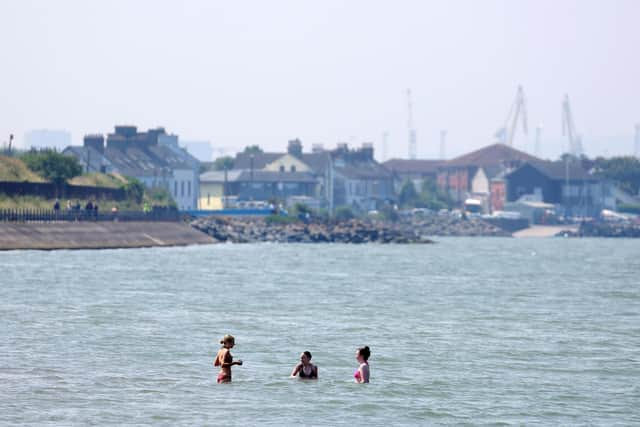

The observatory’s daily rainfall measurements began in 1836, and it began measuring temperature in the 1790s.
It comes after the Met Office released data earlier in the week covering the entire province and showing that it had been the eighth-driest July on record for Northern Ireland.
The Met Office numbers showed that the province had an average of 26.9mm of rain, the equivalent of 30% of the average for the month.
The Armagh figures now show that “total precipitation was an exceptionally low 3.4mm” at the station, said the observatory’s professor Mark Bailey.
This included six trace values, which, if ignored, would mean the total was an even paltrier 3.1mm.
This 3.4mm “was just 4.6% of the 1838-2020 long-term average July precipitation at Armagh (73.4mm) and 4.9% of the slightly lower most recent (1991-2020) 30-year July average (69mm),” added the professor.
On the wettest day of the month, the 31st, just 1.4mm of of rain fell at the station (one of five days when there was any at all).
July 2026 at Armagh saw an average temperature of 17.65C – about 2.78 C warmer than the 1796-2020 average of 14.87C, and 1.93C warmer than the most recent 30-year July average of 15.72C.
The Met Office had earlier showed that Northern Ireland had its joint fourth-warmest July for average temperatures: 16.4C.
The average daily high for the month at Armagh was 22.43C, which was 2.77C warmer than the 30-year average.
Figures from the Republic of Ireland’s official weather service, Met Eireann, yesterday showed that last month was the driest July and the third hottest month ever documented in the Republic.
The second hottest July since 1900 and one of the sunniest months on record saw a hosepipe ban issued in certain counties, a breakout of wildfires in Dublin and Kerry and thunderstorm warnings.
The national mean temperature last month was 17.25C, Met Eireann said, the second hottest July on record after a temperature of 17.34C recorded in July 2013.
It was also the third hottest month overall, with the hottest month recorded in August 1995 with a temperature of 17.75C.
Five of the 10 warmest Julys in the Republic have occurred since 2001.
Last month was also the driest July on record, where 16mm of rain was recorded, or 17% of the long-term average for the period between 1991 to 2020.
Meanwhile yesterday, BBC presenter Chris Packham suggested that disbelieving climate change could be a criminal offence.
He said: “We’ve got to address the mis- and dis-information...
“We’ve got to sort out the media.
“I’ve been fantasising this year that we could perhaps criminalise climate denial – we should certainly criminalise irresponsible journalism.”