
385th anniversary of the start of the Irish Rebellion of 1641
On the 23rd of October, 1641 the Irish Rebellion would commence. It was a Roman Catholic-led uprising in Ireland that attempted to seize power at Dublin and also regain control of lands in Ulster. It was led by Sir Phelim Roe O'Neill of Kinard, County Tyrone, an Irish politician and soldier born December, 1604. This rebellion quickly descended into a widespread sectarian conflict of murder being perpetrated on those of Reformed faith. The target being the people that had arrived in Ulster from 1609 as part of the great migration or plantation from England and Scotland.
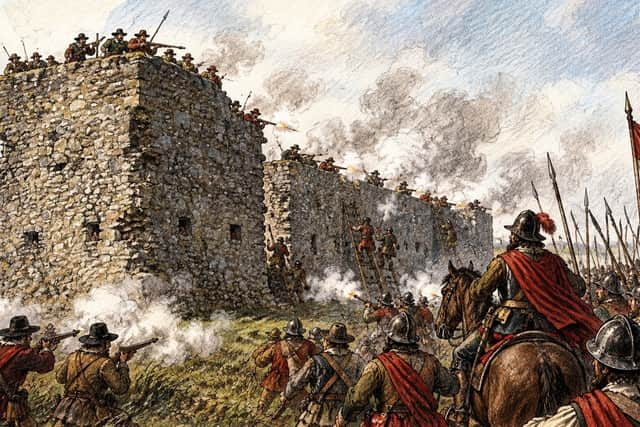

One of the most important early battles was at Castlederg in County Tyrone. The castle from which the town gets its name beside the Derg River was built by Sir John Davies (1569 – 1626) an English poet and politician that became the Attorney-General of Ireland and a chief architect of the Plantation of Ulster. He formulated many of the legal principles that underpinned the British Empire as part of English Common Law. He also built a castle at Kirlish and linked them by a straight causeway 7 miles long across bogs and hills.
Castlederg castle would provide a vital refuge in the early days of the rebellion as a place of great consequence and strength for the scattered colonists of the Tyrone area. On hearing news of the start of movements of forces under Sir Phelim O’Neill the Protestant people had gathered in the castle and a siege began. The refusal of those within that stone fortress to surrender, despite constant attacks, and little food demonstrated an unwavering resistance.
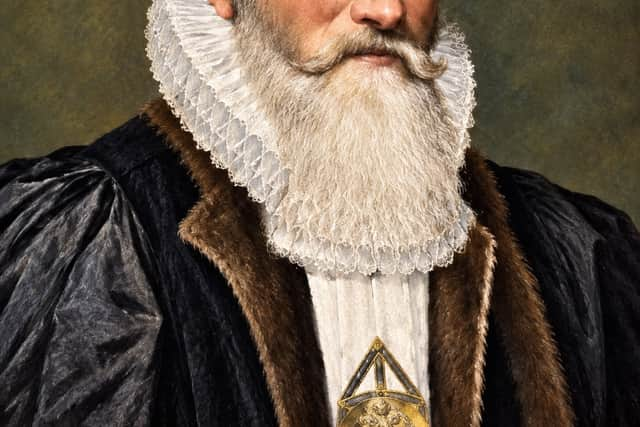
Sir Phelim O’Neill, being unable to take the fortress at Castlederg and with heavy losses of men, horses and weapons was enraged to such an extent that he issued orders to put to the sword every man woman and child of reformed faith in the district. He also ordered all cattle rounded up and killed, to deprive the colonists of food in an attempt to starve them out. The other castle built by Sir John Davies at Kirlish, would be taken and burned down, with the Rev. James Baxter and other colonists murdered in the area.
Eventually the castle at Castlederg would fall when the defenders ran out of ammunition and abandoned it under cover of darkness retreating towards the maiden city of Londonderry that was also under siege.
The unwillingness of Castlederg to surrender together with a few other locations would see the slaughter spreading out across Ulster like at the River Bann in November, 1641 were Protestant men, women and children were drowned and piked to death, the slaughter continuing over the next few years
The rebellion of 1641 was part of the Irish Confederate Wars. Quite simply it was an Ulster holocaust that resulted in around a third of the Protestant population being massacred for their religion, or dying from hunger or exposure to the cold until order was restored.
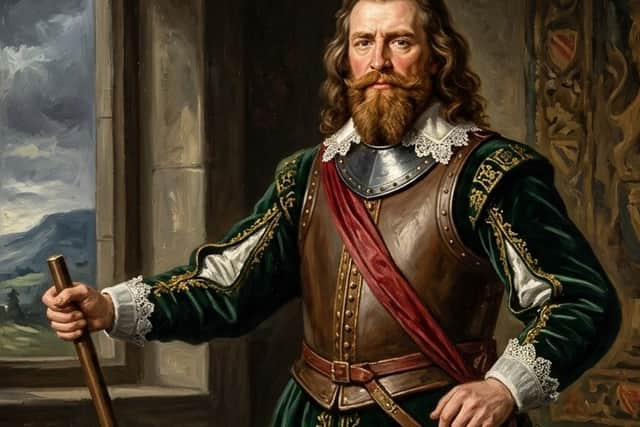
This was finally achieved in 1653 at the end of the Confederate Wars in Ireland by Oliver Cromwell (1599 – 1658), Lord Protector of England, Scotland, and Ireland. That same year Sir Phelim O’Neill leader of the rebellion and who fought through the Confederate Wars would be hung, drawn and quartered at Dublin on the 10th March.
Stevan Patterson, Castlederg, Co. Tyrone