
Plaque unveiled in honour of Francis William Crossley (1839 – 1897)
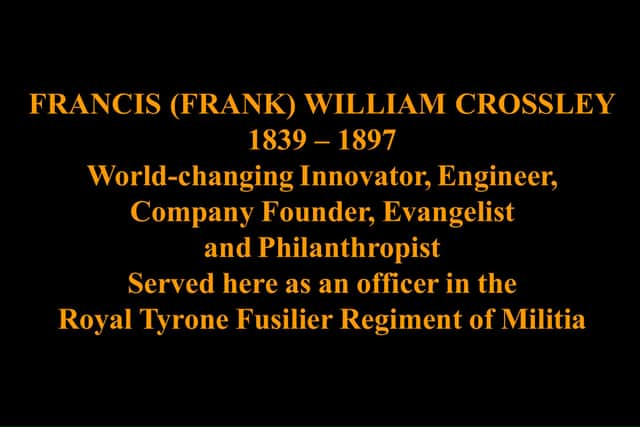
Following a parade and wreath laying service held at St. Lucia Barracks, Omagh, on Sunday 27th September. As a member of the St. Lucia Regeneration Committee that wants to see the historic but unused site still owned by the MOD preserved. I took the opportunity before those in attendance dispersed to unveil a plaque in memory of Francis William Crossley.
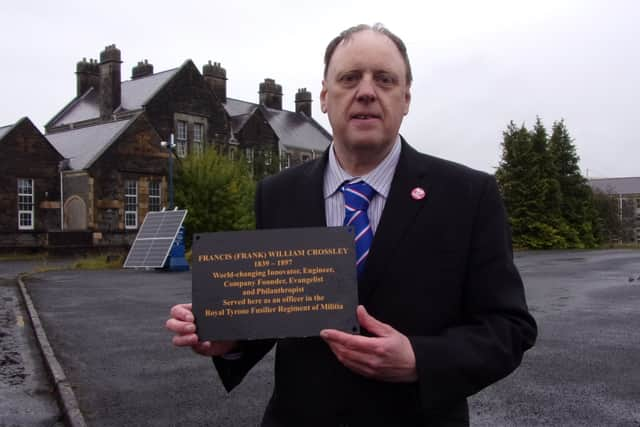

His world changing life story compellingly alone makes the case of why we must preserve St. Lucia Barracks. Simply put, he was the pioneering engineer and innovator who perfected the four-stroke compressed charge engine that would enable all modern transport, agriculture and industrial power. A technology that over the last 150 years played such a pivotal role in the modern world we know today. If you have a car, tractor or any other vehicle with an internal combustion engine, the technology it contains was perfected by him in 1876. The internal combustion engine enabled and shaped the second industrial revolution. Despite being an often forgotten innovator his pivotal role in the modern engine remains that important that he can with justification be considered equal to any of the great innovators to come from Ulster.
Francis William Crossley was the son of Major Francis Adam Crossley, Governor of the Andaman Islands and who served in the East India Company and Elizabeth Helen Crossley (née Irwin). He was born on the 29th November, 1839 at Glenburn, County Antrim.
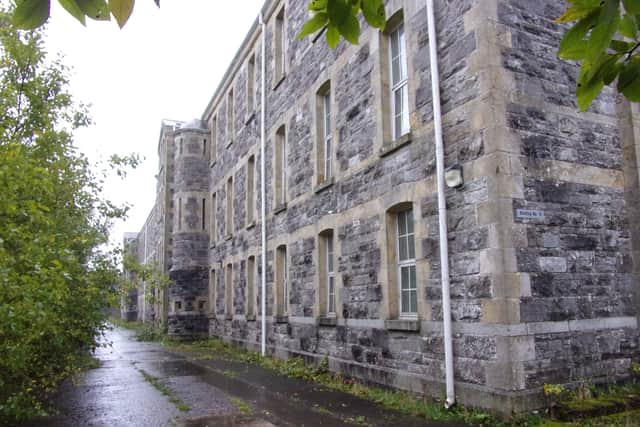
Always known as Frank, he was educated at several schools including at the Royal School Dungannon, County Tyrone. The first school in which he said he began to learn new things. After leaving the school at a crucial time in his life his true innovatory mind started to show as he served for several years as an officer in the Royal Tyrone Fusilier Regiment of Militia, based at the barracks in Omagh. A barracks that would later become St. Lucia Barracks in 1881. So buildings at St. Lucia like the magnificent Waterloo Block of 1835 would have been so well known to him and just perfect for a museum.
While serving in the army in Tyrone, it was apparent even then he was a genius of the highest order, inventing tools and machines that included designing and building model engines. His fellow officers on observing his gift as an innovator persuaded him with his intellectual ability to make a career in engineering.
After more study at Bonn in Germany and apprenticeships in England including at the works of Sir Robert Stephenson at Newcastle. Frank began working at the company of John M. Dunlop that manufactured India-rubber machinery at Great Marlborough Street, Manchester. He patented a machine for making rubber thread that was widely used around the world. With family help he would buy the company in 1866. His younger brother William Crossley (1844 – 1911) would join him in the company on the 8th August, 1867 co-founding the Crossley Brothers Company at Manchester. Moving first into steam engines and pumps then into internal combustion engines, Crossley Brothers would quickly become world famous for engines thanks to the intellectual ability of Frank.
Frank would provide the technical knowhow and William with his business skills, manage the Crossley Brothers Company. Together they made a formidable team that developed the production line and mass produced engines supplying them around the world. Frank had a philosophy to never let an inferior product leave the factory, it had to be world beating. Even Henry Ford would visit the Manchester factory to see the production line in operation, later introducing it to his vehicle manufacturing in the USA.
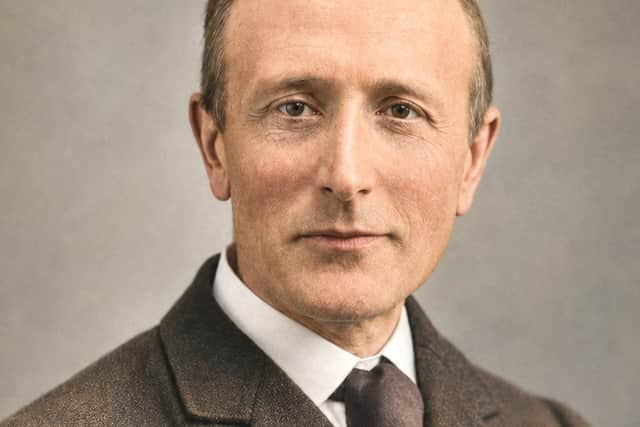
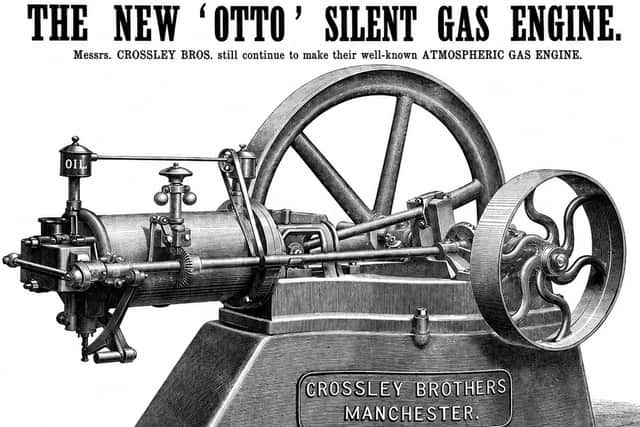
In 1876 German inventor Nikolaus August Otto (1832 – 1891) patented the four-stroke compressed charge internal combustion engine. Sometimes also called the “Otto Cycle”. This engine was much more efficient, quieter than older atmospheric internal combustion engines that Crossley Brothers had been building since 1869 using the patents of Nikolaus Otto and Eigen Langen (1833 – 1895).
While on a visit to Germany during May, 1876 after observing Otto’s experimental engine, Frank had the great vision to see what this new design of engine could become if it was perfected from laboratory ideas and concepts. Working closely with Otto, the brothers acquired the UK and worldwide rights with the exception of Germany to this revolutionary engine. Frank quickly perfecting it and building their first production Otto Crossley engines also in 1876 with notable very important improvements in design by Frank Crossley. The engine would be patented to Nicolaus Otto, of Deutz, Germany, Francis W. and William J. Crossley, of Manchester, England, UK on the 4th June, 1877 under British Patent number 2,777 and later under other worldwide patents. Most importantly to the U.S. Patent Office with the application for the patent no. 196473 issued to Nicolaus A. Otto, of Deutz, Germany, and Francis W. and William J. Crossley, of Manchester, England on the 23rd October, 1877. The patent model is of such world changing importance that it is held at the Smithsonian Institution, Washington, USA.
Within a few years the Crossley Brothers Company had built and sold tens of thousands of engines as Frank continued to advance the technology with many crucial improvements.
Both Frank and William were committed Christian’s only selling engines to those they found morally compatible. They improved working rights for employees and health care. Personally financing many community improvements as Philanthropists. Frank moving to the slums of Manchester to live and spend his vast wealth gained from his share in the building of engines on community projects to improve the lives of the poor. Frank was also a Gospel Preacher and Evangelist.
By the 25th of March, 1897 when Frank Crossley sadly died from a heart attack aged just 57 the internal combustion engine had been accepted around the world as the mobile power unit of choice. Allowing the first cars, tractors and general machines of transportation to be built thanks to him. Frank Crossley left a legacy of innovation and achievement that is so worthy of better recognition and celebration.
The Crossley Brothers Company, Manchester would from 1903 diversify into building cars. Crossley Motors was formed on the 11th April, 1906 to manufacture cars, lorries, buses and tractors, becoming a major world manufacturer of vehicles. Famously building Crossley Military Tenders that were so widely used including at St. Lucia in Omagh.
Nikolaus Otto is remembered as the father of the modern internal combustion engine. Whereas Frank Crossley who actually perfected the technology to make it work in the real world, successfully mass produced it making it globally accepted with his brother William have been largely side-lined and historically forgotten.
St. Lucia Barracks as a centre of Innovation and Achievement would be a worthy location to finally address this and give Frank Crossley’s legacy the recognition deserved as a world changing innovator.
With the history of St. Lucia Barracks, that is cross community we simply cannot be the generation to fail in securing the legacy of St. Lucia for future generations. We still have time and the MOD that owns the site should simply gift it to the nation. The magnificent buildings and site can be restored with possible uses including a veteran’s centre and public space for community events, shows and concerts. The vast site would also make a wonderful location to tell the history of the barracks and those who served in a Military Museum. A County Tyrone Museum can be included as unbelievably County Tyrone has no county museum. And a Museum of Innovation and Achievement that includes facilities to aid global research with world-class scientific facilities to drive international scientific breakthrough research for future innovators and achievers. Linking facilities to the neighbouring new shared Education Campus and further and higher education at South West College and universities it can be a world renowned centre of excellence for education and research.
The former barracks would also be a world must see tourist attraction with so many world changing innovators linked to County Tyrone. Just two more of the many examples include Harry Ferguson the father of the modern tractor who perfected his Ferguson System in County Tyrone in 1935 and John Finlay the father of modern portable quarry screening and crushing equipment.
Stevan Patterson, liaison officer for the St. Lucia Regeneration Committee.