
Matrix NI highlights decarbonisation report at Sustainability Summit
Matrix NI, the industry-led science and technology advisory panel, discussed its latest foresight report on the decarbonisation of Northern Ireland’s built environment at the recent All-Ireland Sustainability Summit at ICC Belfast with over 220 delegates in attendance.
The Decarbonisation of the NI Built Environment report, commissioned by Matrix NI on behalf of the Department for the Economy, outlines recommendations to help Northern Ireland achieve net zero in the built environment by 2050.
The report had been recently launched by Economy Minister Dr Caoimhe Archibald aligning with the priority to deliver a greener, more prosperous society to foster sustainable economic growth while reducing carbon emissions and environmental impact. It sets out strategies to reduce operational and embodied carbon emissions from homes, workplaces and infrastructure — with a particular focus on retrofitting existing buildings, raising energy efficiency standards, and developing skills to support low-carbon technologies and construction methods.
The report informed and provided the basis for a panel discussion on pathways to net zero for the built environment in the context of4 scenarios, exploring how the report’s recommendations can be turned into practical actions that deliver greener, more resilient communities.
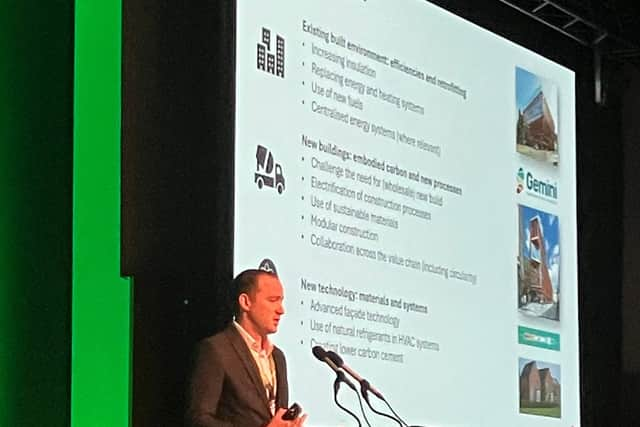

The session wasfacilitated by Eoin McFadden (Head of Matrix Secretariat) and joined by: Dr Michael Shaw (Tetra Tech RPS & Matrix NI), Tom Johnson (Trajectory Partnership), Martin Doherty (CASE), Edward Kerr (DfE), Aidan Donnelly (beespace).
Mr Tom Johnston (Trajectory Partnership) produced the report and presented on the four scenarios, taking a 25-year view and identifying strategies, technologies and case studies that could assist Northern Ireland to meet its net zero target for the built environment.
The recommendations include:
- Capturing immediate opportunities through improved energy efficiency and whole life carbon assessments;
- Reframing decarbonisation as a driver of economic growth, energy security and clean air;
- Accelerating domestic retrofitting and creative reuse of existing buildings;
- Developing long-term frameworks resilient to political and economic change;
- Investing in skills pathways for construction, retrofitting and low-carbon energy systems.
The full report is available to download at: https://bit.ly/DecarbNIBuiltEnv