
‘We have a huge variety within a relatively small area’: Northern Ireland AI firm reveals the regional accent proving hardest for its technology
Portstewart’s ViveoAI says Cork calls have proved particularly challenging as it develops AI receptionists for dental practices across Ireland
A Portstewart technology company developing AI receptionists for dental practices has encountered an unexpected challenge as its systems handle real patient calls across Ireland - the Cork accent.


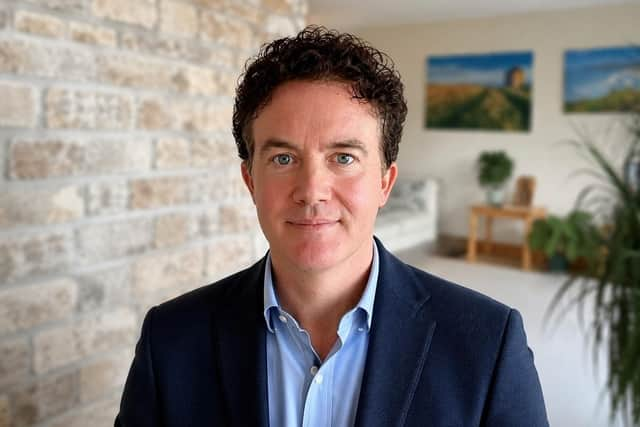
ViveoAI founder Sean Higgins said the company’s experience of operating AI voice receptionists in dental practices around the country has highlighted just how difficult regional accents can be for artificial intelligence.
And among the different accents encountered so far, Cork has emerged as the most challenging for the technology.
The observation came not from a laboratory experiment or artificial accent test, but from the performance of the system during everyday conversations with patients contacting dental practices.
“People shouldn’t have to learn how to speak to AI,” Higgins said. “AI has to learn how to understand people.”
ViveoAI’s technology is designed to answer calls to dental practices, deal with routine enquiries, capture patient information and assist with appointment-related requests when reception teams are unavailable or already busy with patients.

But Higgins said moving voice AI from an impressive demonstration into a real healthcare environment quickly exposes weaknesses that are much less obvious in controlled conditions.
He continued: “You can build something that sounds fantastic in a demonstration, but the real test is what happens when somebody phones a practice with a strong local accent, gives you their surname and mobile number and then explains why they need an appointment.
“If the AI cannot understand those details reliably, it doesn’t matter how impressive the technology sounds.”
The company found that calls from its Cork deployments were more likely to require additional clarification around areas such as names, numbers and particular conversational exchanges.
Higgins believes the challenge is likely to be linked to a combination of pronunciation, rhythm, intonation and the distinctive way certain sounds and words are expressed.
Rather than expecting callers to adapt, ViveoAI has been changing the technology.
The company has introduced local vocabulary and names the system is likely to encounter, refined phrases it expects patients to use and adjusted conversational workflows so that important information can be naturally checked and confirmed.
“Ireland is actually an extraordinary testing ground for voice AI,” he explained.
“We have a huge variety of accents within a relatively small area. Travel an hour or two and pronunciation, rhythm and even common expressions can change considerably.
“A human receptionist deals with those variations almost without thinking about them. For artificial intelligence, they can still be significant.”
Higgins, who originally trained and worked as an optometrist and later completed a Master’s in Digital Media Communication at Ulster University, founded ViveoAI after seeing first-hand the pressure incoming telephone calls can place on busy healthcare practices.
The company is now concentrating particularly on dentistry, developing its systems around the workflows, terminology and practical requirements of dental practices rather than offering a generic call-answering service.
Higgins said that specialisation has become increasingly important as AI moves from general-purpose applications into sectors such as healthcare: “Generic AI is incredibly powerful, but the moment you put it into a real business environment, the details become everything.
“It has to understand how that particular practice works, what information needs to be collected, what should happen next and how real patients actually speak.
“That last part is something the industry probably hasn’t talked about enough.”
He believes regional accents illustrate a wider issue for companies racing to introduce conversational AI.
The success of voice technology, he argues, will ultimately depend less on whether an AI voice sounds human and more on whether it can reliably understand the humans speaking to it.
He added: “In healthcare, getting the details right matters. A patient’s name, mobile number or the reason they are calling isn’t something you want the technology guessing at.”
And while the Cork accent may currently be providing one of ViveoAI’s toughest tests, Higgins sees that as an opportunity rather than a problem: “Every difficult conversation teaches us something about where the technology needs to improve. The answer isn’t to make Ireland more understandable to artificial intelligence. It’s to make artificial intelligence better at understanding Ireland.”