
Chris Bryant had ‘no other decision’ but to halt Drumcree march, court told
Northern Ireland Secretary Sir Chris Bryant could have taken “no other decision” than halting the Drumcree march in Portadown, Co Armagh, the High Court in Belfast has heard.
Legal representatives for the PSNI also pushed back on assertions that police were substantively considering the “feelings of the PIRA (Provisional IRA)” in security assessments relating to the parade’s ability to proceed.
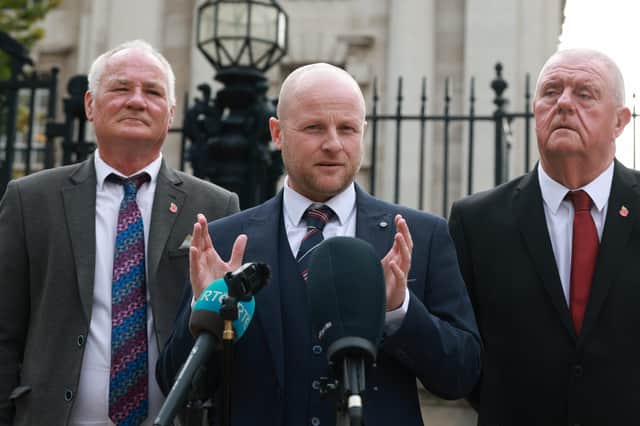

Members of the Orange Order are seeking a judicial review after Sir Chris halted the march from going along the mainly nationalist Garvaghy Road amid large-scale protests by residents opposed to the procession.
His decision on October 9 followed a two-week stand-off.
The application for judicial review against that decision is being heard by Mr Justice Scoffield.
It includes a challenge to the decision by PSNI Chief Constable Jon Boutcher to ask Sir Chris to review the determination made by the Parades Commission, which had given the go-ahead for the parade.
Phillip McAteer KC outlined discussions Sir Chris engaged in with party leaders over the course of the stand-off, as well as with members of the Portadown District and the Garvaghy Road residents, which the barrister maintained were “an attempt to facilitate the procession and reach agreement”.
It was said in the course of those talks there was no resolution that was acceptable to the Orangemen that did not involve going down the Garvaghy Road and none to the residents that involved the Orange Order doing so, leading the talks to end unsuccessfully.
Mr McAteer highlighted that the Secretary of State said at this stage that his door was still open and it was only when he received updated information of the security situation changing that he intervened.
He outlined the Secretary of State’s position by October 9 that the Parades Commission determination “could no longer be given effect, but it was properly reached on the basis of information before the commission at that time”.
“Which reflects something which was important to the Orange Order which was the importance of the fact that their determination had been lawfully reached in the first place, a matter which has been confirmed by the court of appeal,” Mr McAteer said.
“So that preserved that position, but also reflected the reality of the situation whereby the determination couldn’t now be given effect.”
Later, arguing the Secretary of State could not have amended the ruling to allow the march to proceed in a different form, Mr McAteer said it was “repeated over and over and over” that the march for the Orange Order “was only about marching the Garvaghy Road” which the residents were “blatantly opposed to”.
“No other decision by the Secretary of State would have achieved the aims which was to end that stand-off and therefore mitigate all of those risks and avoid public disorder, crime, and ensure an appropriate balancing of the convention rights,” he said.
Mr McAteer went on to address the argument that Sir Chris had not adequately accounted for an incentivisation of law-breaking through his decision.
He highlighted that the point was “made repeatedly” to the Secretary of State, both privately and publicly, over the course of the stand-off that there were concerns about “mob rule” being expressed by some in the Lodge.
Mr McAteer said Sir Chris “was clearly aware of the point being made, it can’t be said that he didn’t take it into account”.
He said the application was “legal nitpicking in circumstances where the court is really required to look at all of the evidence that’s there”.
“I don’t say that would be critical of the applicant, the applicant’s driven to this because of the sheer quality of the decision-making when one looks at it properly and as a whole,” he said.
“When one looks at the sheer weight of the issues that were being raised by the Chief Constable in particular, when you actually look at this and step back, it really is hard to say: could any other decision have been made?”
On Monday, Richard McConkey KC, who represents a member of the Orange Order, referred to a senior officer having access to nine intelligence risk assessments and said a police record from the officer included the phrase “the feelings of the PIRA”.
Barrister for the PSNI, Peter Coll KC, said there were “interests outside the confines of this court” in relation to that line and highlighted there were “other mechanisms” to put concerns around it to the Chief Constable.
He said it had been suggested that “a commander had been taking account of and working with the feelings of PIRA”, when the log was a description of intelligence information.
He said: “What he’s saying there is: ‘I’ve seen intelligence documents, I’m mindful of their contents’ and then he breaks down what the contents are, and the contents include, as he phrases it, ‘the feelings of the PIRA’, and he’s simply stating that as a fact.”
Mr Coll said the main document was the intelligence assessment provided to the Secretary of State and while the police log “may be of some interest to the outside world it’s not actually something that comes to bite in the confines of this case”.
He agreed with the judge’s characterisation of the police position that it is “unfair to read that as: ‘We don’t want to hurt the feelings of the PIRA’”.
Responding, Mr McConkey said there is still an “unexplained relationship between the contemporaneous operational assessment” and the timing of the Chief Constable’s referral.
He also said questions remain as to whether accounts “represented legitimate assessments of security or public order consequences; or whether considerations extraneous to the proper policing statutory purpose materially entered the decision”.
Asked if the reference to the PIRA was used in the referral to the Secretary of State, Mr McConkey said he is “not in a position to say whether the Chief Constable even saw that”, but given it was in police reports at the time, “I would have thought that’s something that would have been referred to by the Chief Constable making this very significant decision”.
A judgment is to be given next week.