
Election shock as Tory grandee is defeated by liberal Whig linen merchant (January 1835)

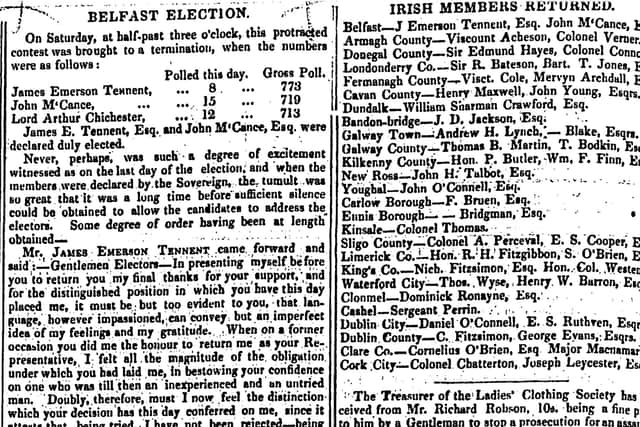
On January 20,1835 the News Letter reported an election shock involving the defeat of the Tory grandee Lord Arthur Chichester by a liberal Whig linen merchant, John McCance.
As the newspaper reported the election result sparked clashes of a sectarian nature in the town. Chichester's running mate James Emerson Tennent was re-elected; they had both won their seats in the acrimonious poll in December 1832 which was, the first held under the wider franchise following the parliamentary reform act passed in June of the same year.
The new franchise exacerbated the sectarian tension in the town because more Roman Catholics were able to vote.
In January 1835 the News Letter reported: “A crowd assembled daily opposite Emerson Tennent's committee rooms on their way they smashed the windows of almost every . Roman Catholic, whose house they passed, and the windows of not a few Protestants whose political sentiments were supposed to differ from theirs, while another mob attacked the homes of some Orangemen.”

Sectarian clashes had become commonplace in a Belfast which was fast developing as an industrial centre with a dependence upon economic conditions elsewhere. Many people were drawn into the town from rural districts and this meant agrarian divisions were imported.
There were riots on Christmas Day 1833 when, the News Letter recorded: “....a good deal of rioting took place in various parts of the town.”
It added: “Troublemakers paraded the streets enjoying the festivities of the occasion, and in the course of the day a number of dangerous encounters took place between opposite political partisans – in the neighbourhood of Peter's Hill two large bodies of Protestants and Roman Catholics kept pelting each other with stones, brickbats and other weapons for a considerable time.”
The News Letter's report continued: “Stones were flying in showers till the road was literally strewn with them, and the confusion and uproar which existed were frightful till the interference of the Magistrates and police caused the combatants to disperse.”
There had been a nasty clash in York Street between the factions, and “a good deal of mischief was done by a set of blackguards on both sides, most of whom were probably drunk”, added the News Letter.
Firearms were used by both sides involved in the clashes and at least one innocent .party narrowly avoided death when a “ball passed within a short distance of his head” as he was walking along the Antrim Road near to the Poor House.
The News Letter commented: “The practice in question cannot be too severely reprobated, and we will call the authorities to it that it may be repressed in future.”
There was at least one recorded fatality of the Christmas Day riots - a youth named Leech was attacked near Waring Street in what was described as a “drunken brawl”. An inquest was told that he suffered from epilepsy; no visible wounds had been found on his body. The jury returned a verdict of “died by the visitation of God”.
In December 1832 there had been a particularly vicious spate of street fighting between factions and involving the police who tried to separate them in which there had been four fatalities.
The Hercules Street riots, as the clashes were subsequently to become known, followed the bitter December 1832 election which saw Chichester and Emerson Tennent defeat their liberal rivals Crawford and Tennent Chichester collected 806 votes, Emerson 701 while Tennent received 610 and Crawford 607.
The News Letter noted that only 200 Protestants had backed Tennent and Crawford. In what the News Letter referred to as “electioneering warfare” Chichester and Emerson Tennent were chaired around the town past the Linen Hall, down High Street and into Hercules Street (now known as Royal Avenue).
The Northern Whig claimed that party tunes had been played during the procession but the News Letter rejected the claim adding: “During the day there were party tunes played by assemblages that paraded the streets but these assemblages were totally distinct from the procession.”
The News Letter continued: “When the latter had reached the corner of Church Street for the purpose of parading down North Street to the Exchange Buildings a tremendous attack was made upon them by the butchers and a mob from Hercules Street. An absolute storm of missiles was discharged and the assailants rushed forward . to the attack with hatchets, butchers knives and other dangerous weapons.”
The police arrived and in an attempt to separate the factions opened fire killing four - Henry McConnell, William Lee, John Robb and Henry Largey. At the subsequent inquest the jury ruled that the deaths had been caused by shots fired by the police “and that at the time of firing considerable rioting had prevailed in the streets”.