
Retro: Excitement at supposed discovery of a petroleum spring in the Kingdom of the Mournes (1890)


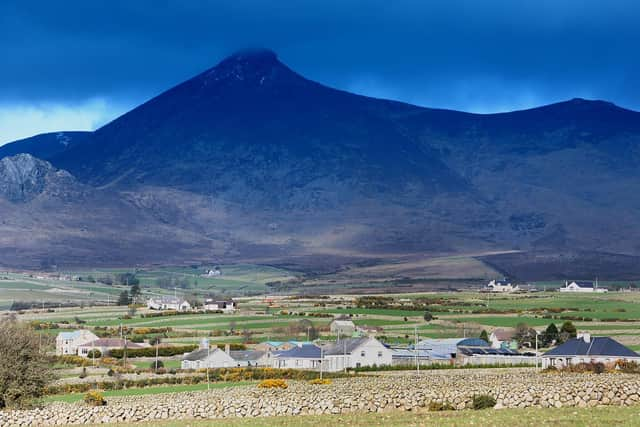
“Near a few days ago the Kingdom of Mourne was agitated by a rumour that a spring had been discovered in the townland of Moneydarragh, near Kilkeel, on the farm of Mr Henry McNeill,” reported the Belfast Weekly News during this week in 1890.
It continued: “It appears that a son-in-law of Mr McNeill, who is over from America on a visit, has repeatedly declared that he had seen what his experience had led him to believe were indications of the presence of a petroleum spring.
“Lately a quarry was opened, in which a quantity of water collected, and upon the surface of this a film of oily substance speedily formed. This was skimmed off, and about a pint of it has been bottled, and will be submitted to an analyst by Mr J Q Henry, JP, agent to the Earl of Kilmorey.”
The News Letter concluded: “If the analyst's report should be favourable, it is expected that borings will be undertaken, with a view of ascertaining if petroleum in quantity is present in the strata underlying the Kingdom of the Mournes.”
ALLEGATION OF 'CANNIBALISM' NEAR BALLYMENA
At Ballymena petty sessions on before Messrs J C Rutherford, RM (chairman); J Mallaghan, JP; and S J McCartney, JP; Arthur Kane, Dunnyvadden, charged Robert Barns, of same place, with having, on the 29th September 1890, assaulted complainant with a billhook.
In two cross-cases Kane was charged with having assaulted Robert Barns and his wife, Jane Barns, on the same occasion.
Messrs Alexander O’Rorke and Son appeared for Kane, and Mr Currie contra.
The evidence of Kane was to the effect that as he was going past Barns’ house on the evening in question about dusk whistling 'The Drummer Boy at Waterloo' [this was greeted with some laughter in the court]. Barns had him to “stand”. He did so, and after some words Barns, as alleged, ran into the house and came out with a billhook and told the witness “to come on”, whereupon Kane repeated the challenge, and Barns struck him a heavy blow with the billhook on the left arm. After a struggle with Barns and his wife, Kane got away, carrying with him the billhook, which he now produced in court.
Mr Currie, in stating the case on behalf of the Barns, said that they were caretakers of a farm in Dunnyvadden, belonging to Mr Lyons, Belfast, and from which certain parties had been previously evicted. The farm in question had at one period been in possession of some friends of Kane.
Robert Barns was examined, and stated that on the night in question he was in his own house when Kane came running in with a stone in each hand, and said to witness “if he would not come out he would drag him out, and kick him”. He then struck witness on the side (on which he has since been wearing a plaster) and struck him on the right temple with one of the stones.
Afterwards witness was put down by Kane, who with his teeth got hold of Barns’ thumb and nearly bit it off. He also bit the fingers of witness's wife badly as she was endeavouring to save her husband.
Altogether Barns in the encounter got thirty cuts and bruises, and “the face was in a manner beaten off him”.
The witnessed said that he had “not for six days” had in his hand the billhook which Kane carried away with him on the occasion. He said that he had been afraid of his life, and frightened to open his door at night from the showers of stones that were thrown at his place of abode.
Mr O’Rorke remarked: “The witness had a gun in his bedroom upstairs. When he went upstairs that night it was on the purpose of throwing himself on the bed, as he felt faint and weak.”
Jane Barns having been examined and corroborated the testimony of her husband.
The chairman said they considered the cases against Andrew Kane fully proved. The bench decided to send him to jail, “without the option of a fine”, for two calendar months, “at the expiration of which he will have to find bail to keep the peace for two years”. The other case against Barns was dismissed.
HARVEST THANKSGIVING SERVICES
The annual Harvest Thanksgiving service had been held in Bangor Parish Church, reported the News Letter.
The News Letter detailed: “The church was beautifully decorated, and presented an appearance in every way appropriate to the occasion. The general effect was perfect. gaily-coloured flowers and luscious fruits being mingled with leaves bearing all the shades and tints of autumn.
“The details of decoration had also received careful attention. On the Communion table were three sheaves of corn, in the centre one, of which was a sickle. The chancel was surrounded by ferns and plants of various descriptions.
“The lectern and reading desk were adorned with grasses and flowers and fruit. The pulpit had evidently been an object of special care and the arrangement of upon it was much admired. The wreaths round the pillars and the adornments on the pendants were placed in such manner as to make the body of the church a picture of natural loveliness”
The News Letter added: The greatest credit is due to all who rendered assistance in the decorating of the church.”
Amongst the various helpers were: Mrs Maguire and family, Mrs Cleland and family, Mrs Bolton, Ms Connor, Mrs Lepper, Mrs Maxwell, Mrs Kinghan, Mrs White and family, Mrs Rainey and family, Madame Berney, Miss Salvage, Mr Fisher (from Bangor Castle), and Mr Russell (from Crawfordsburn).
A congregation of about 900 assembled at the service. The musical portion of the thanks giving was under the able direction of the organist, Mr R Jones. The psalms selected were 104 (Larves C) and 150 (Woodward). The anthem was Gadsby’s ‘Blessed be the name of the Lord’, while the canticles were rendered to the setting of Wesley F.
The service was read by the the Reverend William L T Whatham, curate of the parish, and the lessons by the rector,.the Very Reverend, the Dean of Down, Dr Maguire. An eloquent sermon on the first verse of the 24th Psalm was preached by the Reverend W H Davis, rector of St Jade's, Ballynafeigh, Belfast.