
Retro: Ulster Rifles sail from the Princess Dock, Liverpool, on their way to Korean War (1950)

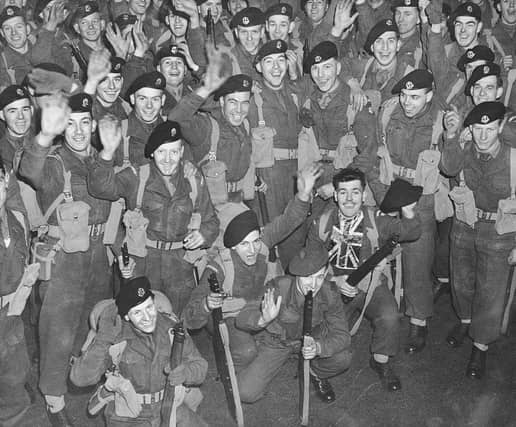

To the strains of ‘The South Down Militia’ and ‘Now is the Hour’, the 1st Battalion Royal Ulster Rifles, about 800 strong, sailed from the Princess Dock, Liverpool, during this week in 1950, on their way to Korea, reported the News Letter.
Mr John Strachey, the War Minister, who spent several hours among the men on the quayside, told them that their mission was an important one for the future peace of the world.
“It is going to be a tough job rounding up the defeated North Korean Army. We do not know what reinforcements they may bring forward,” he said.
The men, who were almost 12 hours en-route from their camp at Colchester, embarked in the former Hitler “Health through Joy” liner, which had become the white-painted British troopship Empire Pride.

They were played aboard by the regimental band, which last played a battalion embarkation at Haifa when the battalion left Palestine for service in Austria.
RESERVISTS
The battalion included about 500 called-up reservists and a number of Korea volunteers. About half its strength was Irish, the other men being reservists from English regiments.
Mr Strachey, whose farewell message was relayed over a public address system throughout the troopship, told the men: “It might seem to you that the fighting in Korea will be all over before you get there, and that it is no longer necessary to send this British force of which you are a part. It is true that the United Nations’ forces have won a great victory – a victory in which the 27th Infantry Brigade have played their full part – but in a country like Korea it is going to be a tough job rounding up the defeated North Korean Army. It would be very unwise to assume that active operations are all over
“Whatever task you are called upon to carry out it will be an important one. It will demand of you the hard and unselfish service which the British soldier gives and always has given.
“I am confident that you will give that service in the practical and traditional way of the British soldier. Good luck to you all.”
MESSAGE FROM ULSTER
A second message carried a more homely word to the men. It was from Sir Reginald-Denning, KBE, CB, General Officer Commanding, Northern Ireland, who wrote: “I send you and your battalion the best wishes of myself and of the troops in Northern Ireland on your departure for overseas. Not only the army, but the civilian population in Northern Ireland will watch your activities with interest.
“I know of the pride and affection which Ulster, and particularly Belfast, has for your regiment, and I also know that it is fully merited by the splendid spirit of the battalion and by its general efficiency. I wish you every success in whatever venture you may have before you.”
As the battalion, fit and experienced fighting men, filed aboard in full kit and with scabbarded bayonets fixed, their Commanding Officer Lieutenant Colonel R J H Carson, the man who commanded the 1st (Glider-borne) Battalion RUR in the D-Day landings in Normandy, said: “All the men are in fine spirit.”
VOLUNTEERS
There were, he said, about 200 reservists in the battalion.
“Those men had not had much time, but no one could have settled down better.”
The battalion included a number of men who “had volunteered for Korea”. It had only two National Servicemen – one officer and one other rank.
“We are all very proud of being part of a force going to Korea to help to finish this most important and worthwhile task,” he said.
“The war seems to be going a bit fast for us as far as I can from the news. It is unusual for the Rifles to be late anywhere. However, once we set foot in Korea opportunities will arise for us to show the stuff we are made of and for us to maintain that high standard set when this battalion was a glider-borne battalion of the 6th Airborne Division.”
One of the the men aboard was the Reverend J G M Kelly, of the Church of Ireland, the son of the Reverend Canon James Kelly, MA, rector of Dungiven, and the only chaplain going with the battalion.
“WOLRD’S BEST”
Mr Kelly, who had served as chaplain with the RAF in Tunisia, Italy and Yugoslavia during the Second World, said of the battalion: “They are a grand crowd – the world’s best – and Ulster should be proud of them.”
The embarkation was the business-like departure of “serious men on a serious mission”, observed the News Letter’s correspondent in Liverpool.
They added: “A song that other soldiers sang might sum up the attitude of the men: ‘We don’t want to leave you, but we know we've got to go' ." When they went, they went singing.”
The correspondent added: “The scene at the departures was was without the mass emotionalism of such occasions in earlier years, yet there were wet eyes at the dockside – the eyes of sisters, wives and mothers grouped together along the rails above the quay with miniature Union Jacks with which to wave fond goodbye, and with last packets of cigarettes to fling down to the men.”
RECALLED
Many of the men might well have considered their soldiering days all over reservists were called from civilian jobs and growing families by the recall to arms. One such was Rifleman John Robertson, of 10, Baskin Street, Belfast, who had served 15 years in the army, who had been captured in the African desert, and spent 3½ years in Nazi prison camps. Robertson, a Belfast tram driver and father of children of 9 and 13 years, scarcely cheered on August 9 when his calling-up papers arrived.
Rifleman Thomas Johnston, of Lake Street, Lurgan, was another of the “veterans". It was the “Skins” he joined in 1938, and the Japanese who held him prisoner for 10 months after his capture in Burma.
Rifleman Charles Fanning, of Allworthy Avenue, Belfast, who served with the “Faughs” in Austria until his “demob” in 1946 and who had married in June 1949, and Lance-Corporal David Clarke, of 48, Eskdale Gardens, Belfast, who has said farewell to his three children, who all had “something less than love for the aggressors who have caused the up-rooting of their homes”, noted the News Letter's correspondent.
“All for it”
Patrick Henry, of 36, Great George's Street, Belfast, had no doubts about going to Korea, despite the fact that he had hoped to get married “in a month or two”.
He told the News Letter: “I’m all for it. I think the job has to be done and I think we’re the boys to do it.”
The News Letter correspondent reflected: “It was men such as these – old campaigners with the soldier's love of a grouse and younger men vibrant with the spirit of adventure – who joined voices in the climax of the Rifles’ departure. On the quay the regimental band played those marches known half the world over – ‘Off, off, Cried the Stranger’, and the rousing ‘South Down Militia’.
“Then from the hundreds of men lining the rails of the troopship there drifted over the widening gap of the waters a song that brought a lump to the throat of listeners, that song of wartime partings, ‘Now is the hour, when we must say good-bye...’
“Spontaneously the group of women who had waited more than eight hours for this parting glimpse of their loved ones took up the chorus, and though some voices quavered the men heard over the darkening waters their response: ‘When you return you’ll find me waiting, dear’”.