
MLA says 'I am exasperated with the judiciary' as serial offender is spared jail for leading police on a 100mph chase in a stolen car full of stolen goods while under the influence
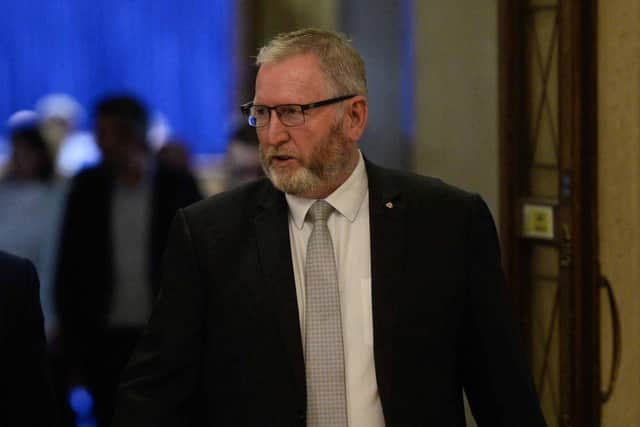
Doug Beattie MLA as declared himself “exasperated” with the Province’s judiciary after a serial offender was handed probation for his latest catalogue of crimes, which culminated in a high-speed police pursuit.
Mr Beattie was reacting to the case of Thomas James Coleman, 32, who was prosecuted for driving a stolen car filled with stolen goods, while unfit to be behind the wheel, and for leading police on a 100mph chase, veering the wrong way through a roundabout, then crashing the stolen car.
Mr Beattie called for the law to be changed so that sentences such as this one can be referred for being unduly lenient.
The News Letter has reported on a number of cases recently where people involved in serious motoring offences, usually extreme speeding, have been dealt with by way of often short driving bans.

In this case, Coleman, of no fixed abode, appeared on Tuesday at Antrim Magistrates' Court (sitting in Ballymena) from jail, where is serving a sentence for other offences.
He admitted dangerous driving, failing to stop for police, driving whilst unfit, failing to provide a specimen, shoplifting, and insurance and driving licence offences.
At 10.45am last May 6, a car was being driven erratically in the Dunsilly Roundabout area near Antrim town.
The vehicle was spotted by police at The Junction shopping complex and police signalled for it to stop using siren and lights.
But the Dacia Sandero fled, swerving in the road and narrowly avoiding colliding with several oncoming vehicles.
At Randalstown Road it did 95mph as vehicles mounted the kerb to avoid being hit.
On the A6 the car hit a speed of "over 100mph".
Coleman then lost control on a roundabout at Toomebridge; the vehicle entered against oncoming traffic and collided with a crash barrier.
Police "extracted" two people from the vehicle, the court heard, and driver Coleman was unsteady on his feet and had dilated pupils.
It was established the vehicle was stolen and that it was ful of about £400 of goods that had been stolen from The Junction.
Coleman came before the court with 107 previous convictions, and his lawyer said he has been "institutionalised" by prison and has an "unstable" lifestyle when he is free.
District Judge Nigel Broderick noted the defendant said if he was put on probation it would be a "harder option" than prison, as it would mean he would have to "fix his life".
Judge Broderick pondered how he could "break the cycle" of reoffending.
He said that he would spare Coleman more jail, but "not without significant hesitation" because the driving had been "extremely dangerous" and it was only by the "grace of God" there had been no serious injury.
Coleman was put on probation for a year, ordered to engage in alcohol/drug treatment, and banned from driving for two years.
Mr Beattie said: “The sentencing guidelines around motoring offences in Northern Ireland are shambolic.
"A serial offender, who was under the influence of drink [or] drugs, who then stole a car which was filled with stolen goods should be enough to get a custodial sentence.
"This individual then tried to avoid police and in doing so crashed the vehicle at speed.
"For this litany of offences, the individual is given a year’s probation and no custodial sentence, even though they have endangered life with these offences."
He noted that, because it was handed down in a magistrates' court as opposed to the more serious crown court, the sentence cannot be appealed.
“As the Ulster Unionist justice spokesperson, I am exasperated by the judiciary now and the appalling sentences they are handing to individuals involved in extremely serious offences."
"It's time the [justice] minister acted and swerving questions with, the ‘judiciary is independent’ is simply not good enough. She should legislate and give guidance and direction now."
A Department of Justice spokesperson said: “Sentencing in individual cases is a matter for the independent judiciary as are Sentencing Guidelines. This is not a matter of the Minister avoiding issues. The Minister has no power to direct the judiciary: to do would fundamentally undermine the independence of the judiciary and amount to political interference in due process.
“Where an offence may be tried in the magistrates’ courts or the Crown Court, it is a matter for the independent Public Prosecution Service to decide which court is appropriate, taking into consideration all the facts of the case. In such cases, the choice of court determines the maximum sentence available for the offence.
“A range of sentences imposed in the Crown Court, where higher sentences can be imposed, may be referred by the DPP to the Court of Appeal as being unduly lenient. The Department’s forthcoming Sentencing Bill will extend these arrangements to all sentences imposed in the Crown Court.”
The Lord Chief Justice’s office, representing the judiciary, responded by saying: “The sentencing framework within which all judges must act is set in legislation. In cases where the prosecution is brought in the Magistrates’ Court, the sentencing powers are lower than they are if the case was prosecuted in the Crown Court...
“In general terms, the sentence imposed in an individual case will depend on the specific circumstances of that case. In calculating the appropriate sentence for a particular offence, the judge will consider the maximum sentence which the court can impose (as set out in legislation), all of the evidence provided to the court, any sentencing guideline judgments relevant to the offence committed, whether the offender pleaded guilty and when, the level of culpability, the offender’s previous convictions, and any other aggravating or mitigating factors presented to the court by the prosecution and defence.”