
Asian Hornets in Northern Ireland 'do pose a direct hazard to humans with sting': Experts ask public to help find nest in Dundonald area of Belfast
Members of the public are being invited to help experts track down a suspected nest of Asian Hornets in the Dundonald area of Belfast.
On Wednesday The Northern Ireland Environment Agency (NIEA) confirmed further sightings of Asian Hornet in the Dundonald area, after one was captured in the area on Friday.
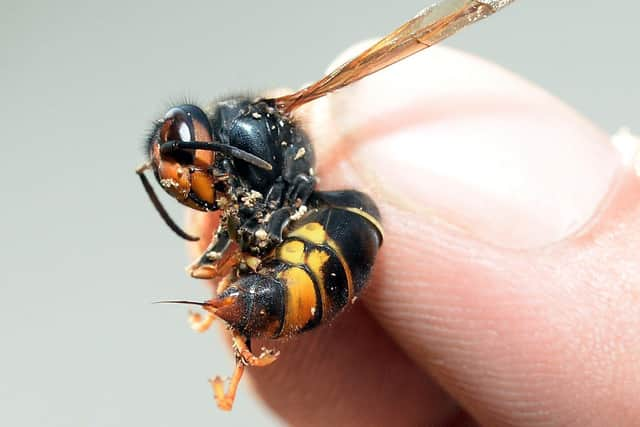

Two nests were found and destroyed in the Cork area earlier this summer.
One hornet can kill 50 honeybee in per day and NIEA say its “aggressive nature and feeding habits” mean it can have a serious impact on biodiversity.
NIEA officials have asked the public to be vigilant and report any suspect insects, ideally with a photograph – but not to approach any nest.
Dr Archie Murchie, an entomologist with the Northern Ireland Agri-Food and Biosciences Institute (AFBI), said the species is about "half as big, again" as a regular wasp and can inflict the equivalent of "a bad wasp sting".
"They do pose a direct hazard to humans, they are like big, quite aggressive wasps," he said.
"Like wasps, they don't want to sting you. They're not really interested in you, unless you go near their nests. Then they will defend themselves and will mass attack."
However their nests are usually located fairly high up in trees, he said.
Once established they could be a nuisance at picnics - just like wasps - where they will try and steal jam or meat.
He praised the speedy actions of NIEA staff in setting up monitoring stations with meat and sugared water in the Dundonald area.
Observers mark individual hornets and, based on average speed and the time it takes them to return to feed, a number of monitoring stations can triangulate the position of any nest.
Dr Murchie and colleagues are on standby in their lab to examine any nest and further hornets that are captured.
They are a serious threat to honeybees, which could pose a threat to crops which rely on bees for pollination, such as apple orchards.
Although local honey bees can sting they have no real defence against them.
Hornets hover outside bee hives to capture bees, taking them back to their nests to feed their grubs, whereas the adults survive more on carbohydrates and sugars.
In China honeybees have developed an effective defensive measure by swarming around the hornet, vibrating strongly until the hornet is effectively "cooked" , he said.
But Irish honeybees have no such skills.
Bumble bees are much more able to defend themselves, and his money would always be on a dragonfly - and its powerful jaws - in any confrontation.
Studies by the University of Exeter found they prey on 1400 species of insects across Europe.
"One of the reasons the beekeepers are particularly worried is they will take out bee colonies," he said.
"In Jersey and also in France, about 30% of the hives are being affected."
The only possible local species to prey on them would be Great Spotted Woodpeckers, which have only arrived recently, with magpies and crows another possibility.
Climate change is making it more viable for them to survive in Northern Ireland.
The hornet arrived in France in a cargo of pottery from China about 20 years ago and has spread rapidly across the continent.
By December 2023, the yellow-legged hornet had established itself in France, Spain, Belgium, the Netherlands, Portugal, Italy, Switzerland, Germany and Jersey.
It was first seen in the UK in 2016, and there have been regular sightings since, including 44 confirmed this year, largely in Kent and East Sussex.
However the spread in the UK has been seriously curtailed with surveillance and rapid eradication of nests.
The public can report Asian Hornets through the Asian Hornet Watch app and online at habitats.org.uk.