
Striking doctors warn low pay fuelling NI health service staffing crisis
Low pay for young doctors in Northern Ireland is having a “massive impact” on the health service, a union leader has warned as resident doctors undertook a 24-hour strike.
Dr Steven Montgomery, chairman of the British Medical Association (BMA) Northern Ireland resident doctors committee, warned there would be “effects felt” for the general public in the form of cancelled appointments and surgeries.
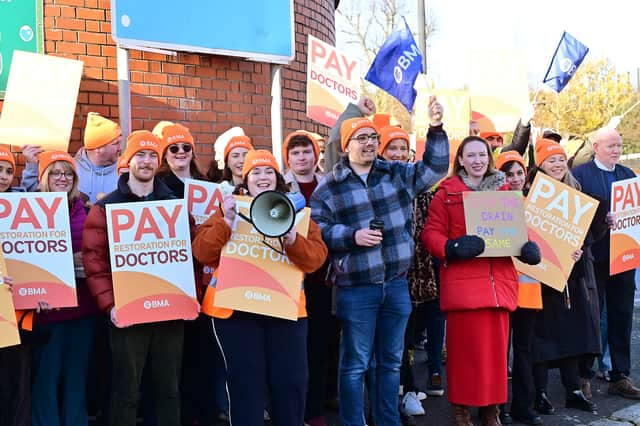

The 24-hour walkout from 7am on Friday until 7am on Saturday sees resident doctors withdraw their labour from hospitals and GP surgeries.
The action will be followed by specialist and consultant doctors in the region striking on Monday November 23.
It is the second round of strike action related to the demand for full-pay restoration, after a 24-hour walkout was also held by doctors in June this year.
Speaking at a picket line outside the Royal Victoria Hospital in Belfast, Dr Montgomery outlined that resident doctors have faced a 20% reduction in pay since 2018.
“That’s having a massive impact on the health service here in Northern Ireland, on the staff here in Northern Ireland, and the sort of morale of people here in Northern Ireland,” he said.
“We’re seeing waiting lists grow exponentially, we’re seeing doctors leaving to work elsewhere and what really is going to fix most of this is retaining the staff we have here and that all starts with pay.
“We need to make sure doctors here in Northern Ireland are paid similarly to their colleagues doing the same job very close by.”
He said the problems people in the region encounter in the health service, such as being placed on waiting lists or long A&E wait times, “all boils down to us not having enough staff here to run the services they want”.
“The massive fix for that is going to be keeping the staff we have here, and that all starts with pay, we need to pay doctors what they’re worth,” he said.
Dr Montgomery said people would feel the impact of resident doctors withdrawing their labour, and he feels “genuinely sorry” that is the case.
“We don’t want to be here, no doctor wants to be on the picket line, no doctor wants to be striking,” he said.
“There will be appointments cancelled, there will be surgeries cancelled, however, there will be emergency care provided by consultants and specialist doctors throughout the day, and there is a process that the trusts can request extra doctors back if there is a situation that arises that needs additional staffing.
“So we’re trying to do this in the safest way possible, but unfortunately, there will be some effects felt.”
Northern Ireland is without an agreed budget 7 months into the current financial year, as Stormont Executive parties argue they cannot agree a package with the offer from Westminster, and Northern Ireland Secretary Sir Chris Bryant insisting no more money will be put on the table.
Dr Montgomery said there are no “perfect answers” about how to resolve the budget impasse but he is clear that “something needs to be fixed” in the health system in Northern Ireland.
“What we’re doing today is we’re raising the alarm that this is a healthcare system in crisis, and it’s a staffing crisis, and we need to fix that,” he said.
“And don’t get me wrong, I don’t think pay is a silver bullet that’s going to fix everything, but I think it’s the first step in improving the health service here in Northern Ireland, and giving patients here in Northern Ireland the healthcare system they deserve.”
The union leader also said they wrote to Stormont health minister Robbie Butler over a month ago and had no reply.
“We need him to engage with us, and that lack of engagement is what has driven us here today, at the end of the day, this strike falls on the minister’s feet,” he said.
“He is the one that has failed to engage with us, he is the one who has failed to talk with us, and he is the one who has failed to avert this.
“We are willing to speak to the minister. We’re just waiting for an invitation to come and speak.”
Two resident doctors on the picket line, Dr Megann Crawford, working in psychiatry at Craigavon Area hospital and Dr Riya Sushil in general medicine at Causeway hospital
“It’s become a bit of a problem with a brain drain,” Dr Crawford said.
“We have a lot of kids that are very smart leaving the country, going to places like Australia for a better life.
“It’s left us very understaffed. They’re not creating any new trainee posts to put doctors coming out of medical school into, and we’re just very underpaid for the hours we work.
“For example, when I was a medical student, I worked in a part-time job and earned more per hour than I did as an F1, so there’s just a lot of things going on that we would like to fight against, just see if we can make it a little bit easier for us.”
Dr Riya Sushil, from England, said that despite the challenges she loves being a doctor in Northern Ireland.
“I think the biggest thing would be there’s not enough doctors working, so you often leave work late almost every day, your rotas are like so packed in every single day, you don’t really have much time off,” she said.
“I love my job, but if I feel like this strike would make things better, then I’d be willing to do that.”
Speaking prior to the action commencing, Mr Butler said he is committed to implementing this year’s pay award.
He added: “I have met the BMA and have outlined the financial constraints facing my department.
“My door remains open but, to be clear, going beyond the 3.5% as recommended by the independent pay review body would have significant repercussions for nurses, teachers, police officers and indeed the entire public sector workforce.
“It is my intention to progress the recommended pay award as soon as possible, however, I am currently unable to do so in the absence of a sufficient budget being agreed for my department.”
Mr Butler added: “When similar strike action took place over two 24-hour periods in June, over 2,200 appointments were cancelled across the system.
“The industrial action planned for November 20 and 23 will have real consequences for patients, waiting lists and service delivery, especially during the busy winter period.
“I am grateful to the many doctors, nurses, allied health professionals and exceptional support staff who will continue to deliver care and see patients throughout the two days of planned industrial action.”