
Ben Lowry: The Ulster Unionist Party is far from finished but like all Northern Ireland parties it struggles to find leaders
The sudden resignation of Doug Beattie has thrown the Ulster Unionist Party into turmoil.
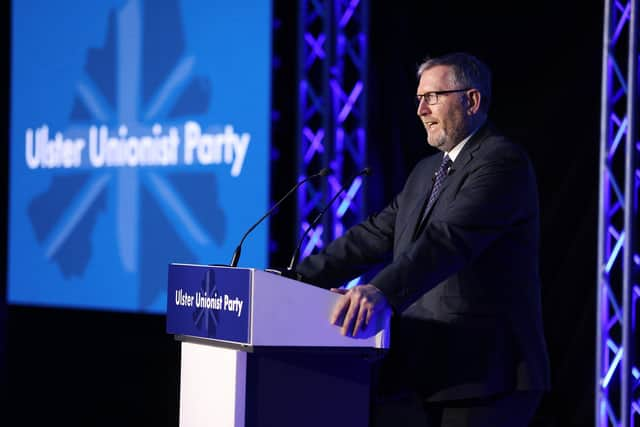

The demise of the party, long predicted, was again foretold this week.
Yet in fact the crisis in the UUP has all happened when the party was doing relatively well.
The conventional wisdom for many years, more than 10, has been that the Ulster Unionists and SDLP are politically finished, but this theory has been shown to be nonsense.
Almost the opposite has been proven to be the case, in that they have in fact both shown that there is a stubborn core of voters who simply will not move to the DUP or Sinn Fein. Far from their decline being a one-way movement to extinction, they both have had several mini revivals, the most dramatic of which was for the SDLP in 2019, in which SF suffered a major setback at their hands (the most notable of which was the landslide recapture of Foyle by Colum Eastwood).
The UUP and SDLP combined still always get at least 20% of the votes in Northern Ireland and on a good day around a quarter. That is more than the political centre ground has ever got in an NI election. If the UUP and SDLP are finished then the Alliance Party is so too, yet no-one says this (and rightly not - Alliance is obviously not finished).
But people predict the end of the Ulster Unionists and SDLP because for decades they were utterly dominant in their communities, so by comparison they appear now to be floundering. Alliance, on the other hand, for most of the first 40 years of its existence got less than 10% of votes cast in Northern Ireland elections. Now it always gets more than 10%, usually more than 15%, and in the European election of 2019 the party got a staggering 18.5% of the vote (and unprecedented for Alliance).
It is true that the SDLP has for the first time begun to dip under 10% of the vote, as it did in the 2022 Stormont election and the councils last year, which is a poor showing by any standard. But it was back at 11% in the recent Westminster elections, and in the previous general election it soared to 15% of the vote, which was not so far behind Sinn Fein's 23% share. That was in the aforementioned 2019 contest, when the party had been written off several times previously, yet it got 65% as many votes as SF did. For every 20 Sinn Fein voters there were 13 SDLP ones. That was a striking comeback.
In this general election, the Ulster Unionists got 12% of the vote compared to 22% for the DUP. That is almost 60% of the DUP vote share. So for every five people who voted DUP, three voted UUP. Only a defeatist would say that that represents the end. They returned to the House of Commons, as they did in 2015. These two parties with the Alliance and the Greens make up more than 40% of the overall vote, and can in fact combined reach totals that approach 50% of ballots cast in NI (almost 47% in 2019).
This means that there is a massive section of the province's electorate that wants to register their preference on the constitutional preference, but does not want to move to the parties that have traditionally been seen as more preoccupied on those matters.
There is, I believe, another key reason why these parties are constantly being written off. They struggle to find leaders. In fact, as we know all five parties in NI find that hard. Of course they do!
Even the most successful of them are having to choose from two or three dozen MLAs, which is not a large pool of candidates. If the United Kingdom, a country of 70 million people, and the United States, a country of 300+ million, struggles to find good political leaders then of course our multi-party system in a small country, barely the size of the county of Kent, will find it almost impossibly hard.
As it happens I share some of the concerns that our columnist Owen Polley just expressed about the UUP at times seeming to interpret liberalism as being soft on some quite core matters of principle (Click here to read Owen Polley: ‘Note to UUP: you can be moderate and firm on the Union’ and to read Alf McCreary on the UUP click here: ‘The UUP seems to have a death wish’). But there will be plenty of time for the party to debate its policy. For now unionism badly needs a centrist party that stems the loss of votes to Alliance – which, incidentally, seems to be happening.
I was beginning to think Alliance would now never suffer for indulging the New Ireland ‘discussion’ or for its radical views on matters such as trans, but its recent setbacks in North Down and East Belfast have caused me to revise that view. There is still a substantial number of potential unionist voters in the centre.
• Ben Lowry (@BenLowry2) is News Letter editor