
Ben Lowry: Unionists seem to support the Turk Cypriots yet they might have backed the Greeks
The island of Cyprus has been divided now for 50 years – more entirely divided, indeed, than Northern Ireland.
The reaction in NI to such an international dispute can divide along the lines of our two main communities, unionist and nationalist.

The obvious example of that is Israel, where for more than 20 years Israeli flags have been seen flying in some loyalist areas while Palestinian symbols are displayed in republican ones. Since the October 7 Hamas attacks in Israel, that division of sympathies within NI has become all the more stark.
Another example is the Basque country and Catalonia, where Irish nationalists side with separatists and unionists with those who want to see Spain survive as a single state.
There are other examples too. You would struggle to find a unionist who had any of the sympathy for Castro’s communist Cuba that Sinn Fein has shown over the years. And it it is hard to imagine Irish nationalist politicians holding a pro Donald Trump banner the way that unionist MPs including Ian Paisley, Sammy Wilson and a Tory MP did at Westminster in 2020.
Which side, then, do politicians side with over Cyprus?
This year I travelled for the first time to the northern territory on the island as a guest of supporters of the de facto independent state that has existed there since the Turkish invasion of the island 50 years ago (July 20 1974). Turk Cypriots reject the term ‘invasion’ and describe it as a necessary intervention after a coup by Greeks. Here are links to the stories I wrote about that trip, this one on the anniversary, and a week later, Saturday July 27, this story in which I spoke to unionists who have links to the diplomatically isolated territory of northern Cyprus. Also, this report on August 3 about the Greek side to the story.
After that visit I have thought there is little hope of a single Cypriot state encompassing the whole island now. There has been almost total ethnic cleansing. By that I do not mean that one community has wiped out the other, although there were terrible massacres and I was taken to a memorial to victims of attacks by Greek militants at the villages Maratha, Sandallar and Atilar in 1974. Greek Cypriots point out that they were also the victims of massacres (in one of my recent articles I cited a British soldier I met in the 1990s who had served in both NI and Cyprus in the 1970s, and who told me he saw worse atrocities in the latter).
What I mean by ethnic cleansing, rather, is that the Greek and Turk Cypriots were sprinkled all over the island but in response to the crisis of 1974 there was major population movement so that the Greeks are now overwhelmingly in the south of the island (the recognised state of the Republic of Cyprus) and the Turks are overwhelmingly in the north (the self-styled Turkish Republic of Cyprus, which is in effect an independent state but is not recognised by any country other than Turkey itself).
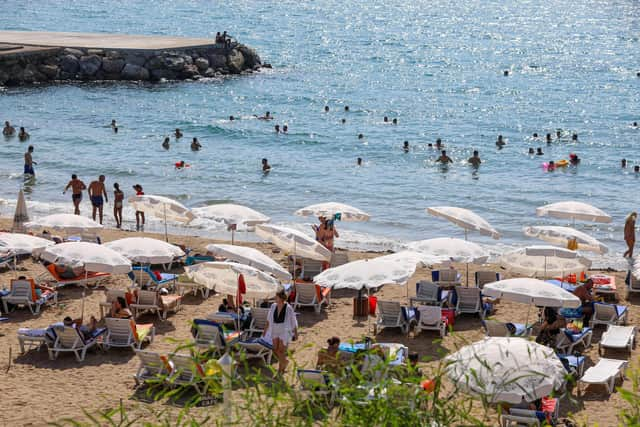
That northern part of the island is the part that is geographically closest to Turkey, about 40 miles at the closest point. You can see the Turkish coast from mountains in northern Cyprus, and I was taken to just such a vantage point, looking out across the Mediterranean, already hot in March.
Beneath us was the town of Kyrenia, with its historic harbour, on the north Cyprus coast. My host and guide said that Turkish Cypriots like him would not have been allowed to enjoy such a town before 1974, and they would only have been allowed in as part of the servant class to prosperous Greek Cypriots. The Greeks dismiss claims of such endemic discrimination, and in turn are bitter at having had to flee the town in the aftermath of the Turkish military landings nearby, thus losing property that they still think is theirs.
Imagine, by way of comparison, a post-meltdown Northern Ireland in which three counties – those closest to Scotland, Down, Antrim, Londonderry – were in an independent state aligned to Scotland. Then imagine looking out from the Belfast hills across to Carrickfergus and Bangor, towns that would now be 100% Protestant. Behind you would be the Lagan Valley, leading towards Armagh, Tyrone and Fermanagh, which would be totally aligned with the rest of Ireland, and 100% Catholic. Between these two ethnically cleansed entities would be a land border that was for a long while fenced and impossible to cross.
It is the area in an around Kyrenia, that now Turk Cypriot town on the north coast, where many British expats live, including some Ulster unionists. In my recent reports Lord Maginnis and Lord Kilclooney about their holiday homes there.
Which brings me back to the question: which side in Cyprus are unionists likely to support? And which side nationalists ?
You might think that unionists would be inclined to follow the south not the north, because:
• They might be sympathetic to the idea that Greek Cypriots were the superior culture and dominant caste who built a good, but unfairly maligned, civilisation.
• The Greek Cypriots are Christian, not Muslim as are Turk Cypriots
• The Greeks are more naturally allied with western values
• The Greeks say illegal violence (the invasion) mustn’t prevail
Unionist support for the Greek Cypriots for the above reasons would be akin to unionist support for Israel, based on similar reasoning. But there is a counter argument to that assumption. The Greek Cypriots supported terror against Britain in their bid to get independence from British rule, which had been in place since 1878. That independence was secured in 1961.
Many British military and police officers were killed in by Greek terrorists seeking independence, including seven members of the Royal Ulster Rifles (I saw a memorial to that too, in Kyrenia). There is still bitter feeling about this – I got an anonymous email from someone sympathetic to, or perhaps involved with, the UK military objecting to my first story about the Turkish anniversary last month. The author sent me images and cuttings, and described the Greeks as the terrorist invaders on the island.
But the Israelis also deployed terror against Britain prior to Israel being established in 1948, and unionists nonetheless sympathise with them over the Palestinians.
I enjoyed north Cyprus and hope to write more about this complex dispute
• Ben Lowry (@BenLowry2) is News Letter editor