
Ben Lowry: Why I said what I did on BBC about how it ignored the unionist vote win, and why I questioned Hilary Benn about not challenging Ireland
It was a busy day last Sunday, as the aftermath of the election was absorbed, locally and across the UK.
I was working that day, helping us to get out another election special edition for Monday.
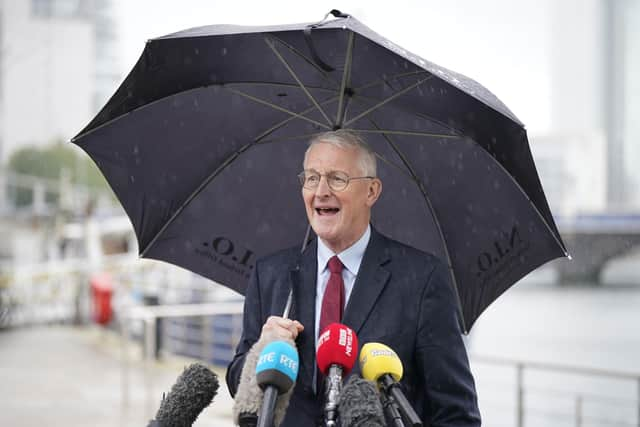

In the morning I was on BBC Sunday Politics and after that I asked a question of Hilary Benn, the new Northern Ireland secretary. In both those exchanges I was, perhaps, outspoken. Let me explain why.
When I came on near the end of the politics discussion it was the last 10 minutes of the show. Five politicians had been on for the previous 50 minutes of the programme, two panellists, a BBC reporter and a London-based journalist.
I had been watching this from the dressing room, then from the edge of the studio. I was so surprised that there was no mention of the fact that unionists had got the largest share of the votes that I wondered if there had been a mention but I had just missed it.
As we detailed last Saturday, the total unionist vote was 43% of the overall ballots cast. The total nationalist vote was 40%. When I mentioned that last week online, republicans mocked me on social media for, they wrongly assumed, failing to include Aontú and People Before Profit in the nationalist total. But we had included them, as we have done previously (such as after the Stormont and council elections). Both want a 32-county socialist republic. Despite including both those two parties to the nationalist tally, unionists were still ahead.
Republicans point out that Sinn Fein stood down in four seats – Lagan Valley, East Belfast, North Down, South and Mid Down – to try to ensure Alliance or the SDLP saw off a unionist MP. The nationalist vote would otherwise have been higher, they say. This is true, but in three of the constituencies SF has traditionally got a negligible vote, only getting sizable support in South Belfast. Based on past performance in those four areas, the party sacrificed around 10,000 votes this year. Even accounting for that, unionists would have been ahead of nationalists.
I also think that the worsening trend of low turnouts in loyalist areas due to depressed morale more than compensates for those lost republican votes. And that matter of morale is why it was so wrong of the BBC to ignore the fact that unionists got most votes.
Republicans know well that demoralising unionist morale could be disastrous for unionist performance in future elections.
No wonder morale is low! Unionists are taunted about an all Ireland, they face an intensifying cultural war at the hands of republicans, such as the growing and provocative use of Irish in areas where there is no demand for it, and they face the neutrality of UK governments amidst pro-nationalist Irish ones.
Any unionist who follows politics closely would have expected in advance that Pat Cullen would not be damaged by her failure, as a strident former nursing leader, to condemn the IRA murder of three nurses in the Enniskillen Poppy Day atrocity, and so it proved – she romped home.
As I keep saying, you would expect not only unionists to be depressed about this growing nationalist tolerance of the worst of past IRA violence, but until recently Alliance and the SDLP would have made clear their contempt for it too. But no longer – unionists are now alone in their dismay.
There were three big stories to come out of the NI election results: 1) Sinn Fein became the largest party at Westminster; 2) four seats dramatically changed hands and 3) unionists got most votes.
Extraordinarily, the BBC almost completely ignored the last point in its election aftermath coverage. Yet unionists are being taunted about an all Ireland. BBC Radio Ulster Talkback has regularly covered the matter of looming constitutional change, BBC The View has given it similarly relentless coverage, including one set of three shows that looked at it consecutively, as well as two interviews with Wallace Thompson, then a follow-up with a loyalist Davy Adams who endorsed Mr Thompson’s tiny minority view within unionism.
Furthermore, the BBC gave huge publicity to the fact that Sinn Fein got the most seats in the 2022 Stormont election, which was unquestionably the story of that election. But it ignored the fact unionists got slightly more votes than nationalists then.
The following year, 2023, it did the opposite: it went big on the fact that nationalists got slightly more votes that unionists for the first time ever.
It is disturbing therefore that it somehow again lost interest in vote totals once unionists pulled back ahead.
Am I saying the result on July 4 was great for unionists? Certainly not. But despite the all-Ireland taunting, and the attempts to depress unionist morale, nationalists have been stuck on 40% of the vote for 25 years.
The first question Mark Carruthers asked me last week was whether I welcomed the re-set in UK-Ireland relations, which I wasn’t expecting. But if Ireland is suing the UK over legacy I don’t.
This then was the basis of my question to Mr Benn, just after the show, when he was touring St George’s Market, before taking questions from the press. Sir Keir Starmer took questions the next day, although the News Letter did not get one then.
As it happens I think unionists have dodged a bullet in getting Mr Benn as NI secretary. We could have had someone hostile to unionism, and he isn’t.
Here is a link to a video of the blunt question I asked him. Will there be no pushback at all, I asked, against a hypocritical Ireland which has ducked scrutiny on its role in the Troubles, eg over extradition? Mr Benn did not answer.
Mr Benn and Sir Keir were asked about Casement (when will it be funded?) and legacy (when will the act be scrapped?). They faced barely any questions other than mine that reflected unionist concerns, yet unionism got most votes.