
Ben Lowry: Hilary Benn witnessed the anger at the ruling against the SAS yet he wants more such inquests
There was a telling moment this week when Westminster discussed the inquest ruling against the SAS for shooting IRA terrorists.
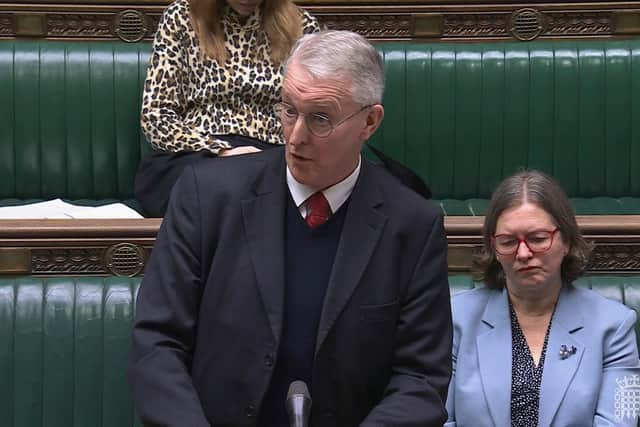

The secretary of state for Northern Ireland, Hilary Benn, said that he could “feel the anger” of the House of Commons over Mr Justice Humphreys’ inquest ruling against the special forces unit who shot dead four members of a republican murder gang at Clonoe in 1992.
Such anger can have an impact on legacy if it leads to political pressure. But it has flared up before, eg over damages to Gerry Adams, but always seems to vanish.
Mr Benn and a government colleague in the House of Lords expressed their clear support for the security forces after the Clonoe finding. But it is important to point out how hollow those words are – not in the sense of being insincere, but in the sense that they are pressing ahead with a process that will lead to many more Clonoe type findings. His restoration of legacy inquests, which the last government tried to closed down because of their imbalance, will – if as devastating as those at Clonoe – also lead to ex police and soldiers in the criminal dock, where no IRA leaders will be.
Mr Benn said that the vast majority of those who served in Northern Ireland “did so with distinction” in the “most dangerous circumstances” in order to protect the citizens of the UK, and “over 1,000 members of the security forces lost their lives in that endeavour”. He said that holding them to the highest standards is “what sets them apart from the terrorist organisations that indiscriminately murdered over 3,000 people”.
Then in the House of Lords, Baroness Anderson, managed to convey her own unease at the Clonoe ruling and her understanding of the anger at the Humphreys ruling. She was responding to a question by the Tory peer Lord Caine, who asked: “Given that the terrorists were clearly on a mission to murder that night does the noble baroness understand why so many people have reacted with anger to the coroners court finding that the lethal force was quote unjustified?” He also asked if she accepted “that the government’s decision to restore coronial inquests in legacy cases will lead to yet more veterans being dragged before the courts?”
She also said “we owe a huge debt to our armed forces” and that “we do appreciate the anger and the hurt that is being felt by many in Northern Ireland” after the contemptible (my word) Clonoe ruling. The baroness mentioned that she was an honorary captain in the Royal Naval and “consider myself part of the military family and I definitely do not support a rewriting of the past and nor does this government and I will always stand with our armed forces”.
But then she undermined all these points with a poorly argued defence of the “reinstatement of inquests”, saying: “I would like to be very clear with the noble lord, I believe that the people of Northern Ireland deserve exactly the same rights as the people of Great Britain, reinstating inquests and civil actions for the people of Northern Ireland so that they have the same rights as you and I.”
This is nonsense. There is no deluge of anti security force inquests in Great Britain. It is a grotesque NI-only process that would not be accepted on the mainland for five seconds. They are, and will be, almost all into deaths in which there are allegations against the state.
Mr Benn once again in effect cited unionist support for the course that he has taken. He said that the last government’s Legacy Act had done “something quite remarkable, it united the political parties and communities in Northern Ireland in opposition to it”.
As I have said repeatedly, including in this article last week (‘Only in the soft UK would we get this Clonoe ruling against SAS and RUC heroes for stopping a heavily armed IRA terror gang’), unionists have consistently failed to make clear that they are not remotely united with Sinn Fein, particularly not on – of all matters – the legacy of terror, given that the party was so long the IRA’s political wing.
Then Mr Benn cited other court rulings on legacy in NI which had found the UK approach to legacy to be incompatible with “our obligations under the European Convention on Human Rights”. Mr Benn is right to identify the role of that document in the legacy process, but he is hailing a convention that has been seized on by republican terrorists and their many helpers, now including the Irish government, to hound the UK.
Most unionists failed to back the last government’s plan to close down these inquests which have become major public inquiries against the security forces who had to deal with mass murderers like the IRA’s sectarian East Tyrone brigade. The DUP even at one point called for the return of inquests and civil cases, seemingly thinking that victims of the IRA would avail of them. But I think few will get such assistance from the coronial or civil legal system.
• Ben Lowry (@BenLowry2) is News Letter editor