
Ben Lowry: It is hypocritical and outrageous of Ireland to sue the UK on legacy, yet the British response has been utterly feeble
Many developments on legacy show how weak the UK (and unionists) have been on the issue.
This newspaper has been reporting on legacy outrage after outrage for 10 years and the response is almost always the same: a brief flurry of uproar at some latest grotesque legal or investigative historic victory for the IRA, followed by sluggishness and indifference.

Within no time the anti-security force legacy juggernaut is back on track, with millions found for some new probe or other into allegations against a UK state that prevented civil war. Gerry Adams winning the prospect of damages for his internment is a recent example. The inquest finding against the SAS for stopping an IRA murder gang at Clonoe in 1992 is another.
The reaction to that verdict in Westminster was one of justified fury, and even now has finally caused the Labour government, which since it came to power has put itself at the helm of the legacy imbalance, to snap. (Keir Starmer and Hilary Benn had soon after taking office begun to reverse the attempt of the last government to prevent Mr Adams getting damages, had overturned the last government decision not to spend millions more investigating the murder of Pat Finucane, one victim of the Troubles among 4,000, and restored the sort of inquests into allegations against state killings of Clonoe was an example). News of the government’s legal challenge to the Clonoe inquest findings of Mr Justice Humphreys happened after last Saturday’s News Letter had gone to press, and on Monday we ran a 3,000 critique of that contemptible verdict written by Jeff Dudgeon – here is the link to it.
But I still think that there are few examples that more perfectly illustrate this legacy scandal than Ireland in 2023 deciding to take the UK to the European Court of Human Rights over its plan in the Legacy Act to halt legacy inquests, civil cases (which are also almost all against the security forces) and criminal prosecutions for Troubles killings.
It is hard to know where to begin when trying to assess who was to blame for this case. Unionists hardly helped matters by repeatedly letting the Irish government and others including Labour in opposition cite “all the political parties in NI oppose to the Legacy Act”. This newspaper urged unionists to make clear that their position was not a shared one with Sinn Fein, but was in fact one of contempt for an amnesty for republican terrorist violence, and contempt for an Irish state that so helped the IRA by refusing to extradite them, even after the UK agreed the Anglo Irish Agreement in 1985, naively thinking that Dublin would help it on security. Thus unionists put themselves in the position that Ireland could say it was defending their interests.
Another person who has questions to answer about this atrocious Irish legal action is Michael Gove, who as a then senior UK cabinet minister was in Dublin shortly before Ireland decided to take its case and was asked about that possibility. He said: “We know and understand the Irish government’s position, and we respect the autonomy of the decision-making process within the Irish government.”
He did, in fairness, go on to say: “We, I think it is clear, believe it would be preferable not for a case to be taken forward.” He was in classically understated British diplomatic language saying the suing the UK would be a silly thing to do, but then further said that any Irish decision “in no way leads to any deterioration or difficulty in any of the other conversations that we have”
I believe that he gave Dublin the sense that it had a green light to sue.
Leo Varadkar, the then taoiseach, said that Ireland had made “a commitment to survivors in Northern Ireland and to the families of victims that we would stand by them”.
Which families? The families of nationalist victims of violence? That is a very important category of victims, many of whom were murdered by loyalists for being Catholic. It is true that the Irish government has been very active in supporting such victims, which is in stark contrast to the UK’s abject failure to give significant support to victims of the IRA. But Ireland has given no support at all to that latter group. In fact it has stonewalled victims of Kingsmills and others, now including victims of Omagh (Ireland has just given some useless pledge to help the public inquiry into that republican bomb atrocity, one of so many such car bombs).
But, worse, Ireland’s extradition refusals during the Troubles helped facilitate (inadvertently) the massacre of hundreds of Protestants along the border. How on earth has this stubborn, and I believe deeply sectarian, refusal over 25+ years not been subject to a moment of scrutiny when the UK state is being pulled apart by detailed and vindictive Troubles probes?
I am sorry to say that among the DUP and UK government failures in the Stormont House legacy deal of 2014 was to have no proposed vehicle to examine Ireland’s Troubles culpability. Yet that state, which got off the hook for its role in the past, then has the sheer nerve to sue Britain.
But there is a reason the Irish legal action is even worse than that sounds. Dublin has pursued a very obvious policy of undeclared amnesty towards the IRA, just as Britain itself has done for IRA leaders like Martin McGuinness. The former Irish justice minister Michael McDowell said that from 1998 to 2006 Sinn Féin had “incessantly demanded” immunity from criminal prosecution for IRA members and the Irish government of which he was a part decided “that further investigation and prosecution by An Garda Síochána of such historic offences was no longer warranted or justified by reason of the greater interest”.
So Ireland pursued this amnesty yet has been allowed to sue the UK.
The response to it from London has been lamentable. The last Tory government was at least openly critical of it and wrote to Dublin requesting information on its past legacy investigations. But it did not take the sort of unilateral action that I have long recommended to re-balance all the huge investigations into the UK state.
It could have started with just two: a massive inquiry into the IRA, how led it, who helped it, and the harm it did. And a major investigation into Irish extradition policy and the harm it caused. Dublin would not have helped that probe, of course not. So what? They are suing us – the flagrant hypocrites.
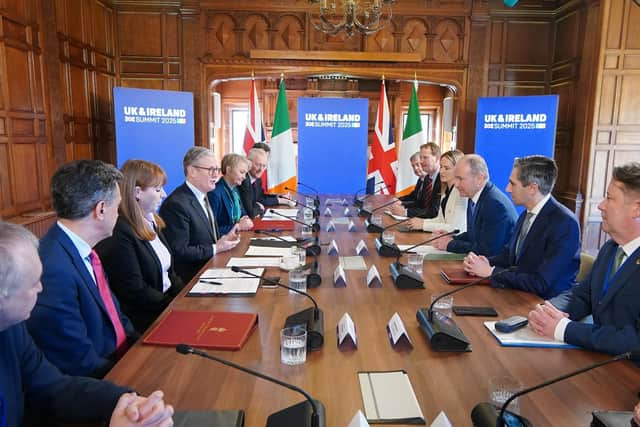
But Labour has been far worse, and has proudly reset relations with Ireland, including the recent summit involving the highest levels of the UK government, and has not pushed back at all against this legal case.
It is expected that Ireland will drop the action soon, but even so: the feeble response to it has been a betrayal of our country and its restrained response to decades of IRA murder and mayhem.
• Ben Lowry (@BenLowry2) is News Letter editor