
Ian Ellis: Ireland takes the EU presidency at a time of global challenges
At the beginning of July, for the eighth time and with some degree of fanfare, the Republic of Ireland took on the rotating, six-month presidency of the Council of the European Union.
It is not just a ceremonial or simple chairing role, but presents an enormous responsibility for the management of EU affairs.
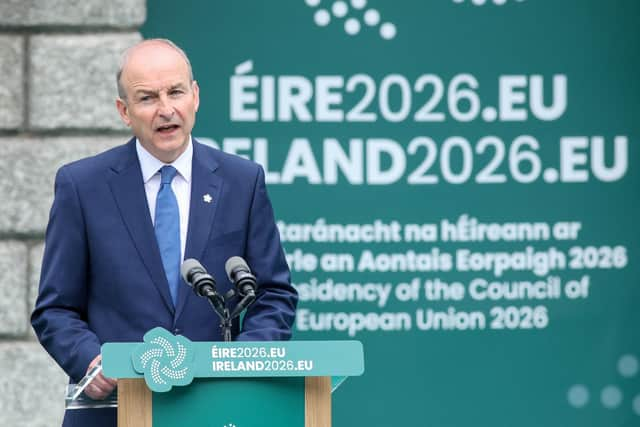

Northern Ireland rightly has some interest in this because one result of Brexit has been the fact that, unlike the rest of the UK, we are subject to so many EU regulations, particularly regarding trade and industry.
The three main pillars of the latest Irish EU presidency have been announced as competitiveness, security and the EU's foundational values.
In addition, there is the considerable challenge of what has been described as the presidency's “overarching priority” of facilitating agreement on the EU's 2028-2034 €2 trillion budget.
It is known as the Multi-annual Financial Framework, which the European Commission says “will equip Europe with a long-term investment budget matching its ambitions to be an independent, prosperous, secure and thriving society and economy over the coming decade”.
Getting this agreed will be far from plain sailing.
For example, according to the Brussels-based online news outlet Euractiv, the German government has called for a €400 billion EU budget cut, calling it "impossible" to find a deal based on the current draft.
The challenge of getting 27 member states to agree on such massive spending puts Stormont's difficulties in agreeing budgets into a certain perspective.
Present as a guest at the launch of the presidency at Dublin Castle was Ukraine's President Volodymyr Zelenskyy who made a speech during a press conference in which he said that while Ukrainians knew how much the Republic values its neutral status, at the same time, with regard to Russia's war on his country, “you have not remained neutral in your feelings – you have clearly seen good and evil, and you are doing what is necessary to ultimately bring peace closer”.
In his formal address to the assembled politicians, Mr Zelenskyy made another remark that was not lost on his audience: “Unfortunately, there are companies in Europe that are owned or effectively controlled by Russia and its sanctioned oligarchs. They keep supplying the aggressor with essential materials. Even now.”
Controversy has surrounded shipments of alumina - a vital element in the manufacture of aluminium - from the Aughinish Alumina refinery in Co. Limerick to Russia. It is owned by Russian conglomerate Rusal.
In June, Euromaiden Press, a website carrying English-language information about Ukraine, indicated that while the EU bans aluminium exports to Russia, it does not ban alumina, the powder from which aluminium is smelted, with Estonia reiterating its earlier call for a full ban on alumina exports from the EU to Russia.
According to the Estonian national broadcaster ERR, the country's foreign minister Margus Tsahkna commented: “Alumina is a key input in aluminium production, and aluminium is a strategically important material for Russia's defence, aviation and military industries. We must do everything possible to reduce Russia's ability to continue its war of aggression against Ukraine.”
He added that all loopholes that enable Russia's military industry to obtain the materials it needs have to be closed.
Taoiseach Micheal Martin has indicated that a government investigation into the Co. Limerick refinery's operations is in progress, nearing conclusion, and that the outcome of the investigation would be discussed with the European Commission to develop an approach.
Church representatives from both Europe and Ireland met with Mr Martin on July 9 in connection with the Irish EU presidency. A press release indicated that the delegation recognised the importance of strengthening European defence in the current global context, and encouraged the presidency “to support the development of a European peace strategy, providing a deeper and broader framework focused on peacebuilding, conflict prevention and reconciliation”.
No doubt there will have been extensive preparations for the Republic taking on the EU presidency role, but the agenda facing its government over the coming months will certainly not be for the faint-hearted.
• Canon Ian Ellis is a former editor of The Church of Ireland Gazette