
Jonny McCambridge: The (new) dentist and the perennial struggle to keep all of my own teeth
Back when I was a young child, I remember that my grandparents who lived in Belfast had false teeth.
I knew this because occasionally I noticed the dentures would slip when my granny or granda were laughing or eating and, when I stayed at their house, I saw them being kept in a glass in the bedroom (the false teeth, not the grandparents).

At the time I supposed this was just the natural order of things. You got old and your teeth fell out. In addition, I recall being told that when the NHS was first introduced there was such excitement at the prospect of free dental care that some people had all their pearly whites pulled and false sets made to ensure they lived the rest of their lives free from the threat of toothache.
But the point was that my grandparents were old. Fantastically and remotely ancient in a way that was almost incomprehensible to a runny-nosed boy racing around in short trousers.
But recently I’ve been doing the maths. A crude calculation shows that when I was very young, my grandparents would have been in their 50s. Or to put it another way, they were not many years older than I am now when they had false teeth.
Much has changed since then, both in my outlook and in how society views the ageing process. I don’t consider myself anything close to old. Moreover, I would really, really like to keep my own teeth.
The problem is that I have spent my adult years regretting and paying for not looking after my teeth properly when I was young and daft.
There used to be a really annoying TV ad for a brand of toothpaste where kids would beam smiles at the camera and proclaim gaily, ‘I’ve never had a filling in my life!’ I came at it from the other direction in that I’ve never had a tooth in my life which didn’t need filling (and my smile isn’t as impressive).
As well as several painful root canal procedures, I have three gaps along the gums in my gob where there have been difficult extractions. Also, my front two teeth were shattered in an accident some years ago and are now crowned.
That means I am five down on a full set, leaving me with 27 of my own teeth. The maths is still on my side, but I don’t really want to lose any more.
I’ve had the same dentist for decades now. The surgery is not close to my house, but I jealousy cling on to my place on its list of patients as I know the prospect of getting an NHS spot closer to home is hopeless. My dentist has always been sympathetic and non-judgmental about the poor state of my teeth.
It is the day of my check-up and I am almost looking forward to it because, for once, I have no oral problems. It is close to unique for me to not have to report that I have a lingering toothache or that a part of my mouth has fallen off.
But when I enter the surgery there is a person who I do not recognise. She tells me that my regular dentist has retired, and she has taken over. Absurdly, I feel slighted. I have to stop myself from saying indignantly ‘But she didn’t say anything to me about retiring!’
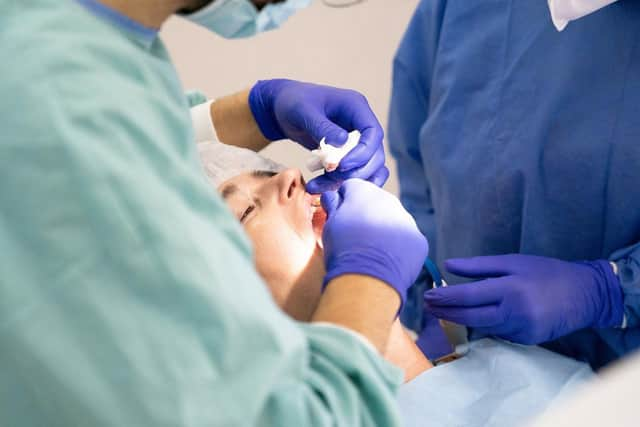
While the broad disciplines of dentistry are universal, each practitioner will have their own unique manner. This new dentist’s style could be described as a touch agricultural. She cleans my teeth with the delicacy of a labourer clearing a blocked drain with a stick.
Each time I emit a soft groan of distress or pain, she quickly says ‘sorry’ before proceeding to thrust the buzzing, whirring electric drill further into my mouth until my brain begins to vibrate in my skull.
The clean concludes but the ordeal goes on. I note the look of concern on the dentist’s face. She picks up a long, metal implement and begins to strike my teeth and gums with the end of it as if my mouth were a xylophone. This is unpleasant and I’m not sure of the purpose of the exercise.
She looks even more serious now.
‘Your gums are bleeding,’ she says. ‘I’m a bit worried about that.’
I have a ready response. What I want to say is, ‘Of course they are bleeding because you keep whacking them with a big metal pole.’ But my mouth is still wide open, and the metal pole is still inserted so I settle for just grunting a noise of affirmation.
She tells me to sit up and rinse out my mouth. After a few seconds, I have recovered some sense of poise and dignity.
She asks: ‘What sort of toothbrush do you use?’
I have no ready response to this. I suspect it would not go down well if I answer, ‘a blue one’. Instead, the new dentist tells me about gum disease, interdental toothbrushes and how it is not enough to clean my teeth, I need to clean between my teeth. I nod along like a naughty schoolboy being told off.
She continues: ‘Normally we’d bring you back in six months for your check-up, but I want to keep an eye on those gums, so I’m going to bring you back in three months instead.’
I leave the surgery and go down to the room below where I hand the receptionist the slip of paper. She clicks her nails on a keyboard and makes another appointment for me, six months from now.
‘But the dentist said she wanted to see me in three months?’ I sputter uncertainly.
‘There are no appointments in three months. This is the earliest one we can give you.’
I take the little card with the appointment date and time. As I leave the building, I find I am thinking about my grandparents’ false teeth in a glass.