
Samuel Morrison: Do not lose sight of the star this Christmas, as the wise men briefly did
If your family is anything like mine, Christmas did not begin this week. Rather, much of December has been taken up with seasonal events that steadily mark the approach of Christmas long before Christmas Eve arrived.
For us, the first Friday of the month saw the festivities begin when our church hosted its end-of-term children’s Christmas party. There were traditional games like pass the parcel and seasonal takes on old favourites such as Santa Says.

Our minister closed the evening with a memorable message on the parable of the lost coin before food was served and the children went home laden with sweets won as prizes and selection boxes.
The following Saturday brought with it a well-established Morrison family tradition: a trip to the Waterfront Hall to watch the 1982 film The Snowman, accompanied by the Ulster Orchestra performing its famous score live. Having attended this concert for 10 of the past 11 years, I was disappointed that, for the first time, all carols were dropped from the programme. That loss, however, was more than made up for over the course of the following week, during which most of the family attended three separate carol services — one run by my daughter’s primary school, one organised by the Orange Museum at which my wife played, and the annual Orange District carol service, which I have had the honour of addressing for the past four years.

The following week was no less busy. Ahoghill Loyal Sons of William Flute Band visited Stormont to celebrate their 40th anniversary, leaving the Great Hall echoing with traditional tunes as they played among the festive lights and decorations. Saturday brought another carol service where again I had the opportunity to speak, before services in church on Sunday that were full to capacity as parents and wider family members gathered to hear children and young people take part in readings and carol singing.
Tomorrow we will be joined by my parents and aunt for a traditional turkey dinner.
In the midst of all this activity, it is all too easy to forget the reality of what we claim to be celebrating at this time of year.
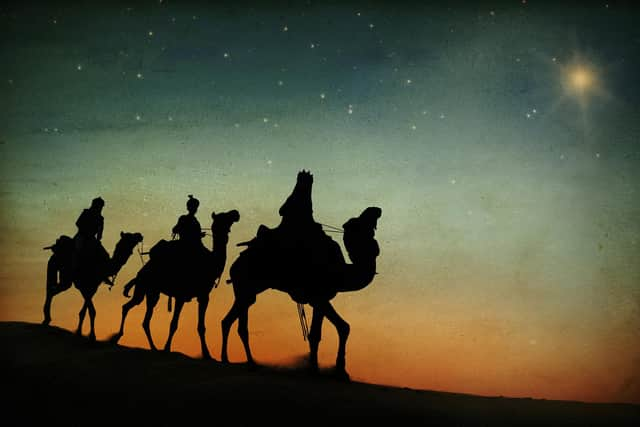
For several years now, I have reflected on Luke’s account of the nativity at our annual Orange District carol service. The opportunity to take another service this year allowed me to consider Matthew’s account more closely than before, particularly the story of the wise men — a story often embellished in popular culture.
What struck me for the first time was this: no one else in Matthew’s Gospel appears to see the star at all. When the wise men take a detour to Jerusalem and rely on their own reasoning — that a new king must surely be found in a palace — they lose sight of it altogether. Only when they are corrected by Scripture, specifically Micah 5:2, do they get back on the right road to Bethlehem and regain sight of the star. There is no record of anyone else seeing it.
In the midst of all the business — even while we profess to be celebrating the entry of Christ into the world — it is easy to miss the core of the message. There are some who can see clearly the claims of Christ, claims that shine more brightly than any star in the sky. There are others who see nothing at all. Or, to put it in Scriptural terms, Christ is “a root out of a dry ground”; He has “no beauty that we should desire him”.
As you celebrate Christmas, do you recognise the claims that Christ has upon you? That He is no mere Jewish king, but one who demands that you, like the wise men, kneel before Him? That, like them, you are called to seek first the Kingdom of God and abandon anything that would hold you back from searching for and finding Him?
I am mindful that many who read this piece will be taken up with preparations for tomorrow and, like myself, can easily lose sight of why the nativity is so important — that a Child came into the world who, as the angel told Joseph, was to be called Jesus (meaning Saviour), “for he shall save his people from their sins”.
Others, however, cannot see the star because clouds of sorrow and loss obscure it. All that is visible is an empty place at what was once a united family table. If that is your experience this Christmas, I sincerely pray that you will know the truth of the promise found in Isaiah 9:2: “The people that walked in darkness have seen a great light.”
May I take this opportunity to wish all your readers a very happy Christmas and a peaceful 2026. And if I could offer one piece of advice — whether crowded by busyness or burdened by sorrow — do not lose sight of the star.