
Battle of Le Cateau in 1914 was a controversial rearguard action that ultimately prevented greater losses
The Battle of Le Cateau took place in August 1914 and was the second British engagement of the First World War.
John Lucy, 2nd Royal Irish Rifles, recorded in his memoir, ‘There's a Devil in the Drum’, that ‘it is said by some that through the course of the entire war never were British troops as heavily outnumbered’. Nevertheless they gave a good account of themselves and bought valuable time.

The Battle of Le Cateau, three days after the Battle of Mons, took place on August 26 – the anniversary of Edward III’s victory over the French at the Battle of Crécy in 1346 – and at the time was the British army’s biggest battle since the Battle of Waterloo in 1815.
Retreating, hotly pursued and hard-pressed by the German First Army, Sir Horace Smith-Dorrien, the commander of the II Corps of the British Expeditionary Force, decided to make a stand against a force more than twice as large as his own. His decision was prompted by a desire to gain time so that the bulk of the BEF could withdraw unmolested.
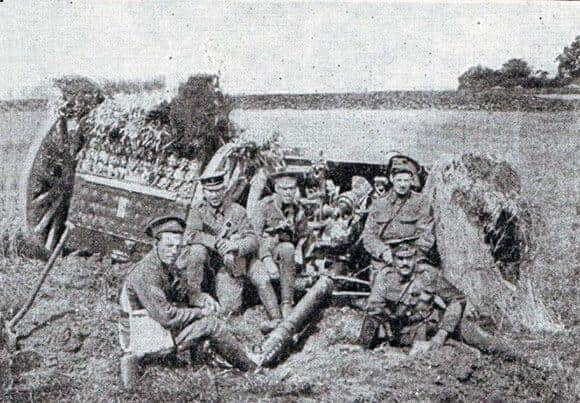
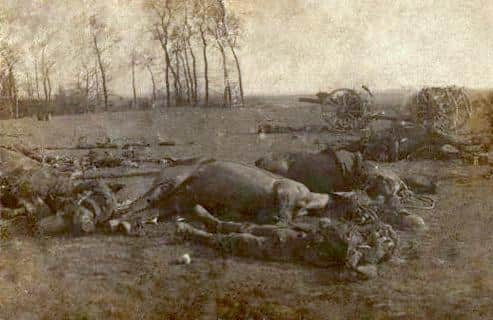
Anxious to stiffen the infantry, the artillery of the 5th Division placed its guns well forward to give direct support. Unfortunately, German artillery fairly rapidly established the range of the British guns and started knocking them out of action. Orders were given to retrieve the guns.
The guns of 122,123 and 124 batteries were especially exposed.
Captain R A Jones of 122 Battery called for volunteers and soon six teams of horses and men were ready to attempt the hazardous undertaking. Captain Jones led the teams down the shell-torn slope to the guns. The Germans unleashed a torrent of machine-gun fire on the men and horses. In the first minute, eight men, including Captain Jones, were killed, 11 men wounded and 20 horses fell.
The rest of the teams reached the guns and succeeded in limbering up three of them. One team was shot down almost immediately. The other two teams galloped up the slope through the lines of the 2/Royal West Kents, who rose to their feet and cheered wildly.
The guns of 123 and 124 batteries could not be retrieved. Their crews smashed the sights and withdrew the breech blocks before retiring.
During the course of August 26 Smith-Dorrien’s corps fought off a double envelopment and successfully disengaged before night fall. The price was high: the corps lost 7,812 men (including 2,600 taken prisoner) out of 40,000 men and 38 guns.
Smith-Dorrien’s decision to fight was controversial because it was contrary to Sir John French’s orders to retire ‘at the earliest possible moment’.
Originally, it was Smith-Dorrien’s intention to comply and he had issued preliminary orders to that effect. However, after consultation with Allenby and Major-General Hubert Hamilton of the 3rd Division, he concluded that the Germans would be upon his exhausted men before he could get away. He hoped a brisk ‘stopping action’ would halt the Germans long enough to allow an uninterrupted withdrawal.
Had he complied with Sir John French’s orders Smith-Dorrien probably would have ended up fighting a similar battle elsewhere in less favourable circumstances.
Sir John subsequently contended that Smith-Dorrien had risked the destruction of his corps in an unnecessary battle.
Smith-Dorrien did not agree. In the event his corps, though sorely tried, did not loose its cohesion. In a memorable description, Smith-Dorrien likened his retreating troops to ‘a crowd coming away from a race meeting’. Admittedly, John Lucy contrasted his own men’s disciplined behaviour to that of the ‘undisciplined mob’ around them.
Whether Smith-Dorrien should have fought at Le Cateau continues to be a matter of heated debate but at the time French gave Smith-Dorrien the discretion to do so: ‘If you can hold your ground the situation appears likely to improve … Although you are given a free hand as to method this telegram is not intended to convey the impression that I am anxious for you to carry out the retirement, and you must make every effort to do so.’
In the immediate aftermath of the engagement French paid handsome tribute to Smith-Dorrien’s ‘rare and unusual coolness, intrepidity, and determination’ in his official despatch. However, there was no love lost between French and Smith-Dorrien, dating back at least to the period when Smith-Dorrien succeeded French at Aldershot, and when the two met on August 27, the old acrimony reasserted itself.
In April 1915 French told Douglas Haig, commander of I Corps, that he regretted not court-martialling Smith-Dorrien for giving battle, a view Haig fully shared.
Significantly, Richard Holmes, the biographer of French, defends Smith-Dorrien’s decision: ‘…. with the clarity of hindsight there can be no question that Smith-Dorrien was right to give battle. Although II Corps was badly mauled … it would have been in an infinitely worse state if Smith-Dorrien had simply withdrawn as ordered’.
Smith-Dorrien succeeded in his aim for the German pursuit was never as pressing again.