
Billy Kennedy on 50 years at the News Letter: We were a close team that reported on terrorism - and on the good news in Northern Ireland too
Billy Kennedy looks back on his 50 year career with this newspaper
Journalism has been one of the most illustrious professions for centuries and I have been extremely privileged to work half a century for a newspaper that today is recorded as the oldest English-written daily publication in the world.
The Belfast News Letter, established in Belfast in September 1737, holds that proud position and is 50 years older even than The Times, of London (1785).
My journalistic link with the News Letter began on Monday, November 17, 1974 and, my career over five full decades, has primarily focused on news gathering, political and feature writing, editorial direction and high-level editorial comment in the much-read column of 'Morning View'.
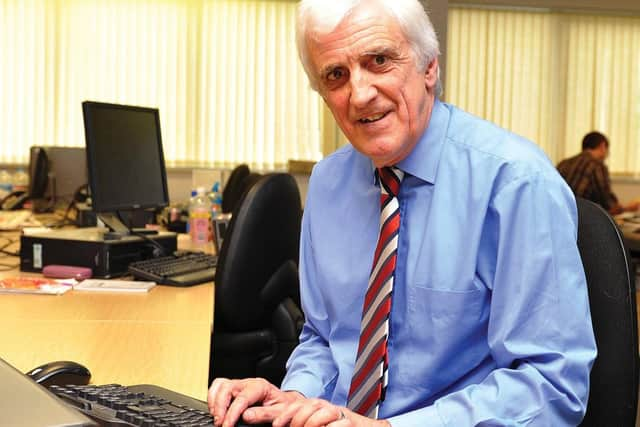

Journalism was the one profession I really wanted to enter when growing up in Bessbrook, South Armagh and, on my way to the News Letter in Donegall Street, Belfast, I spent close on four years on the editorial teams as a news reporter with three Co Armagh newspapers, Ulster Gazette, Portadown News and Portadown Times.
Over time I developed in journalism an insatiable 24/7 appetite for news, and looking back I consider my experience in working with the weeklies was invaluable, particularly my time spent in Portadown in the early period of the 'Troubles' when tensions were high due to IRA attacks and counter loyalist paramilitary violence.
Tragically, 'Troubles' stories then in those dark years got the biggest headlines, even in weekly newspapers. However, moving to the News Letter at Donegall Street in the centre of Belfast on November 17, 1974 was a whole new experience for me, with news and media coverage totally dominated by the continuing spiral of terrorist violence and sectarian divison, on a level far above what was happening in the provincial towns.
On March 20, 1972, close on two years before I joined the News Letter, the Donegall Street bombing took place outside the front door of the News Letter offices. The Provisional IRA detonated a car bomb when the street was crowded with shoppers, office workers and many schoolchildren. Seven people were killed in the explosion, five civilians and two RUC officers. That was the grim and dark situation in Belfast city centre at the time and for the several decades of the 'Troubles' was where I worked.
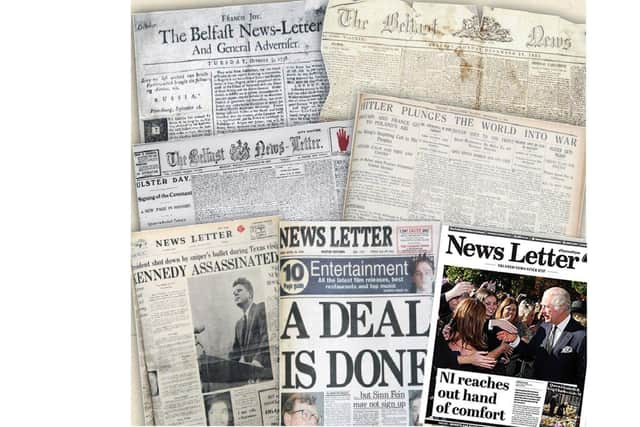
When I arrived in Donegall Street, the News Letter, then edited by the erudite Cowan Watson, had – incredibly – an editorial staff of 52, with deputy editors, news and court reporters, feature writers, sports team, sub-editors and photographers (there were five cameramen on staff), all bunched together in a massive and aged four-storey building, that had to the front administrative and editorial suites and at its rear the massive printing presses which rolled out the tens of thousands of papers on a daily basis.
As many as 200 staff were on the payroll of the News Letter (Century Newspapers) at that time. The editorial team was male-dominated with only three females on staff – prolific court reporter Maureen Martin; women's issues' editor Niki Hill, and news reporter Penny Henderson, daughter of the paper's proprietor Captain OWJ (Bill) Henderson. Within six months, I moved on to the paper's newsdesk, working with the news editors Stewart Mackey and Harry Robinson, like myself a Co Armagh man.
I was also given a roving role to cover local government in Belfast, Craigavon and Newtownabbey and was assigned by editor Watson to a 1975 weekly 'Your Town' feature news series that focused on main towns in the then 26 district council areas of Northern Ireland. This proved a popular series and it allowed me to see at first hand civic and cultural life in the rural towns on issues that were of importance, most significantly, to the traditional core News Letter readership who resided there.
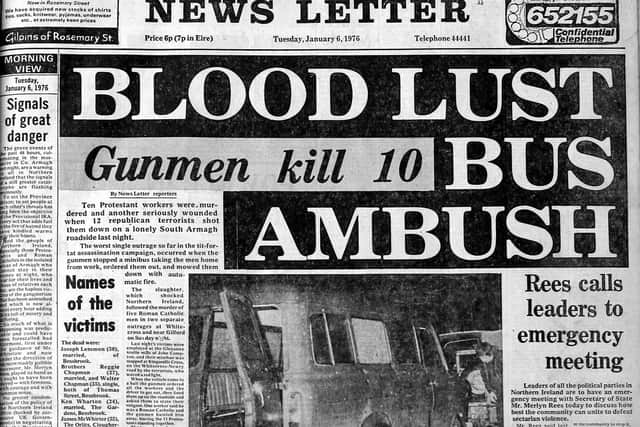
When covering 'Troubles' incidents one had to be totally detached from the emotions of the story and painlessly report accurately on what were the essential details. However, on one occasion, I was deeply emotionally affected by what had happened. It was the Provisional IRA Kingsmill attack where 10 Protestant workmen from the Bessbrook area lost their lives on Monday, January 7, 1976. Being a Bessbrook man, I personally knew most of the workmen (survivor Alan Black was a second cousin) and, after hearing the news of the attack while covering a meeting of Craigavon Borough Council in Portadown town hall, I immediately drove down to Bessbrook to meet family and friends and share with them the grief over what had happened.
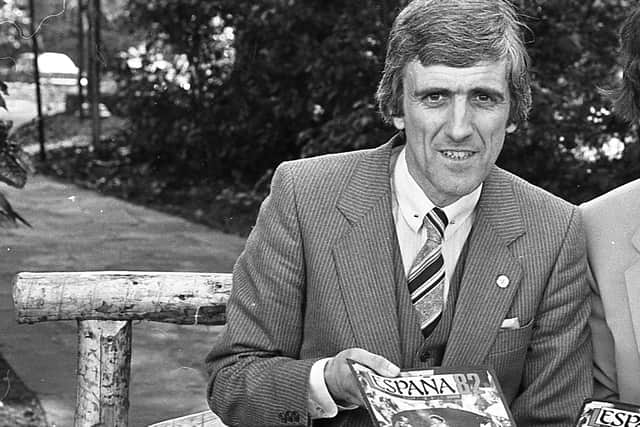
It was a sad week in the close-knit South Armagh Protestant community and I starkly recall seeing five coffins carried into the village Presbyterian church and three into the Church of Ireland for the services. Both funeral days were wet and miserable; I remember the News Letter headline used on my funeral reports – 'The skies wept over a village in mourning'.
There were other terrorist major atrocities I covered, including the La Mon House IRA attack in Castlereagh on Friday, February 17, 1978. That Friday evening I was on the News Letter news desk and got a tip-off from Jim McDowell, one of our senior reporters, about an incident at the Castlereagh venue. Big Jim, a seasoned hack, was not working that evening, but volunteered to cover the story which he did in detail as a true professional.
As the death toll mounted to 12, with more than 30 injured, our early deadlines passed and we finished publishing five editions for that Saturday edition by 5am. I got home that Saturday morning to Tandragee at 7am, with my late wife Sally unaware of the tragic events that had kept me occupied at the paper in Belfast.
When the Mountbatten killings occurred in Sligo in August 1979, I was also on the newsdesk that day and again Jim McDowell volunteered to travel to the scene of the attack. He stayed with the story for several days, filing back to the paper excellent first-hand reports and reaction. And these in days when there were no mobile phones.
For the first two decades of my journalistic career, we wrote up our stories on typewriters – computers were not introduced to the News Letter until the late 1980s. Indeed, when I first arrived at the paper, the chief leader writer Bertie Sibbett was compiling his Morning View pieces hand-written and passing them along to the graphical department. Over the years of the 'Troubles' we were a close-knit and professional editorial team at the News Letter. And together we survived two winter strikes at the paper – one a journalist dispute and the other printing. Tragically, the stories of killings of RUC officers, UDR soldiers and civilians and bomb atrocities were high on our daily news agenda, but to maintain our sanity we felt obliged to glean stories that were more upbeat and positive, non-troubled related and our features team played a major part in this.
One such story was about a personal telephone call received I received to the News Letter office on March 31, 1988 from American country singer Willie Nelson from his home in Dallas, Texas. Willie was due to appear in concert at the King's Hall, but due to the IRA killing of two soldiers in West Belfast, the show was cancelled.
Nelson was irate about this and said he wanted to come to Belfast, demanding that the show be re-arranged by the promoter Jim Aiken which it was at a later date. The story, which we considered human interest, gave us a front page lead that weekend and other media followed it up.
l The second part of this memoir is published on Monday
Billy Kennedy received a Lifetime Achievement Award from the CIPR for his contribution to journalism in 2010. His authorship of 11 books on Scots-Irish migration history has been personally acknowledged by American presidents Jimmy Carter, Bill Clinton and George W. Bush.