
Co Antrim: Vacant guesthouse earmarked for use as a supported residential centre for people living with addiction
A planning application has been made to Antrim and Newtownabbey Borough Council for a proposed change of use from a guesthouse to a supported residential centre.
The application has been made by an agent on behalf of Teen Challenge UK for a property at Killead Road, Aldergrove, Crumlin.
Teen Challenge UK is a registered charity with more than 40 years’ experience in providing support and counselling to those suffering from drug and alcohol dependency through residential centres. There is no centre currently located within NI.
A design and access statement submitted with the application said it is anticipated the proposed centre would accommodate up to 24 residents at any one time.
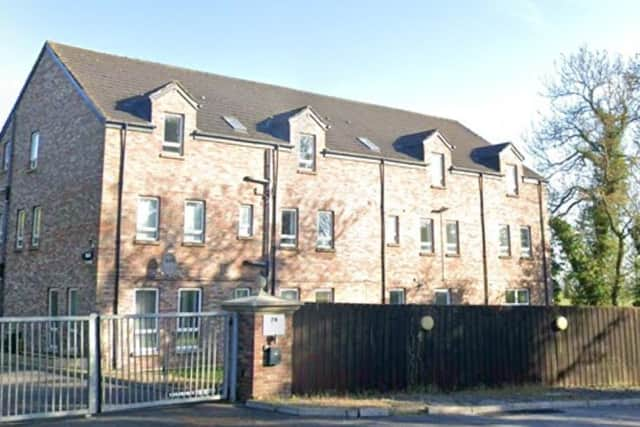

“The residents will reside full-time at the centre for a period of 11 months and will follow a daily programme which offers physical and learning activities and counselling as means of support for living with and coping with addiction.
“It is anticipated that nine staff will be employed with staff available on site 24/7. There is no proposal to extend or alter the existing building as the existing lay-out remains fit for purpose.”
The statement noted the vacant guesthouse site is accessed via a gated entrance onto Killead Road with Belfast International Airport’s runway to the north.
It said: “There is a clear need for the supported residential centre. The charity has received over 250 applications from Northern Ireland demonstrating that there is a need for this type of centre at a regional level which is not currently being met.
“The nature of the development seeks to remove residents from proximity to the local community to provide relief from addiction and access to substances, therefore, a site outside of any settlement is essential in this case. The rural location of the site in this circumstance is therefore appropriate for the proposal.
“The property owner has marketed the site for guesthouse and hotel operators for a period of five years without interest. It is evident there is no demand for the existing use nor for any hotel or similar tourist accommodation.
“Notably any demand for such accommodation in proximity to the airport is fulfilled by the existing Maldron Hotel and the hotel under construction at the junction of Airport Road and Antrim Road.
“The amenity of future temporary residents (up to 11 months) will not be adversely impacted by way of noise associated with Belfast International Airport through appropriate mitigation measures of suitable glazing and ventilation.”
In a letter submitted with the application, Phil Hills, chief executive, of Teen Challenge UK, said: “Northern Ireland has a significant drug problem with estimates of the cost of drug and alcohol misuse to Northern Ireland annually of £1bn.”
Mr Hills reported that Antrim and Newtownabbey Borough has the fourth highest number of drug-related death numbers among Northern Ireland council areas and the third highest rate of alcohol-related hospital admissions. The need to provide support to those struggling with substance abuse and to relieve demand on services is abundantly clear. “Our residential centres are open to people from across the UK, however, demand for the facilities has increased significantly in recent years. Since June 2024, the charity has received more than 250 applications alone from NI.
“With the current demand to facilitate residents in mainland UK and increased number of applications from Northern Ireland, our existing residential facilities are under significant pressure. “Due to the continuing rise in the number of applications from Northern Ireland, it is now prudent that the charity establishes a centre within Northern Ireland to cope with demand and to meet the obvious needs from the local community.
“It is our experience that our residents are far more likely to succeed in a rural setting than in an urban environment and therefore, the majority of our centres are intentionally located away from urban areas and the local community. “The countryside has proved to offer the best opportunity for distraction free peace and natural tranquillity to help with overcoming substance abuse and addictions.
“It is an environment free from many of the daily triggers associated with their addictions. It removes them from geographical proximity to fellow users and dealers and allows greater focus for deeper emotional and mental reflection. “The premises at 26 Killead Road provides all essential building requirements for the charity’s first residential centre in NI. “The existing building, formerly a guesthouse, comprises self-contained bedrooms with en-suites, suitably sized dining and communal/meeting space without need for the charity to spend significant funds on maintenance or alterations that could be spent on other essential resources and outreach for the charity.
“Furthermore, it allows the charity to occupy the premises at an earlier opportunity to facilitate the rising number of applications without delay of building works. Given the ongoing demand, it is expected that the residential centre will need to be ready for operational use in or by spring 2027.”
In a letter of support, Jonathan Patton, chair, of the South Eastern Health and Social Care Trust said: “A residential centre would offer more than a short-term intervention. It would provide time, structure, accountability, pastoral care, practical life skills and the opportunity for residents to rebuild their lives in a safe and supportive environment.
“A centre in rural County Antrim would be especially suitable. A rural setting can provide distance from harmful routines, destructive environments and pressures that often contribute to relapse.”
He went on to say such a place could become a “regional place of hope for all of Northern Ireland”.
“Rather than people having to travel outside the region for residential help, a County Antrim centre would provide familiarity, a peer group that can be related to, continuity, local accountability, and ongoing connection with families and communities at home.”