
Eric Montgomery, public servant and visionary behind the Ulster-American Folk Park
Eric Montgomery enjoyed a rich, varied and distinguished career in the public service and had a strong fascination with the connections between the Scotch-Irish in Ulster and in America which culminated in the creation of the Ulster-American Folk Park and the Mellon Centre for Migration Studies near Omagh and the Museum of American Frontier Culture in Staunton, Virginia, on the other side of the Atlantic.
A Tyrone man like W F Marshall, the author of ‘Ulster sails West’, Montgomery was born on April 19 1916 in Moy. His father, John Montgomery, was a Methodist minister, who became president of the Methodist Church in Ireland in 1952.

Educated at Methodist College, Belfast, and Queen’s University, Belfast, he began his working life as a journalist on the Impartial Reporter in Enniskillen and then the Banbridge Chronicle.
With the advent of the Second World War, he joined the Royal Irish Fusiliers before being quickly transferred to the North Irish Horse, an armoured regiment. He was then seconded to the Royal Electrical and Mechanical Engineers attached to the Guards Armoured Division.
In 1944 the military mission in Washington DC required an officer who knew something about Sherman tanks to oversee their delivery prior to D-Day and the Normandy campaign in which they would play a prominent part.
Montgomery fitted the bill and thus found himself in Washington. This experience gave him a heightened appreciation of the connections between Ulster and the United States.
After the war he remained in the Army, in a public relations role, before leaving, with the rank of major and a military MBE, for the Northern Ireland Civil Service.
In 1956 Montgomery established the Government Information Service, operating initially with just one assistant, and was responsible for organising various initiatives to publicise trade opportunities. He worked very closely with a succession of Northern Ireland prime ministers, especially Lord Brookeborough and Terence O’Neill.
In the same year he was one of the founding trustees of the Ulster‐Scots Historical Society, and retained a guiding role when it developed into the Ulster Historical Foundation in 1975.
Montgomery was involved with fundraising for, and organising the restoration of, the ancestral homes of some of the US presidents with connections in Ulster.
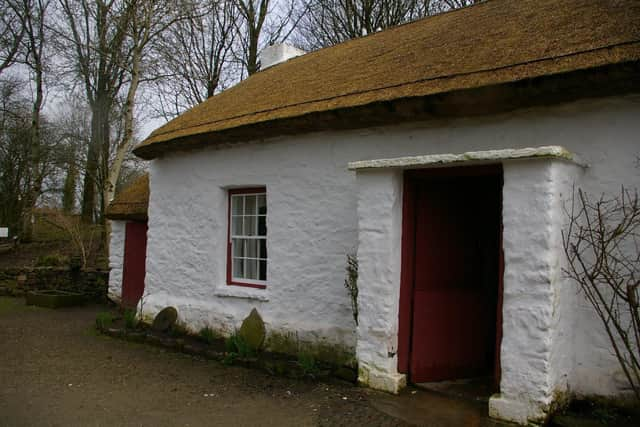
This prompted Matthew Mellon, a grandson of Thomas Mellon (1813–1908), to approach Montgomery about the restoration of the modest Mellon family homestead at Camp Hill Cottage, Castletown, near Omagh.
Thomas Mellon had emigrated as a five-year-old child from there in 1818. In due course Mellon became an outstanding entrepreneur (largely through making shrewd and intelligent use of his wife’s money), lawyer and judge and the patriarch of the Mellon family, enjoying a brilliant career which in material terms easily surpassed that of Benjamin Franklin. (At the age of 14, Mellon read and was greatly inspired by the ‘The Autobiography of Benjamin Franklin’, Franklin’s rags-to-riches tale.)
His most enduring achievement was the founding of T Mellon & Sons Bank. By the end of the 19th century the Mellon Bank was the largest banking institution in the United States outside of New York. The bank was largely responsible for the transformation of western Pennsylvania into one of the industrial powerhouses of the world in the 40 years before the Great War.
The Mellon ancestral home was opened to the public in 1968 and became the nucleus of the Ulster American Folk Park at Castletown, near Omagh, which opened in 1976.
Montgomery worked tirelessly to realise his vision of the folk park as a tourist and educational attraction.
On his retirement from the civil service, Montgomery became its first director of the folk park.
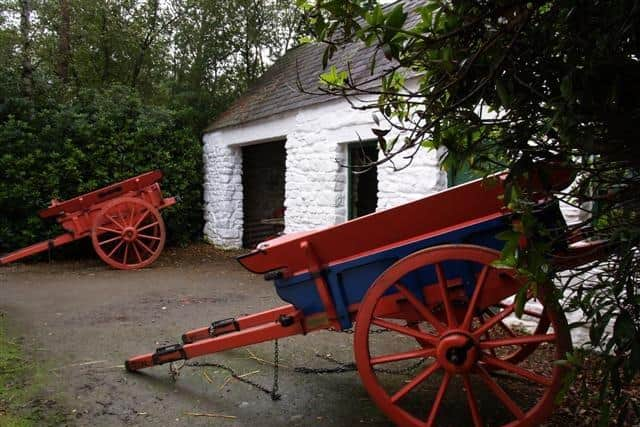
Typical or individually significant buildings from both Ulster and the New World were dismantled on their original sites and rebuilt in the folk park to form a landscape physically embodying aspects of the historical links between Ulster and North America.
A memorable feature of the folk park is how the visitor moves from the ‘Old World’ created by an Ulster landscape and villagescape via a replica emigrant ship to the ‘New World’ of the eastern seaboard of America.
The folk park now boasts a Centre for Migration Studies (which offers an MSSc degree in Migration Studies accredited by Queen's University) and a Library.
Montgomery proposed the creation of another outdoor museum in the United States to portray the cultures of the various peoples who had settled the American frontier.
He and Alan Burgess, vice‐chancellor of the New University of Ulster, and Professor E R R Green of Queen’s University, visited the United States to promote the concept.
The museum operates on 188 acres of land in Staunton in the Shenandoah Valley in Virginia. It features 11 exhibits, eight of which are working farms displaying the daily life of those who relocated to the Shenandoah Valley, either by choice or by force, from Europe and West Africa, as well as their descents in the Shenandoah Valley.
In 2008 a new area of this museum was named Montgomery Springs in honour of Eric Montgomery who had been one of the museum’s trustees.
Apart from his interest in the Scotch-Irish, Montgomery was involved in other significant initiatives and projects too.
He was the initiator of a government-funded youth employment and training scheme which became Enterprise Ulster.
Montgomery oversaw ‘Ulster ’71’, an ambitious celebration of the 50 years of existence of the Northern Ireland parliament and state. Although in terms of visitors and the interest generated the project was a great success, violence and civil unrest detracted from it.
Another interest of Montgomery’s was transport. He rescued redundant railway items and campaigned for the establishment of the Ulster Transport Museum at Cultra.
His contribution to the cultural and economic life of Northern Ireland was recognised in 1991, when he was appointed OBE.
Eric Montgomery died in Belfast on September 29 2003, and was buried at Cleenish parish church, Bellanaleck, Co Fermanagh.
A gallery in the Discover Ulster-Scots Centre chronicling the Ulster-Scots story in America is named in Eric Montgomery’s honour.